
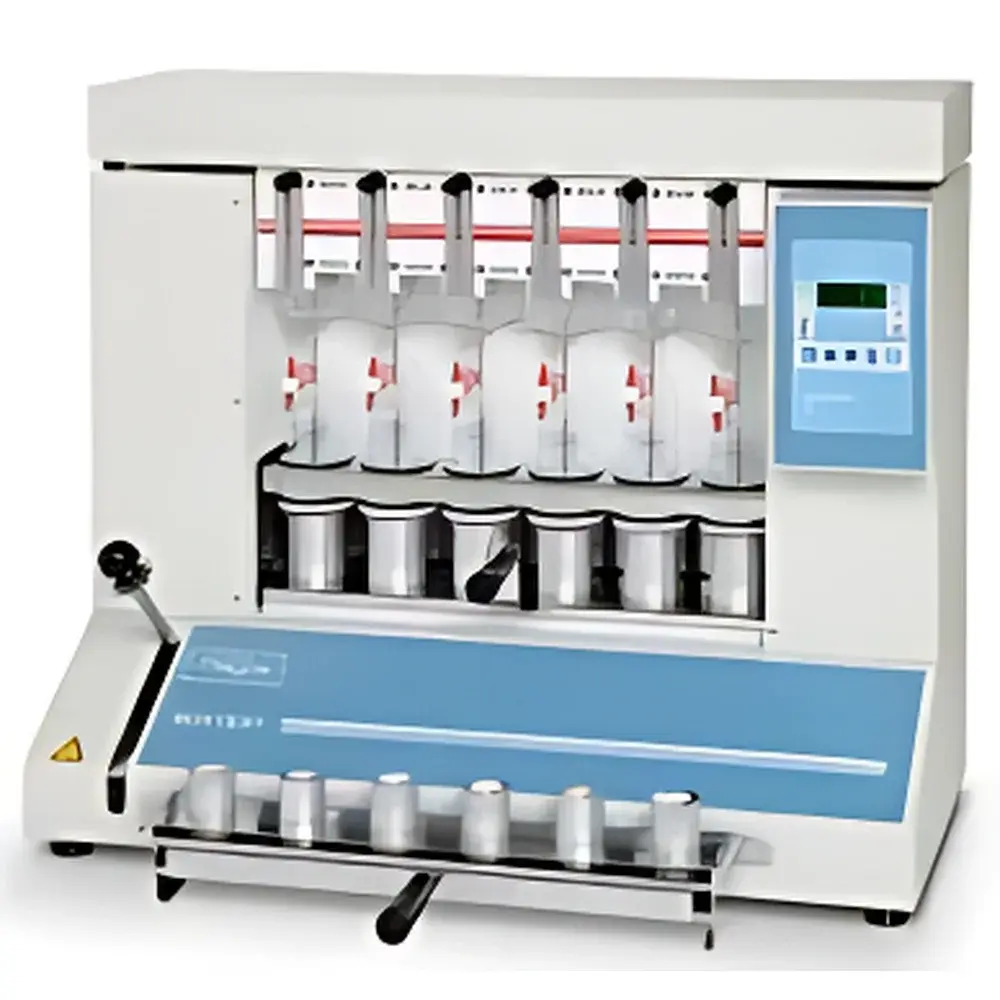
Raypa SOXTEST Soxhlet Fat Extraction System
| Brand | Raypa |
|---|---|
| Origin | Spain |
| Model | SOXTEST |
| Extraction Chamber Volume | 50 mL |
| Receiver Flask Volume | 6 mL |
| Temperature Range | RT + 5 °C to 250 °C |
| Temperature Control Accuracy | ±0.1 °C |
| Number of Channels | 6 |
| Solvent Recovery Rate | 60–70% |
| Sample Capacity | up to 25 mL |
| Reproducibility | ±1% |
| Extraction Thimble Dimensions | Ø26 × 60 mm |
| Boiling Extraction Time | 0–500 h |
| Rinsing Extraction Time | 0–99 h |
| Compatible Solvents & Max Recommended Extraction Temperatures | Diethyl Ether (100 °C), Petroleum Ether (100 °C), Hexane (140 °C), Chloroform (150 °C), Vinyl Chloride (190 °C), Methanol (200 °C), Ethanol (200 °C), Toluene (200 °C) |
Overview
The Raypa SOXTEST Soxhlet Fat Extraction System is a fully programmable, six-channel benchtop instrument engineered for precise and reproducible fat and lipid-soluble compound quantification in accordance with standardized gravimetric methods—primarily the classical Soxhlet extraction (AOAC 920.39, ISO 1444, USP <467>) and the accelerated Randall technique. It operates on the principle of continuous solvent reflux: solid or semi-solid samples are placed in porous thimbles, subjected to repeated cycles of solvent boiling, condensation, percolation through the sample matrix, and return of enriched extract to the receiver flask. This thermodynamically driven process ensures exhaustive extraction of non-polar and moderately polar analytes—including triglycerides, waxes, sterols, resins, and certain surfactants—while minimizing thermal degradation through controlled, uniform heating.
Key Features
- Six independent extraction channels with individual microprocessor-based temperature control via PT100 platinum resistance sensors, enabling simultaneous yet distinct method protocols across samples.
- Programmable dual-phase timing logic: separate user-defined parameters for “boiling extraction” (0–500 h) and “rinsing extraction” (0–99 h), supporting both classical and modified AOAC/ISO workflows.
- Robust stainless-steel mainframe with epoxy-coated interior surfaces, resistant to organic solvent corrosion and facilitating long-term operational integrity in demanding QC/QA environments.
- Armored resistance heating elements embedded in aluminum heating blocks ensure rapid thermal response and exceptional spatial uniformity (<±0.1 °C setpoint stability), critical for method reproducibility and inter-laboratory comparability.
- Integrated overtemperature protection with audible and visual alarm activation when sensor readings exceed user-configured safety thresholds—compliant with IEC 61010-1 for laboratory electrical equipment safety.
- IP65-rated electronic enclosure provides dust-tight and water-jet resistant protection for control modules, enhancing reliability in humid or solvent-vapor-rich fume hood installations.
Sample Compatibility & Compliance
The SOXTEST accommodates a broad spectrum of heterogeneous matrices without pre-drying or homogenization: foodstuffs (meat, dairy, cereals), animal feed, environmental solids (soil, sludge), polymers, pulp and paper products, textiles, rubber, petrochemical residues, and pharmaceutical excipients. Each channel accepts standard Ø26 × 60 mm cellulose or glass-fiber thimbles (ASTM D297, ISO 11338). The system supports validated solvent selection per analyte polarity and matrix composition, with maximum recommended temperatures aligned to solvent flash points and thermal stability limits (e.g., hexane ≤140 °C; methanol ≤200 °C). All operational parameters—including time, temperature, and solvent volume—are logged with timestamped audit trails, supporting GLP/GMP documentation requirements and FDA 21 CFR Part 11 readiness when integrated with compliant LIMS or data acquisition software.
Software & Data Management
While the SOXTEST features an intuitive front-panel interface with LCD display and tactile keypad, its full traceability potential is realized through optional RS-232/USB connectivity. When paired with Raypa’s dedicated PC software (or third-party SCADA-compatible platforms), users gain access to real-time temperature profiling, event-triggered logging (e.g., boil onset, condensate detection), and exportable CSV reports containing start/stop timestamps, setpoints, deviations, and operator IDs. Data files retain cryptographic integrity and support electronic signature workflows, fulfilling analytical data governance mandates under ISO/IEC 17025 and EU Annex 11.
Applications
- Regulatory fat content verification in nutritional labeling (EU Regulation No. 1169/2011, FDA 21 CFR 101.9).
- Crude fat determination in animal feed formulations per AOAC 920.39 and EN ISO 6496.
- Residual solvent analysis in polymer processing and pharmaceutical manufacturing (ICH Q3C).
- Lipid recovery from biomass and algae for biofuel feedstock assessment.
- Extraction of hydrophobic contaminants (e.g., PAHs, PCBs) from soil and sediment prior to GC-MS analysis.
- Quality control of surfactant content in detergents and cleaning agents (ISO 4325).
FAQ
What extraction standards does the SOXTEST support?
It complies with AOAC 920.39, ISO 1444, ISO 6496, EN ISO 6496, USP <467>, and ASTM D297 for gravimetric fat and lipid-soluble substance determination.
Can different solvents be used simultaneously across channels?
Yes—each channel operates independently; solvent compatibility must be verified against temperature limits and material compatibility (e.g., avoid chlorinated solvents with aluminum components unless specified).
Is the system compatible with automated thimble loading or solvent dispensing?
No—the SOXTEST is a manually loaded platform; however, its modular design allows integration with third-party robotic sample handlers via digital I/O triggers.
How is solvent recovery efficiency achieved?
Through optimized condenser geometry, consistent cooling water flow regulation (recommended 15–20 °C inlet), and minimized vapor path length—yielding 60–70% typical recovery for common solvents like petroleum ether and hexane.
Does the system include validation documentation?
Factory calibration certificates (temperature, timer) are provided; IQ/OQ protocols and templates are available upon request for GxP-regulated installations.



