
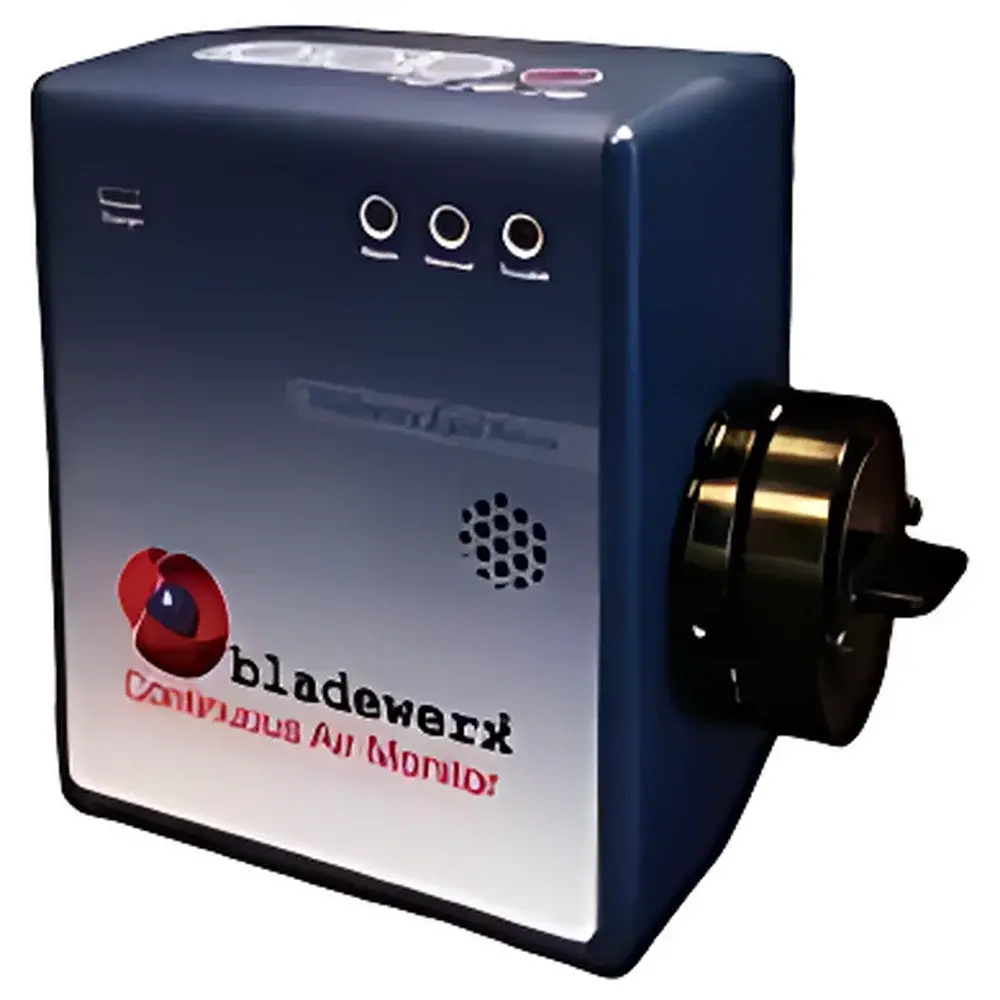
Bladewerx EpeeCAM Alpha/Beta Air Monitor
| Brand | Bladewerx |
|---|---|
| Origin | USA |
| Model | EpeeCAM |
| Instrument Type | Laboratory-grade Portable Alpha/Beta Aerosol Monitor |
| Flow Rate | 6.0 LPM (adjustable) |
| Flow Accuracy | ±1% FS |
| Timing Accuracy | ±1 s/h |
| Repeatability | ±1% RSD |
| Particle Size Distribution Uncertainty | ±1% (for 0.3–10 µm equivalent aerodynamic diameter) |
| Indication Error | ±1% of full scale |
| Detector | Ion-implanted silicon solid-state detector (450 mm² active area, 500 µm depletion depth) |
| Energy Range | 1.0–8.0 MeV (Rn mode: 1.0–10.0 MeV) |
| MCA Resolution | 256-channel pulse-height analysis with Po-isotope peak fitting (²¹⁴Po, ²¹⁸Po, ²¹²Po, ²³⁹Pu, and one user-defined nuclide) |
| Power | 7.4 V Li-ion battery (4.1 Ah) |
| Dimensions | 12 × 14 × 7.6 cm (4.7 × 5.5 × 3.0 in) |
| Weight | 1.0 kg (2.2 lbs) |
| Operating Temp | −20 to +50 °C |
| Relative Humidity | 5–100% RH (non-condensing) |
| Ingress Protection | IP54-equivalent (splash- and dust-resistant polymer housing, no external ports or protrusions) |
| Data Interface | USB 2.0 (PC connectivity for calibration, configuration, and data export) |
| Software | Included Windows CE-based firmware with RadNet-compatible output (text/.cdt format), real-time spectral display, acute (120 s) & chronic (240 min) integration modes, net count rate alarm logic, and source-response diagnostics |
Overview
The Bladewerx EpeeCAM Alpha/Beta Air Monitor is a compact, laboratory-validated portable instrument engineered for real-time, quantitative measurement of airborne alpha- and beta-emitting radionuclides—including radon progeny (²¹⁸Po, ²¹⁴Po, ²¹²Po), plutonium isotopes (e.g., ²³⁹Pu), and other transuranic or fission-product aerosols. It operates on the principle of alpha/beta spectroscopy via direct detection of charged particles deposited on a high-efficiency PTFE filter during active air sampling. The integrated ion-implanted silicon solid-state detector (450 mm² active area, 500 µm depletion depth) provides energy-resolved pulse-height analysis across a calibrated 1.0–10.0 MeV range—optimized for both routine radon potential alpha energy concentration (PAEC) assessment and low-background nuclear material surveillance. Its flow-controlled design (6.0 LPM nominal, continuously adjustable) ensures consistent aerosol collection efficiency across variable environmental conditions, while the sealed, non-porous thermopolymer housing meets IP54-equivalent mechanical and environmental robustness requirements for field-deployed radiological monitoring.
Key Features
- Compact form factor (12 × 14 × 7.6 cm; 1.0 kg) enables belt-mount, tripod-mount, or benchtop deployment—ideal for personal exposure assessment, respiratory zone sampling, or fixed-point environmental surveillance.
- Dual operational configurations: (1) qualitative screening for anomalous alpha/beta activity (e.g., uranium/plutonium particulate release), and (2) quantitative PAEC determination per ICRP Publication 137 methodology using time-resolved ²¹⁸Po/²¹⁴Po spectral deconvolution.
- Adjustable pump flow rate mitigates filter loading under high-dust conditions—extending filter service life and preserving battery runtime without compromising counting statistics.
- Onboard Windows CE-based Intel XScale processor executes real-time 256-channel multichannel analyzer (MCA) algorithms, including Po-isotope-specific peak fitting, background subtraction, and acute (120 s) / chronic (240 min) integration modes with configurable net-count-rate alarms.
- Integrated visual (red-alert backlight) and audible alarms triggered by user-defined thresholds per isotope channel; alarm states and raw spectra are timestamped and stored locally in Excel-compatible .cdt files.
- USB 2.0 interface supports full bidirectional communication: firmware updates, calibration coefficient upload (using traceable ²⁴¹Am or ²³⁹Pu check sources), and post-processing data export without proprietary drivers.
Sample Compatibility & Compliance
The EpeeCAM accepts standard 37 mm diameter filters—including Speclon™ 1.5 µm PTFE membranes and hydrophobic PTFE variants—with effective dust collection area of 25 mm diameter. Its aerosol inlet geometry and laminar-flow path minimize particle bounce and electrostatic losses for particles ≥0.3 µm aerodynamic diameter. The system complies with ISO 7211-4 (air sampling for radioactive aerosols), ANSI N13.1 (sampling and monitoring of airborne radioactivity), and supports audit-ready data integrity under GLP/GMP frameworks via timestamped spectral records and calibration logs. While not FDA 21 CFR Part 11-certified out-of-box, its deterministic firmware architecture and immutable .cdt file structure facilitate validation for regulated environments requiring electronic record retention.
Software & Data Management
Pre-installed embedded software delivers real-time spectral visualization, automatic isotope identification (based on known Po decay energies), and configurable alarm logic with dual independent thresholds for alpha and beta channels. All measurements are archived as ASCII-formatted .cdt files containing acquisition time, flow rate, temperature/humidity metadata, raw spectrum counts per channel, fitted peak areas, and net count rates. Files are accessible via USB mass-storage mode and import directly into Microsoft Excel or third-party spectral analysis tools (e.g., Genie 2000, GammaVision). Optional RadNet network integration enables remote status polling and centralized data aggregation across multi-instrument deployments—compatible with existing site-wide radiation information management systems.
Applications
- Occupational health monitoring in uranium enrichment facilities, nuclear fuel fabrication plants, and decommissioning sites where alpha-emitting particulates pose inhalation hazards.
- Environmental baseline surveys and post-incident response for radon progeny mapping in mines, caves, or legacy waste storage areas.
- Regulatory compliance testing per EPA Method M-112 (radon progeny in air) and DOE Order 458.1 (radiological control programs).
- Research applications involving short-lived alpha-emitter aerosol dynamics, filtration efficiency studies, and calibration transfer between reference laboratories and field instruments.
- Mobile surveillance at border crossings or sensitive infrastructure where rapid, operator-portable detection of illicit nuclear materials is required.
FAQ
What filter types are compatible with the EpeeCAM?
Standard 37 mm diameter filters are supported—including 1.5 µm PTFE (e.g., Speclon™) and hydrophobic PTFE membranes with ≥25 mm effective collection area. Custom filter substrates may be validated upon request.
Can the EpeeCAM distinguish between radon progeny and other alpha emitters?
Yes. Its 256-channel MCA and Po-isotope-specific peak-fitting algorithm resolve ²¹⁸Po (6.00 MeV), ²¹⁴Po (7.69 MeV), and ²¹²Po (8.78 MeV) with sufficient energy resolution to separate them from ²³⁹Pu (5.16 MeV) and other transuranics when calibrated with appropriate standards.
Is external power required for extended operation?
No. The internal 7.4 V Li-ion battery (4.1 Ah) supports 8 hours of continuous sampling and analysis. An AC adapter is available as an optional accessory for stationary use.
How is calibration performed?
Calibration is conducted via PC-connected software using traceable alpha sources (e.g., electroplated ²⁴¹Am or ²³⁹Pu, 37 mm diameter, 25 mm active area). Efficiency curves, energy calibration offsets, and background subtraction parameters are stored in non-volatile memory.
Does the EpeeCAM meet international regulatory requirements for workplace monitoring?
It satisfies technical performance criteria outlined in ISO 7211-4 and ANSI N13.1. Validation documentation, including test reports and uncertainty budgets, is provided with each unit to support site-specific regulatory acceptance.







