
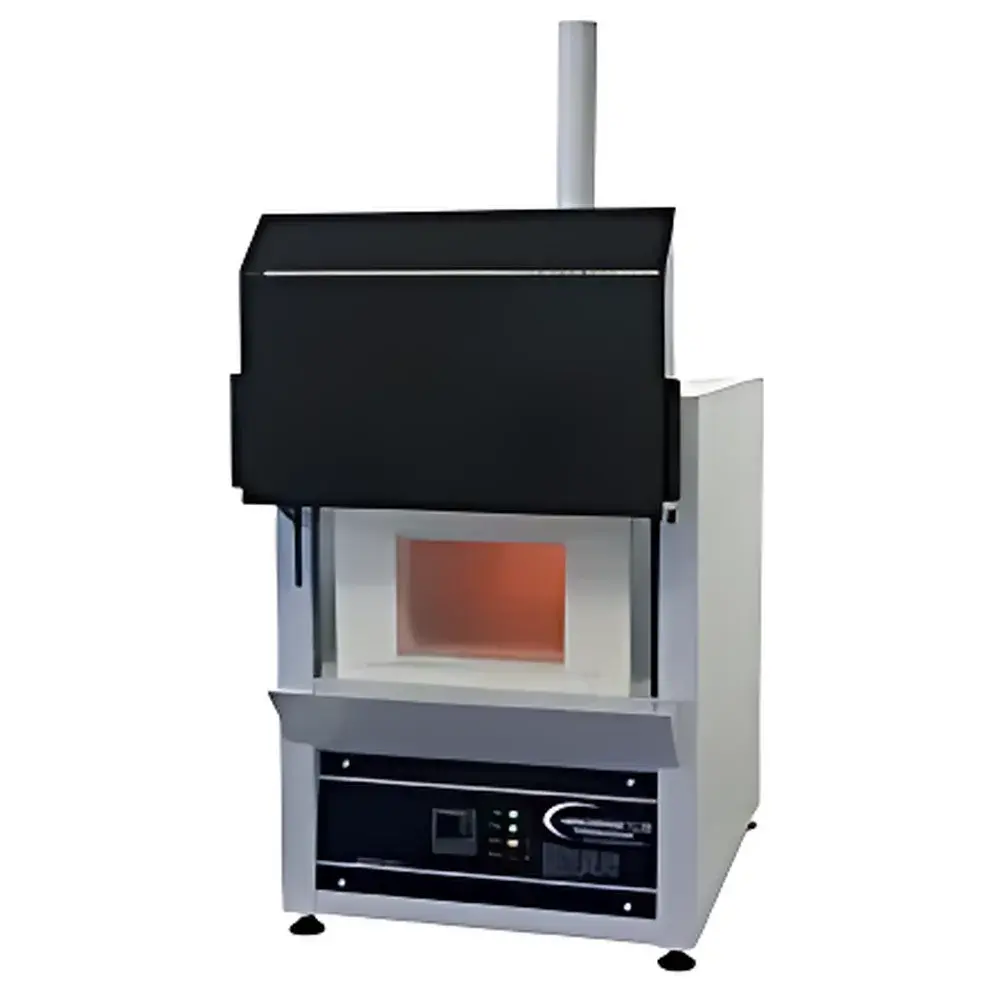
Vecstar EF2 Advanced Box-Type Muffle Furnace (1100 °C)
| Brand | Vecstar |
|---|---|
| Origin | United Kingdom |
| Model | EF2 |
| Furnace Type | Box-Type Muffle Furnace |
| Max Operating Temperature | 1100 °C |
| Continuous Operating Temperature | Up to 1150 °C (per specification sheet) |
| Temperature Uniformity | ±1 °C (at setpoint, within working zone) |
| Control Accuracy | ±1 °C |
| Max Power | 4000 W |
| Heating Rate to Max Temp | 40 °C/min (typical, no-load) |
| Internal Dimensions | 350 × 350 × 410 mm (L×W×H) |
| Internal Volume | ~5.0 L |
| Heating Element | High-Grade Kanthal A1 Resistance Wire Wound on Ceramic Core |
| Insulation | Dual-Layer High-Density Ceramic Fiber + Refractory Brick Composite |
| Door Mechanism | Vertical Lift with Safety Interlock |
| Exhaust Port | Integrated Stainless Steel Chimney (Ø50 mm) |
| Controller Options | PID Digital Temperature Controller with Ramp/Soak Programming, Optional Data Logging & RS485 Interface |
| Compliance | CE, UKCA, IEC 61000-6-3, IEC 61000-6-4, EN 60519-1 (Electrical Safety for Industrial Electroheating Equipment) |
Overview
The Vecstar EF2 Advanced Box-Type Muffle Furnace is a precision-engineered, laboratory-grade thermal processing system designed for controlled high-temperature applications including ashing, calcination, heat treatment, sintering, and thermal stability testing. Operating up to 1100 °C (with short-term capability to 1200 °C and continuous duty rated to 1150 °C), the EF2 employs a robust ceramic chamber architecture with resistance-heating elements—Kanthal A1 alloy wire wound directly onto high-purity alumina ceramic cores. This configuration ensures exceptional thermal uniformity (±1 °C across the 5.0 L working volume), mechanical durability, and long-term resistance to oxidation and thermal cycling degradation. The furnace complies with IEC 60519-1 for industrial electroheating equipment safety and integrates dual-layer insulation comprising high-density ceramic fiber and refractory brick to maintain external casing surface temperatures below 50 °C under full-load operation—minimizing ambient heat load and improving lab ergonomics.
Key Features
- Vertically opening door with mechanical safety interlock: Automatically de-energizes heating elements upon door actuation, eliminating risk of accidental exposure to elevated temperatures.
- Ceramic chamber with embedded Kanthal A1 resistance windings: Delivers stable, repeatable temperature profiles and a chemically inert, smooth interior surface resistant to corrosion from ash residues or volatile salts.
- Dual-stage thermal insulation system: Combines low-conductivity ceramic fiber blanket with structural refractory brick lining to maximize energy efficiency and reduce standby heat loss by >35% compared to single-layer designs.
- Stainless steel exhaust chimney (Ø50 mm): Facilitates controlled venting of combustion byproducts, volatiles, or process gases—compatible with standard fume hood ducting or optional scrubber integration.
- Programmable PID digital controller: Supports multi-segment ramp/soak profiles, real-time temperature logging (via optional RS485 interface), and user-configurable alarm thresholds for overtemperature, thermocouple break, and cooling rate deviation.
- Robust stainless steel exterior housing: Powder-coated for abrasion and chemical resistance; engineered for long-term use in QC labs, academic research facilities, and GLP-compliant environments.
Sample Compatibility & Compliance
The EF2 accommodates standard crucibles (alumina, quartz, platinum, and silicon carbide), ceramic boats, and metal retorts up to 300 mm in height. Its uniform heating zone supports ASTM E1111 (ash content determination), ISO 1171 (determination of ash in coal and coke), and USP <281> (residue on ignition). The furnace meets CE and UKCA marking requirements and conforms to electromagnetic compatibility standards IEC 61000-6-3 (emissions) and IEC 61000-6-4 (immunity). For regulated environments, optional controller firmware supports audit-trail-enabled operation compliant with FDA 21 CFR Part 11 when paired with validated data acquisition software.
Software & Data Management
The standard EF2 controller includes local display, keypad navigation, and non-volatile memory for up to 10 user-defined programs. Optional connectivity modules enable serial (RS485) or USB communication with PC-based monitoring platforms. Logged data—including time-stamped temperature, setpoint, power output, and alarm events—is exportable in CSV format. When integrated into validated workflows, the system supports electronic signature capture, user access levels (admin/operator), and change history tracking—aligning with GLP and GMP documentation requirements for thermal validation studies.
Applications
- Quantitative ash analysis per AOAC 942.05, ASTM D3174, and ISO 1171 in food, feed, pharmaceutical excipients, and environmental samples.
- Thermal decomposition studies of polymers, catalysts, and battery electrode materials under inert or air atmospheres.
- Pre-treatment of silica gel, activated carbon, and zeolite supports prior to BET surface area analysis.
- Calibration and verification of thermocouples and RTDs using fixed-point reference materials (e.g., Zn, Al, Cu ITS-90 points).
- Heat treatment of metallurgical specimens for microstructural homogenization prior to metallographic examination.
FAQ
What is the recommended maintenance schedule for the EF2 furnace?
Annual inspection of heating element continuity, thermocouple calibration verification, and ceramic insulation integrity assessment are advised. Replace ceramic fiber gaskets every 2–3 years under daily use.
Can the EF2 operate under inert gas purge?
Yes—optional gas inlet/outlet ports (NPT 1/4″) can be factory-installed to support nitrogen or argon purging; consult technical specifications for flow rate limits and pressure rating.
Is the temperature controller compliant with FDA 21 CFR Part 11?
The base controller is not Part 11–compliant; however, the optional RS485-enabled version with validated third-party software (e.g., WinFurnace Pro v3.2+) supports electronic signatures, audit trails, and role-based access control.
What thermocouple type is used for internal sensing?
Type K (Chromel–Alumel) thermocouples with ceramic protection sheaths are standard; Type S (Platinum–Rhodium) is available as a high-accuracy option for critical validation work.
Does the EF2 include overtemperature protection beyond the main controller?
Yes—a redundant independent overtemperature cut-off (OTC) device with mechanical reset is hardwired in series with the main power supply, meeting EN 60519-1 Class II safety requirements.



