
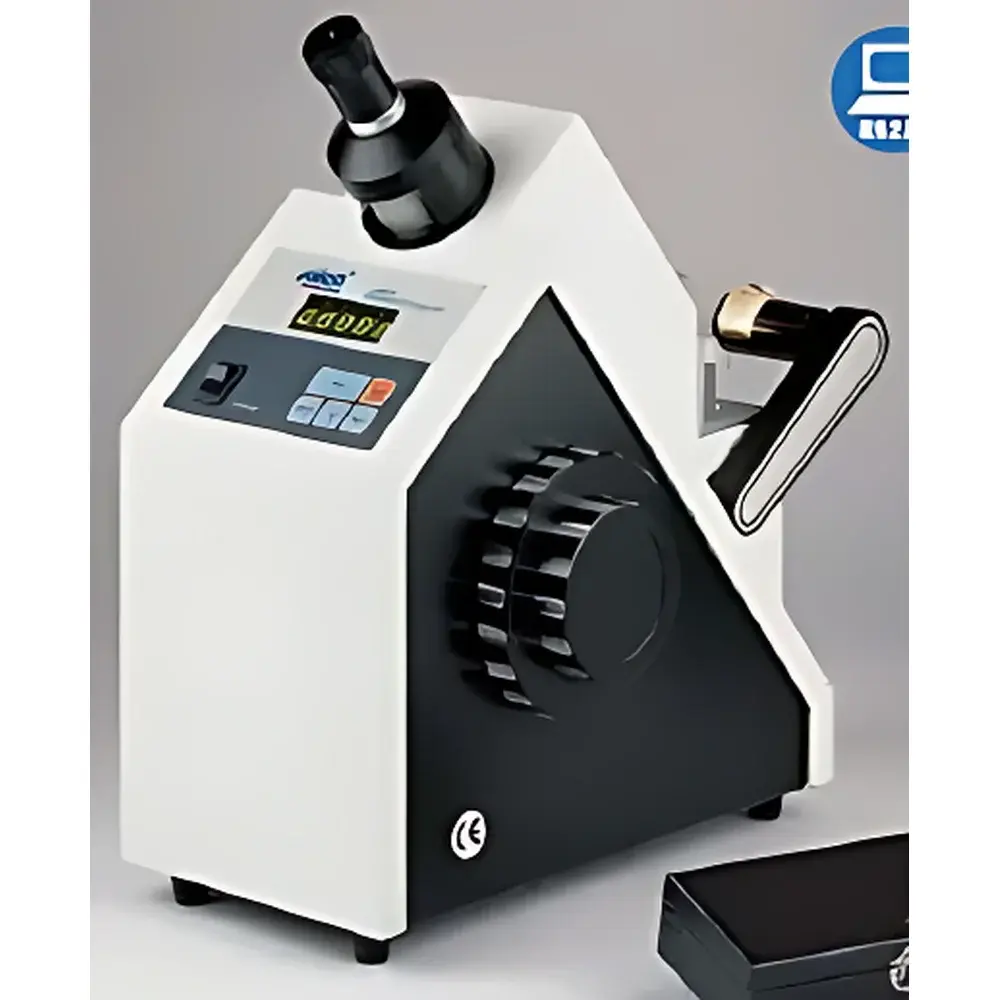
JP WYA-2S Digital Abbe Refractometer
| Brand | JP |
|---|---|
| Origin | Spain |
| Model | WYA-2S |
| Type | Benchtop Refractometer |
| Temperature Control | Yes |
| Digital Display | Yes |
| Refractive Index Range (nD) | 1.3000–1.7000 |
| Brix Range | 0–95% |
| Brix Accuracy | ±0.1% |
| Refractive Index Resolution | ±0.0002 |
| Temperature Compensation Range for Brix | 15–45 °C |
| Operating Temperature Range | 0–50 °C |
| Interface | RS232 port with dedicated software |
Overview
The JP WYA-2S Digital Abbe Refractometer is a precision benchtop optical instrument engineered for high-reproducibility measurement of refractive index (nD) and temperature-compensated Brix concentration in liquid and solid transparent or semi-transparent samples. Based on the classical Abbe principle—utilizing collimated sodium D-line illumination (589.3 nm) and critical angle detection—the instrument employs a double-lens telescope system with built-in chromatic aberration correction to sharply define the boundary between light and dark fields. This optical architecture ensures stable, operator-independent endpoint determination without subjective visual interpolation. The integrated temperature-sensing prism block enables real-time thermal compensation aligned with ISO 21542 and ASTM D1218 standards for refractive index reporting. Designed for laboratory environments requiring traceable, GLP-compliant measurements, the WYA-2S delivers metrological consistency across daily use in quality control and R&D workflows.
Key Features
- Abbe-type optical path with achromatic objective and ocular lenses for precise critical-angle visualization and minimized parallax error
- Thermostatically controlled sapphire-coated measuring prism (temperature range: 15–45 °C), compatible with external water bath circulation via standard inlet/outlet ports
- Digital readout of refractive index (nD) with 0.0001 resolution and Brix (%) with 0.01% display resolution, both simultaneously shown on dual-line LCD
- Automatic temperature compensation algorithm compliant with ICUMSA Method GS6/8-4 (for sucrose solutions) and AOAC Official Method 932.12
- RS232 serial interface supporting bidirectional communication with Windows-based acquisition software for data logging, calibration history tracking, and CSV export
- Robust aluminum alloy chassis with anti-vibration base and ergonomic sample stage for repeatable prism contact pressure
Sample Compatibility & Compliance
The WYA-2S accommodates a broad spectrum of optically homogeneous materials including aqueous sugar solutions, organic solvents, pharmaceutical syrups, edible oils, polymer melts (in molten state), and clarified biological extracts. Sample volume requirement is ≤0.5 mL per measurement. Its design conforms to IEC 61010-1 for electrical safety and meets CE marking requirements for laboratory instrumentation. Calibration verification follows NIST-traceable reference standards (e.g., distilled water at 20 °C: nD = 1.3330; certified sucrose standards per USP <851>). Data integrity protocols support audit readiness under FDA 21 CFR Part 11 when used with validated software configurations.
Software & Data Management
The included PC software provides full instrument control, real-time nD/Brix trending, multi-point calibration curve generation (linear or polynomial), and automatic timestamped report generation. All measurement sessions are logged with operator ID, ambient temperature, prism temperature, and calibration status flags. Audit trail functionality records parameter changes, calibration events, and user logins—enabling compliance with ISO/IEC 17025 clause 7.7 and EU Annex 11 requirements for electronic records. Raw data files are stored in open-format .csv, facilitating integration into LIMS or statistical process control (SPC) platforms.
Applications
- Pharmaceutical QC: Determination of active ingredient concentration in liquid dosage forms and excipient purity verification
- Food & Beverage: Brix quantification in fruit juices, soft drinks, honey, and dairy concentrates per Codex Alimentarius standards
- Petrochemical analysis: Refractive index profiling of hydrocarbon fractions, lubricant base oils, and biodiesel blends
- Academic research: Teaching optical property fundamentals, polymer characterization, and thermodynamic solution studies
- Edible oil industry: Detection of adulteration (e.g., palm oil in olive oil) via nD deviation from reference values
FAQ
Does the WYA-2S support automatic calibration verification?
Yes—it accepts user-defined calibration points using certified reference liquids, and stores up to five calibration profiles with date/time stamps and operator IDs.
Can it measure opaque or highly viscous samples?
No—samples must be optically transparent at 589 nm and flow sufficiently to form a uniform film on the prism surface; suspensions or emulsions require prior centrifugation or filtration.
Is temperature control internal or external?
The instrument features an integrated Peltier-based thermostat for the prism block, but also supports connection to an external recirculating chiller for extended stability or non-standard temperature setpoints.
What regulatory documentation is supplied?
Each unit ships with a Factory Calibration Certificate (traceable to national metrology institutes), CE Declaration of Conformity, and full technical manual compliant with ISO/IEC Guide 99.
How often should recalibration be performed?
Recommended before each analytical session when operating under GLP/GMP; minimum frequency is daily for regulated environments, with intermediate checks using water standard every 2 hours during continuous operation.



