
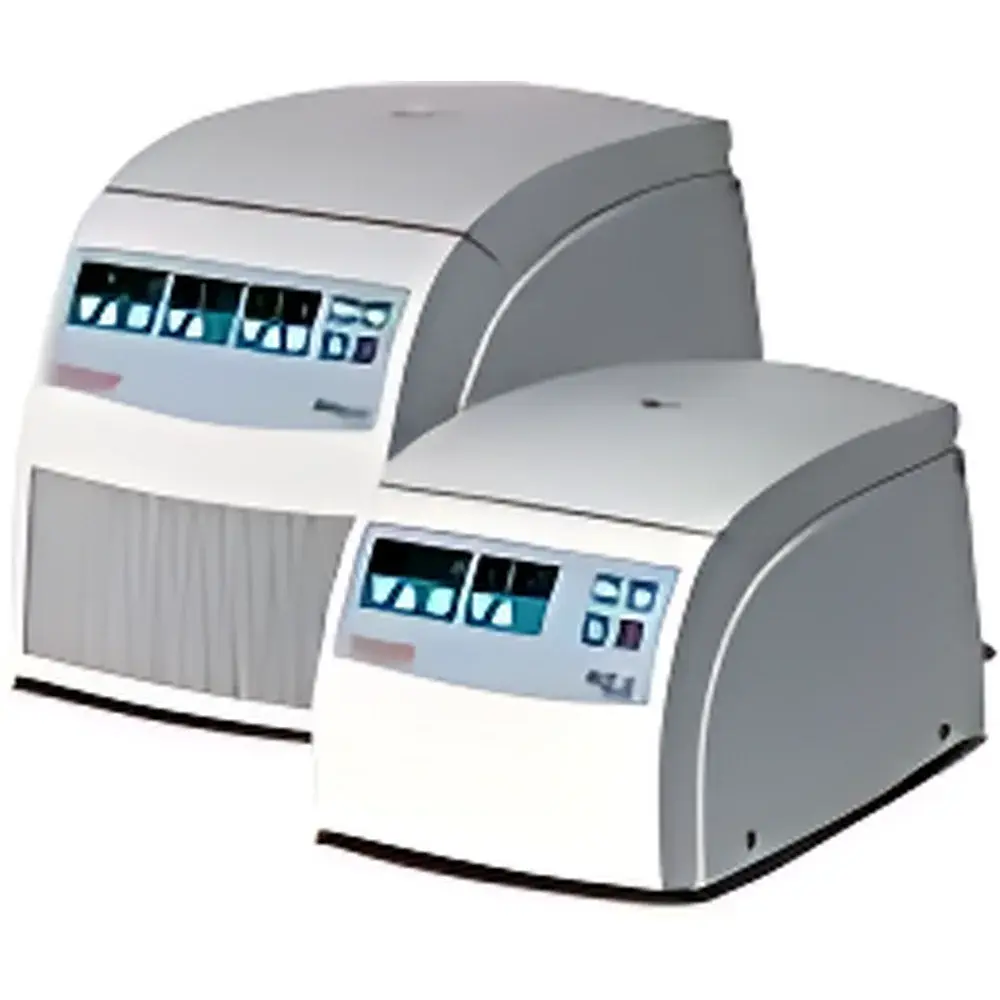
Thermo Scientific Heraeus Fresco 17 and Fresco 21 Microcentrifuges
| Brand | Thermo Fisher Scientific |
|---|---|
| Origin | USA |
| Model | Fresco 17 / Fresco 21 |
| Maximum RCF | 17,000 × g / 21,000 × g |
| Acceleration/Deceleration Time | 12 s / 12 s |
| Certified Biosafety | CAMR-validated ClickSeal™ rotors |
| Compliance | IEC 61010-1, IEC 61010-2-020, IEC 61326, cCSAus (120 V models) |
| Rotor Compatibility | 24 × 1.5–2.0 mL (ClickSeal™), 18 × (2.0 + 0.5 mL dual-row), 36 × 0.5 mL, 48 × 0.2 mL PCR tubes, hematocrit capillaries |
Overview
The Thermo Scientific Heraeus Fresco 17 and Fresco 21 microcentrifuges are compact, high-performance benchtop instruments engineered for precision, safety, and workflow efficiency in molecular biology, clinical diagnostics, and pharmaceutical quality control laboratories. Utilizing brushless induction motor technology and advanced rotor dynamics, these centrifuges deliver reproducible acceleration and deceleration profiles—reaching maximum speed in just 12 seconds and stopping with equal rapidity—minimizing run time without compromising separation integrity. The dual-model architecture (Fresco 17: up to 17,000 × g; Fresco 21: up to 21,000 × g) enables method scalability across applications ranging from routine nucleic acid pelleting and protein precipitation to high-speed clarification of viral particles or exosome isolates. Their compact footprint (W × D × H: 22.5 × 32.5 × 23.5 cm) and lightweight aluminum-magnesium alloy housing support flexible placement in biosafety cabinets, cold rooms, or shared instrumentation suites—without sacrificing structural rigidity or thermal stability during extended operation.
Key Features
- High-speed capability: 17,000 × g (Fresco 17) and 21,000 × g (Fresco 21) maximum relative centrifugal force, supporting demanding protocols including RNA integrity preservation and small-volume sample concentration.
- ClickSeal™ biosafety-certified rotor system: All standard rotors—including the included 24-position 1.5–2.0 mL rotor—are validated per CAMR (Centralised Advisory Service on Animal Health and Plant Health) standards for containment of biohazardous aerosols during operation and lid opening.
- Dual-format rotor versatility: The optional 18-position dual-row rotor accommodates both 2.0 mL and 0.5 mL tubes simultaneously—eliminating adapter swaps and reducing cross-contamination risk during multi-step workflows.
- Robust rotor materials: Anodized aluminum and reinforced polymer composites withstand repeated autoclaving (121 °C, 20 min), chemical disinfection (e.g., 70% ethanol, 0.5% sodium hypochlorite), and mechanical stress over >10,000 operational cycles.
- Intuitive human-machine interface: LED display with tactile membrane keys enables direct parameter entry (speed, time, RCF), real-time status feedback, and error-code diagnostics—designed for glove-compatible operation under ISO Class 5 cleanroom conditions.
Sample Compatibility & Compliance
The Fresco platform supports a comprehensive range of microvolume containers essential for modern life science workflows. Standard configurations include compatibility with conical-bottom 1.5–2.0 mL Eppendorf-style tubes, filter-based spin columns (e.g., Qiagen RNeasy, Zymo DNA Clean & Concentrator), 0.5 mL microtubes, 0.2 mL PCR strips and tubes, and calibrated hematocrit capillaries. All rotors undergo independent validation per ISO 13485–aligned manufacturing controls and are supplied with traceable calibration certificates. Regulatory compliance extends to IEC 61010-1 (safety of laboratory equipment), IEC 61010-2-020 (particular requirements for centrifuges), and IEC 61326 (EMC for in vitro diagnostic medical devices). For regulated environments, the instrument’s non-volatile memory logs all run parameters—including date/time stamp, rotor ID, speed, duration, and final RCF—for GLP/GMP audit readiness. While not natively 21 CFR Part 11 compliant, full electronic record export (CSV/Excel) is supported via USB interface for integration into validated LIMS or ELN systems.
Software & Data Management
Fresco centrifuges operate as standalone instruments with no embedded operating system or network stack—ensuring deterministic response times and eliminating cybersecurity vulnerabilities associated with connected firmware. All operational data (run history, rotor usage count, maintenance alerts) are stored locally in non-volatile EEPROM with timestamped entries retained for ≥5 years. A dedicated USB port enables secure, read-only export of run logs for external archival or QA review. No proprietary software installation is required; exported files conform to ASTM E1384-19 (Standard Guide for Recording and Sharing Laboratory Data) and are compatible with common laboratory informatics platforms. Firmware updates—distributed via Thermo Fisher’s validated download portal—require manual initiation and include cryptographic signature verification to ensure integrity and version traceability.
Applications
- Molecular biology: Plasmid DNA purification, PCR product cleanup, cDNA synthesis prep, siRNA transfection complex pelleting.
- Clinical microbiology: Bacterial cell harvesting prior to MALDI-TOF MS identification, serum/plasma fractionation for biomarker analysis.
- Pharmaceutical QC: Residual solvent removal from lyophilized intermediates, particulate matter assessment in sterile injectables (USP ).
- Cell culture & virology: Exosome isolation via differential ultracentrifugation (preparatory spins at 10,000–16,000 × g), lentiviral vector concentration.
- Point-of-care diagnostics: Rapid separation of whole blood into serum/plasma fractions for lateral flow immunoassays or microfluidic cartridge loading.
FAQ
What is the difference between Fresco 17 and Fresco 21?
The Fresco 17 achieves a maximum RCF of 17,000 × g at 14,000 rpm, while the Fresco 21 delivers 21,000 × g at 17,500 rpm—enabling higher-resolution separations for dense macromolecular complexes or small extracellular vesicles.
Are rotors interchangeable between Pico and Fresco series?
No. Fresco-specific rotors are mechanically and electronically keyed to prevent use on legacy Pico platforms. Each rotor includes an RFID tag verified at startup to ensure correct speed/RCF mapping.
Does the instrument support temperature control?
No. The Fresco 17/21 are non-refrigerated microcentrifuges. For temperature-sensitive applications, Thermo Fisher recommends pairing with an ambient-controlled lab environment (15–25 °C) or using pre-chilled rotors and tubes.
How often does the rotor require recalibration?
Rotors do not require field recalibration. Annual verification of speed accuracy (±10 rpm tolerance) and RCF calculation is recommended per ISO/IEC 17025-accredited metrology labs using NIST-traceable tachometers.
Can the device be integrated into automated liquid handling workcells?
Yes—via dry-contact relay outputs (included) for start/stop signaling and status feedback (lid closed, rotor at rest, error condition), compatible with common PLC and robotic controller I/O modules.
Related Products



