
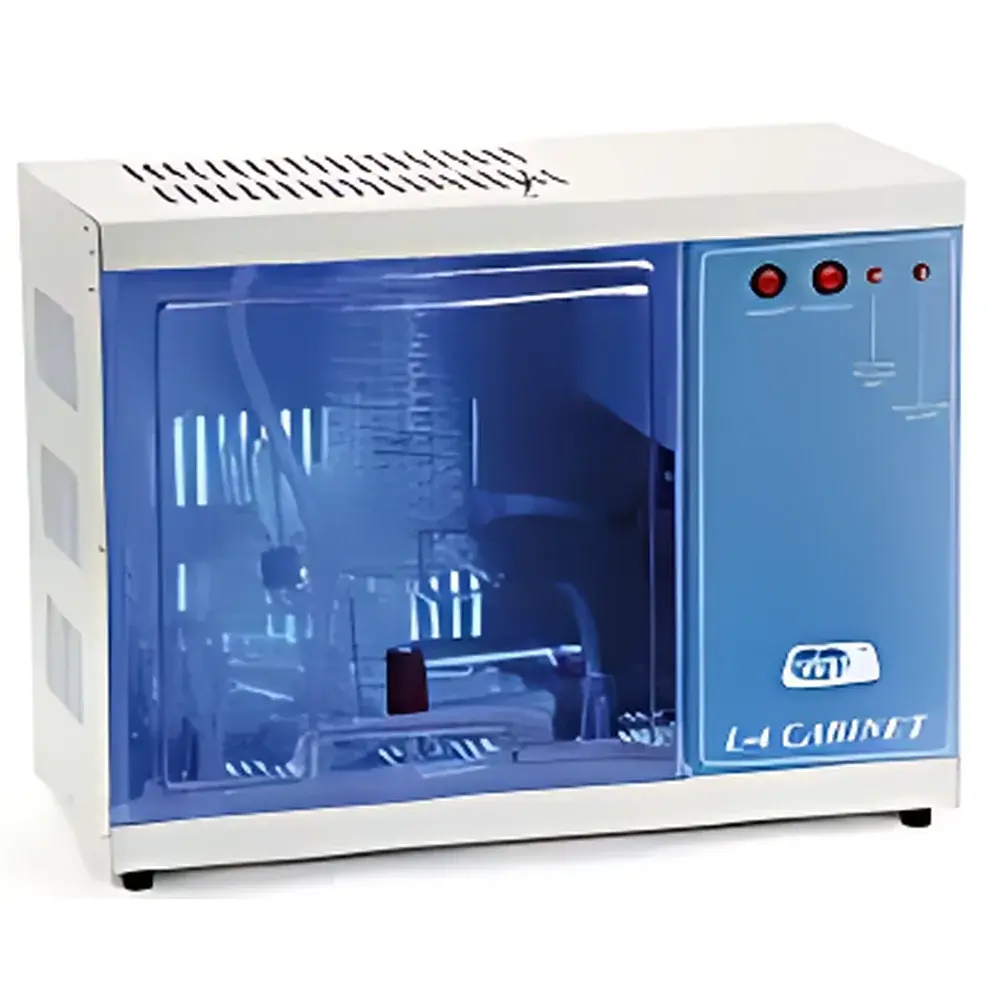
JP L-4 Cabinet Desktop Distillation Unit
| Brand | JP |
|---|---|
| Origin | Spain |
| Type | Cabinet-style desktop distillation unit |
| Purified Water Grade | ASTM Type I / ISO 3696 Grade 1 |
| Resistivity | ≥18.2 MΩ·cm at 25°C |
| Heavy Metals & Soluble Silica | <1 ppb |
| Total Organic Carbon (TOC) | <3 ppb |
| Microbial Count | <0.001 EU/mL |
| Particles (>0.1 µm) | <1 particle/mL |
| Flow Rate | 4 L/h |
| Feed Water Conductivity | ≤412 µS/cm |
| Power Consumption | 3000 W |
| Dimensions (L×W×H) | 40 × 55 × 22 cm |
| Weight | 12 kg |
| Cooling Water Consumption | 12 L/min |
| Safety Systems | Dual-level water level sensor + dry-run thermal cut-off |
Overview
The JP L-4 Cabinet Desktop Distillation Unit is a fully automated, benchtop-scale primary purification system engineered for continuous production of high-purity distilled water compliant with ASTM D1193 Type I and ISO 3696 Grade 1 specifications. Unlike membrane-based systems, this unit employs classical vapor-phase separation via controlled boiling and condensation—ensuring effective removal of non-volatile contaminants including ions, heavy metals, endotoxins, colloidal silica, and microorganisms. Constructed entirely from borosilicate glass (Duran® or equivalent), the core distillation chamber and condenser are housed within a rigid, insulated stainless steel cabinet featuring a transparent polycarbonate front door for real-time visual monitoring of the boiling process, condensate flow, and heating element status. The dual-heater configuration enables rapid startup and stable thermal equilibrium, while integrated refrigerated condensation ensures near-quantitative recovery of vapor without reboiling or carryover.
Key Features
- Borosilicate glass distillation path—chemically inert, low extractables, resistant to thermal shock and alkali corrosion
- Double-wall insulated cabinet with IP20-rated electrical enclosure and safety-interlocked transparent access door
- Dual independent heating elements (primary boiler + auxiliary pre-heater) for precise energy modulation and reduced scaling
- Refrigerated condenser with adjustable coolant flow (12 L/min max), maintaining condensate temperature ≤25°C to minimize volatile organic compound (VOC) re-entrainment
- Automatic fill-and-shut-off cycle: integrated float-level sensors trigger feed-water solenoid valve opening and terminate distillation upon reservoir saturation
- Dual redundant safety architecture: (1) bimetallic thermostat disconnects power if water level falls below heater immersion threshold; (2) capacitive water-level probe halts control logic until minimum coverage is restored
- Wall-mountable design (optional bracket kit available) and compact footprint (40 × 55 × 22 cm) suitable for ISO Class 5–7 clean benches and QC laboratories with space constraints
Sample Compatibility & Compliance
The L-4 unit accepts municipal tap water, softened water, or pretreated reverse osmosis (RO) permeate as feedstock—provided inlet conductivity remains ≤412 µS/cm. It is validated for consistent output meeting pharmacopeial requirements for Water for Injection (WFI) precursor use under USP , EP 2.2.44, and JP XVIII. While not a final WFI generator per FDA 21 CFR 211.65(a), its distillate serves as a robust upstream source for polishing by ultrafiltration or UV oxidation in GMP-compliant water-for-pharma workflows. All wetted surfaces comply with USP Class VI biocompatibility standards. The system supports GLP/GMP audit readiness through mechanical logbook recording of run duration, total volume produced, and safety event timestamps (e.g., dry-fire interruption).
Software & Data Management
The L-4 operates via an embedded microcontroller with no external PC dependency. All operational parameters—including real-time water level, heater status, and cycle counter—are displayed on a backlit LCD panel with tactile push-button interface. No proprietary software or drivers are required. For regulated environments, optional analog 4–20 mA output (with isolated signal conditioning) enables integration into building management systems (BMS) or centralized lab monitoring platforms. Audit trail capability meets FDA 21 CFR Part 11 baseline requirements when paired with external timestamped data loggers recording analog outputs.
Applications
- Preparation of reagent-grade water for HPLC mobile phase preparation, spectrophotometric blanking, and trace-metal analysis (ICP-MS, AAS)
- Feed water for secondary purification systems including ultrapure water (UPW) generators employing EDI, UV photooxidation, and 0.1 µm final filtration
- Calibration standard dilution in clinical chemistry analyzers and environmental testing labs requiring low TOC and endotoxin-free matrix
- Steam generation for autoclave pre-vacuum cycles where mineral-free steam prevents chamber scaling
- Electrode rinsing and reference electrode filling solutions in electrochemical research
- Long-term stability testing of pH buffers and enzymatic assay media sensitive to trace metal catalysis
FAQ
What feed water quality is required to achieve ASTM Type I output?
Inlet water must have conductivity ≤412 µS/cm and free chlorine <0.5 mg/L. Pre-filtration (5 µm sediment + activated carbon) is strongly recommended to extend heater life and reduce maintenance frequency.
Can the L-4 be connected to a central cooling loop?
Yes—the unit accepts chilled water supply at 10–25°C with pressure range 1–3 bar. A flow meter and pressure regulator are advised for stable condenser performance.
How often does the borosilicate glass chamber require descaling?
Under typical municipal feed conditions, descaling intervals average 3–6 months. A citric acid-based cleaning protocol (0.5% w/v, 60°C, 2 h soak) is validated and documented in the operator manual.
Is the distillate suitable for cell culture applications?
While endotoxin levels (<0.001 EU/mL) and microbial counts meet sterile filtration prerequisites, final sterility requires 0.22 µm filtration prior to use in mammalian cell culture. The unit itself is not sterile-grade certified.
Does the L-4 support remote monitoring or Ethernet connectivity?
No native Ethernet or Wi-Fi interface is included. Remote status monitoring is achievable only via optional 4–20 mA analog output linked to third-party SCADA or LabVantage systems.
Related Products



