
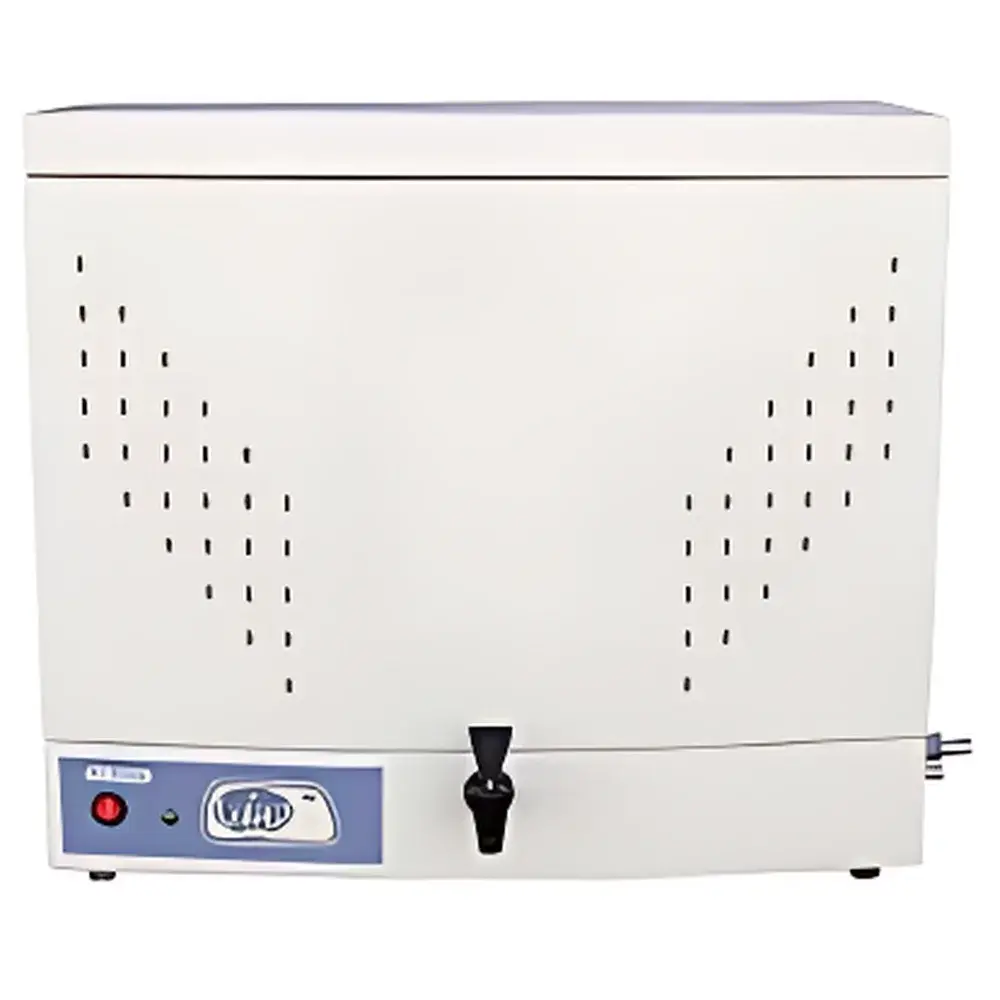
R-4 Reser Distillation Unit by JP (Spain)
| Brand | JP |
|---|---|
| Origin | Spain |
| Model | R-4 Reser |
| Purified Water Grade | Type I (ASTM D1193-20) |
| Resistivity | 18.2 MΩ·cm at 25 °C |
| Heavy Metals & Soluble Silica | <1 ppb |
| Total Organic Carbon (TOC) | <3 ppb |
| Microbial Count & Endotoxins | <0.001 EU/mL |
| Particles (>0.1 µm) | <1 mL⁻¹ |
| Flow Rate | 4 L/h |
| Feed Water Conductivity | ≤412.5 µS/cm |
| Power Consumption | 3000 W |
| Dimensions (L×W×H) | 47×54×31 cm |
| Weight | 24 kg |
| Cooling Method | Epoxy-Coated Resin Enclosure with Stainless Steel Heating Elements |
| Safety Features | Automatic Dry-Run Cut-Off, Full-Tank Shut-Off, Manual Restart Required After Drain |
Overview
The R-4 Reser Distillation Unit, manufactured in Spain and distributed globally by JP, is a benchtop or wall-mountable Type I ultrapure water production system engineered for laboratories requiring consistent, high-fidelity distilled water for critical applications. Unlike membrane-based purification systems (e.g., reverse osmosis or EDI), the R-4 Reser employs classical vapor-phase distillation—where feed water is heated to boiling, vaporized, and then condensed in a thermally isolated chamber—ensuring near-complete removal of non-volatile contaminants including ions, endotoxins, nucleases, heavy metals, colloidal silica, and particulates. This principle delivers water meeting ASTM D1193-20 Type I specifications and complies with ISO 3696:1987 Class 1 requirements for analytical laboratory use. The unit integrates stainless steel heating elements and an epoxy-resin-coated enclosure, providing corrosion resistance, thermal stability, and simplified maintenance—key attributes for long-term operational reliability in QC, pharmaceutical development, and trace elemental analysis environments.
Key Features
- Stainless steel heating assembly and condenser core ensure chemical inertness and thermal durability across repeated distillation cycles.
- Epoxy-resin coated external housing resists ambient moisture, chemical splashes, and mechanical abrasion—enhancing service life in shared lab spaces.
- Automated safety interlocks: dry-run protection disables heating when reservoir level falls below operational threshold; full-tank detection halts distillation upon collection vessel saturation.
- Manual restart protocol after drainage enforces procedural discipline and prevents unintended reactivation during maintenance.
- Benchtop footprint (47 × 54 × 31 cm) with optional wall-mount configuration optimizes space utilization in ISO-certified cleanrooms or GLP-compliant analytical suites.
- Consistent 4 L/h output rate supports continuous operation for multiple downstream instruments—including HPLC mobile phase preparation, cell culture media formulation, and ICP-MS calibration standards.
Sample Compatibility & Compliance
The R-4 Reser accepts feed water with conductivity up to 412.5 µS/cm (typically equivalent to municipal tap or pretreated RO water). Its distillation architecture inherently excludes volatile organics—making it unsuitable as a standalone solution for TOC-sensitive applications unless paired with post-distillation UV oxidation (e.g., 185/254 nm lamp). However, the integrated design achieves <3 ppb TOC when used with low-TOC feed and proper storage protocols. All performance claims are validated per ASTM D1193-20 and align with ISO 3696:1987 Class 1 water specifications. The system supports audit-ready documentation for GMP/GLP environments through user-defined log entries (time-stamped start/stop/drain events), though native electronic record functionality requires integration with external LIMS or ELN platforms.
Software & Data Management
The R-4 Reser operates via electromechanical controls without embedded firmware or touchscreen interface—intentionally minimizing validation burden in regulated settings. All operational states (heating active, tank full, standby) are indicated via discrete LED status lights. No internal data logging or network connectivity is provided; however, the unit’s deterministic behavior—consistent flow rate, fixed power draw (3000 W), and repeatable thermal cycle timing—enables external monitoring via PLC-linked current sensors or programmable timers. For FDA 21 CFR Part 11 compliance, users may integrate third-party environmental data loggers to capture temperature, pressure, and runtime metadata linked to batch records.
Applications
- HPLC and UHPLC mobile phase and blank preparation where ionic contamination must be minimized.
- Preparation of calibration standards for ICP-OES and ICP-MS, particularly for alkali metals and transition elements.
- Final rinse water in semiconductor wafer cleaning processes requiring ultra-low particle counts (0.1 µm).
- Formulation of parenteral drug solutions under USP purified water guidelines.
- Trace metal analysis in environmental testing labs adhering to EPA Method 1638 or ISO 17294-2.
FAQ
Does the R-4 Reser include real-time water quality monitoring?
No. It produces Type I water based on process fidelity—not inline sensors. Resistivity and TOC verification require external meters (e.g., Mettler Toledo InPro 7250 or GE Analytical TOC-3000) at point-of-use.
Can it be connected to a central purified water distribution loop?
Not natively. The unit is self-contained and intended for point-of-use generation. Integration into a loop requires external pressure regulation, backflow prevention, and continuous recirculation—modifications outside manufacturer support scope.
What maintenance intervals are recommended?
Heating element descaling every 200–300 operating hours using citric acid solution; condenser inspection quarterly; resin enclosure wipe-down with isopropanol biweekly in high-humidity environments.
Is the R-4 Reser compliant with EU CE marking directives?
Yes—certified under 2014/35/EU (Low Voltage Directive) and 2014/30/EU (EMC Directive) with technical file available upon request from JP’s authorized EU representative.



