
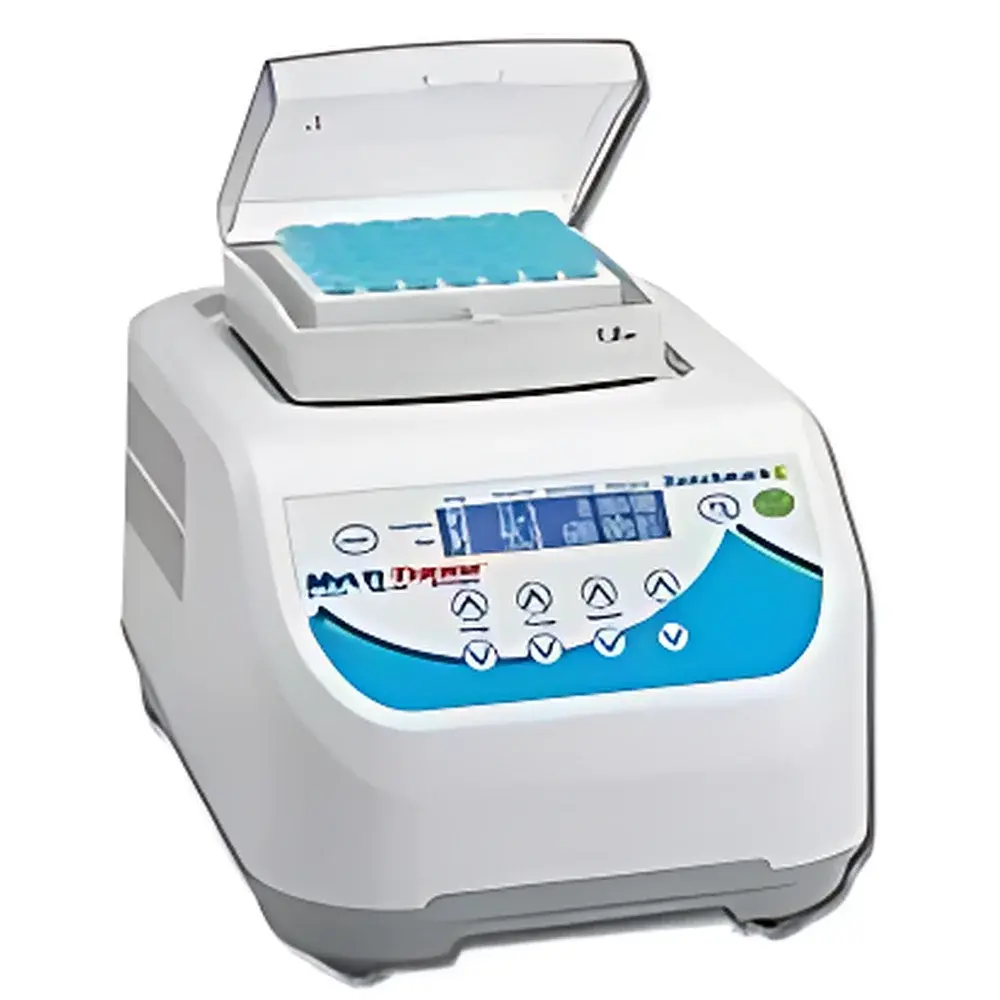
Benchmark Multi-THERM Cooling/Heating Orbital Shaker H5000
| Brand | Benchmark |
|---|---|
| Origin | USA |
| Manufacturer Type | Authorized Distributor |
| Product Category | Imported Instrument |
| Model | Multi-THERM |
| Price Range | USD 2,700 – 6,800 (est.) |
| Instrument Type | Temperature-Controlled Orbital Shaker |
| Timer Range | 1–120 min (or continuous) |
| Oscillation Speed | 200–1500 rpm |
| Orbit Diameter | 2 mm |
| Temperature Range | −20 °C to +100 °C (HC model) |
| Heating Rate | 5 °C/min |
| Cooling Rate | 2.5 °C/min |
| Temperature Accuracy | ±0.1 °C |
| Platform | Single-Deck Orbital Platform |
| Dimensions (W×D×H) | 21 × 29 × 21 cm |
| Weight | 8 kg |
| Power Supply | 120 V, 60 Hz / 230 V, 50 Hz |
| Compatibility | Standard microtubes (up to 6 × 50 mL), 96-well plates, PCR strips, and custom aluminum blocks |
Overview
The Benchmark Multi-THERM Cooling/Heating Orbital Shaker H5000 is an integrated temperature-controlled orbital shaker engineered for precision thermal management and reproducible mixing in molecular biology, microbiology, and biochemistry workflows. Unlike conventional shakers limited to ambient or heating-only operation, the H5000 employs a dual-mode Peltier-based thermoelectric system—capable of both active cooling down to −20 °C and rapid heating up to +100 °C—enabling tightly regulated reaction environments across a broad operational spectrum. Its orbital motion (2 mm diameter) generates uniform, low-shear agitation ideal for sensitive biological samples such as enzymatic digests, nucleic acid hybridizations, cell lysis protocols, and temperature-dependent protein refolding assays. The device complies with IEC 61010-1 safety standards for laboratory equipment and is designed for use in GLP-compliant laboratories where traceable thermal stability and mechanical consistency are prerequisites for assay validation.
Key Features
- Integrated thermoelectric (Peltier) module delivering precise temperature control from −20 °C to +100 °C with ±0.1 °C accuracy and real-time feedback via high-resolution NTC sensor
- Orbital shaking platform with adjustable speed range (200–1500 rpm) and fixed 2 mm orbit diameter, ensuring consistent mixing without vortexing or splashing
- Dual-range timer: programmable 1–120 minute interval or continuous operation mode, with auto-shutdown and audible alert
- Large backlit LCD display showing simultaneous setpoints and actual values for temperature, speed, and time—enabling immediate verification during protocol execution
- Over-temperature protection circuitry and thermal cutoff fuse safeguard instrument longevity, user safety, and sample integrity under fault conditions
- Compact footprint (21 × 29 cm base) accommodates standard labware including six 50 mL conical tubes, 96-well microplates, PCR tube strips, and modular aluminum blocks (sold separately)
- Universal power input (120 V/60 Hz or 230 V/50 Hz) with internal voltage regulation ensures stable performance across global laboratory infrastructures
Sample Compatibility & Compliance
The H5000 supports a wide range of consumables through its universal flat platform design and optional accessory blocks—including 0.2 mL, 0.5 mL, 1.5 mL, and 2.0 mL microtube holders; 96-well PCR plate adapters; and deep-well block configurations. It is routinely employed in applications requiring adherence to ASTM E2912 (standard practice for thermal validation of laboratory equipment) and ISO/IEC 17025-accredited methods. While not FDA 21 CFR Part 11–validated out-of-the-box, the instrument’s deterministic thermal response and non-volatile parameter storage support audit-ready documentation when integrated into validated workflows per USP Analytical Instrument Qualification guidelines.
Software & Data Management
The H5000 operates as a standalone instrument with no embedded software or network interface. All parameters are configured manually via front-panel controls, and operational history is not logged internally. For laboratories requiring electronic recordkeeping, the device may be incorporated into broader data acquisition ecosystems using external USB-connected environmental loggers (e.g., HOBO UX100 series) or PLC-integrated lab automation systems. Parameter reproducibility is ensured by factory calibration traceable to NIST-certified references, with recalibration intervals recommended annually or after 500 operational hours.
Applications
- Thermally gated enzymatic reactions: restriction digests, ligations, reverse transcription, and phosphorylation assays
- Nucleic acid denaturation and renaturation studies under controlled ramping profiles
- Lipid extraction and solubilization protocols requiring sub-zero incubation with agitation
- Bacterial and yeast culture maintenance at defined growth temperatures with continuous aeration
- Antibody-antigen binding kinetics under variable thermal stress conditions
- Pre-analytical sample preparation for LC-MS, NGS library construction, and ELISA workflows
- Controlled thawing and homogenization of cryopreserved biologics and tissue lysates
FAQ
Does the H5000 support programmable temperature ramps (e.g., linear heating/cooling profiles)?
No—the H5000 maintains a single user-defined setpoint throughout operation. It does not offer multi-step ramp-soak programming.
Can it accommodate microcentrifuge tubes in a 24-position configuration?
Yes, when used with the optional 24-place 1.5/2.0 mL aluminum block (part #MT-B24), which fits securely on the platform without modification.
Is the cooling function effective at ambient temperatures above 30 °C?
Performance degrades above 30 °C ambient; optimal cooling efficiency is achieved at ≤25 °C ambient with adequate ventilation clearance (≥10 cm on all sides).
What safety certifications does the unit carry?
It bears CE marking and complies with IEC 61010-1:2010 (Edition 3) for electrical safety and EN 61326-1:2013 for electromagnetic compatibility.
Is routine maintenance required beyond cleaning the platform surface?
Yes—annual inspection of Peltier module thermal interface paste and fan filter cleaning is recommended to sustain thermal transfer efficiency and prevent condensation-related corrosion.
Related Products




