
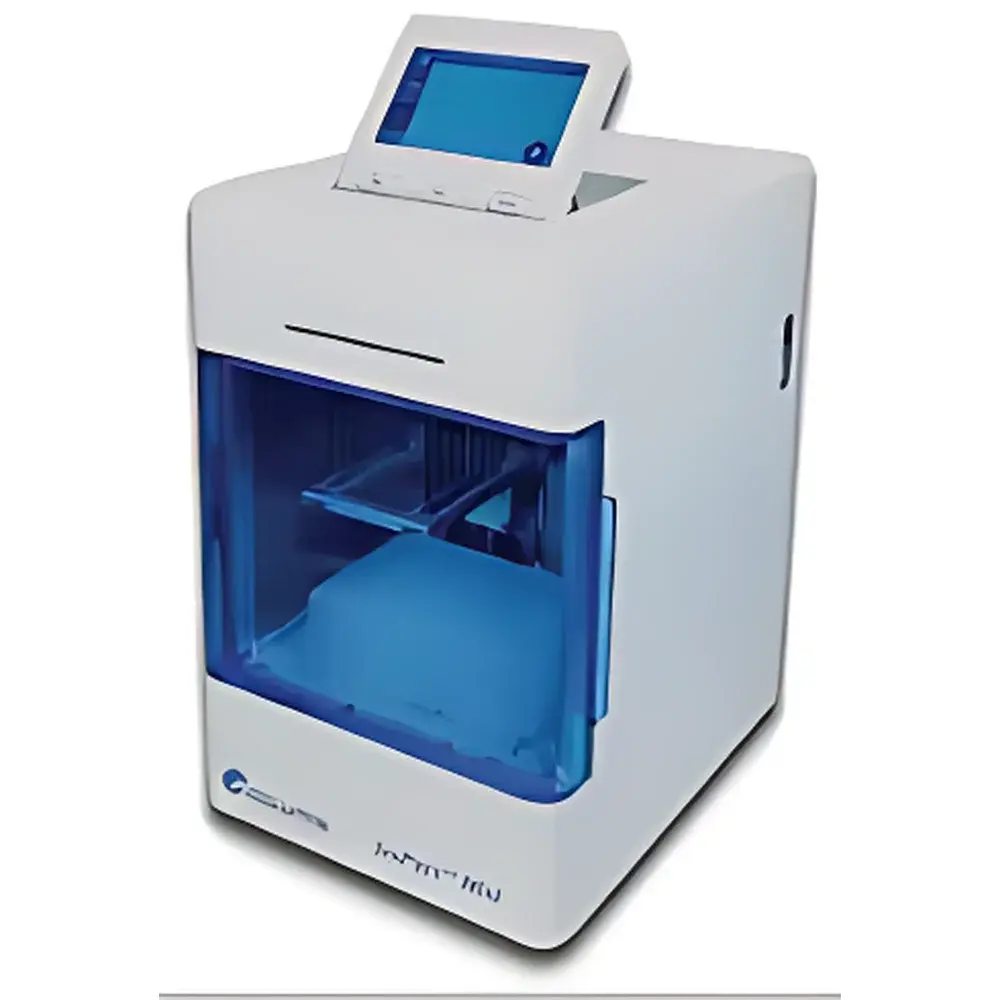
Benchmark AP1016 Magnetic Bead-Based Nucleic Acid Purification System
| Brand | Benchmark |
|---|---|
| Origin | USA |
| Manufacturer Type | Authorized Distributor |
| Origin Category | Imported |
| Model | AP1016 |
| Instrument Type | Magnetic Bead-Based Purification |
| Automation Level | Dedicated Fully Automated |
| Throughput | 16 Samples per Run |
| Sample Volume Range | Up to 50 mL |
| Processing Time per Batch | 10–60 minutes |
| Heating Block Temperature Range | Ambient +5°C to 120°C |
| Compatible Vessel Formats | Deep-Well Plates & 6-Position Sample Strips |
| Cooling | Integrated Fan-Based Thermal Management |
Overview
The Benchmark AP1016 Magnetic Bead-Based Nucleic Acid Purification System is an engineered platform for high-reproducibility, walk-away isolation of DNA, RNA, and other nucleic acid targets from diverse biological matrices—including whole blood, saliva, tissue homogenates, cultured cells, and environmental samples. It implements a standardized magnetic bead separation workflow grounded in surface chemistry principles: paramagnetic beads functionalized with carboxyl or silane groups bind nucleic acids under chaotropic salt and pH-controlled conditions, followed by sequential magnetic immobilization, wash steps (ethanol-based), and low-salt elution. This principle ensures minimal carryover of inhibitors—such as heme, polysaccharides, or humic substances—that commonly compromise downstream applications like qPCR, NGS library preparation, and Sanger sequencing. Unlike vacuum- or centrifugation-based systems, the AP1016 eliminates manual pipetting variability and operator-induced contamination risk while maintaining full compatibility with commercially available, off-the-shelf magnetic bead kits (e.g., those compliant with ISO 18385:2016 for forensic-grade DNA purification).
Key Features
- Dedicated fully automated architecture optimized exclusively for magnetic bead workflows—no reconfiguration required for alternate chemistries.
- 16-position sample processing capacity per run, supporting standard 96-well deep-well plates (1.2 mL) and modular 6-position sample strips for flexible throughput scaling.
- Precisely controlled thermal module with ±0.5°C accuracy across a range of ambient +5°C to 120°C, enabling on-instrument lysis (e.g., proteinase K digestion at 56°C) and temperature-sensitive elution (e.g., RNA stabilization at 45°C).
- Integrated cooling fan maintains stable ambient temperature at the deck level, critical for preserving enzyme integrity during extended protocols or high-ambient lab environments.
- Programmable multi-step protocol engine supporting up to 12 independently defined stages—including bead resuspension, binding incubation, magnetic separation, wash cycles (up to 3), air-drying, and heated elution—with adjustable agitation speed, duration, and temperature per step.
- Robust liquid handling system featuring positive-displacement pipetting for viscous lysates and high-volume inputs (up to 50 mL), minimizing cross-contamination via disposable tips and sealed reagent reservoirs.
Sample Compatibility & Compliance
The AP1016 accommodates primary and secondary sample types validated under CLIA-waived and ISO/IEC 17025-aligned laboratory practices, including EDTA-anticoagulated whole blood, buccal swabs, FFPE tissue digests, bacterial cultures, and plant leaf extracts. Its open-system design permits integration with third-party magnetic bead kits meeting ISO 20387:2018 (biobanking) and ISO 15189:2022 (medical laboratories) requirements. All thermal profiles and timing parameters are logged with timestamped audit trails, supporting GLP/GMP documentation needs. While the instrument itself does not hold FDA 510(k) clearance, its operational parameters align with USP Analytical Instrument Qualification guidelines for Category B instruments.
Software & Data Management
Controlled via a dedicated Windows-based interface (AP1016 Control Suite v3.2+), the system supports protocol import/export in XML format, user-level access control (admin/operator/guest), and electronic signature capability compliant with FDA 21 CFR Part 11 Annex 11 expectations. All run logs—including temperature history, motor actuation events, tip ejection records, and error codes—are stored locally with optional network backup. No cloud connectivity is embedded; data residency remains fully on-premise unless integrated into existing LIMS via HL7 or CSV export.
Applications
- High-throughput genomic DNA extraction for SNP genotyping and microarray analysis.
- Routine RNA isolation from low-yield clinical specimens (e.g., CSF, plasma exosomes) prior to RT-qPCR or digital PCR.
- Plasmid DNA purification for cloning validation and transfection-grade prep.
- Metagenomic DNA recovery from soil or wastewater samples for 16S rRNA sequencing.
- Forensic casework processing under ISO 18385-compliant chain-of-custody protocols.
- Biobank accessioning workflows requiring traceable, auditable nucleic acid stabilization and archiving.
FAQ
Does the AP1016 support custom magnetic bead chemistries?
Yes—its open protocol architecture accepts any magnetic bead kit that specifies binding/wash/elution buffer volumes and thermal requirements within the system’s physical limits.
Is validation documentation provided for IQ/OQ/PQ execution?
Benchmark supplies a comprehensive User Requirement Specification (URS), Factory Acceptance Test (FAT) report, and template qualification protocols aligned with ASTM E2500-13 and EU GMP Annex 15.
Can the system process samples in tubes instead of plates?
No—the AP1016 is configured exclusively for deep-well plates and 6-position strip carriers; tube-based formats require manual transfer prior to loading.
What maintenance intervals are recommended?
Daily tip deck inspection, monthly magnetic head calibration using included test beads, and annual preventative service including pump tubing replacement and thermal sensor verification.
Is remote monitoring supported?
Local network status monitoring is available via Ethernet-connected PC; no native SNMP or IoT telemetry is implemented.





