
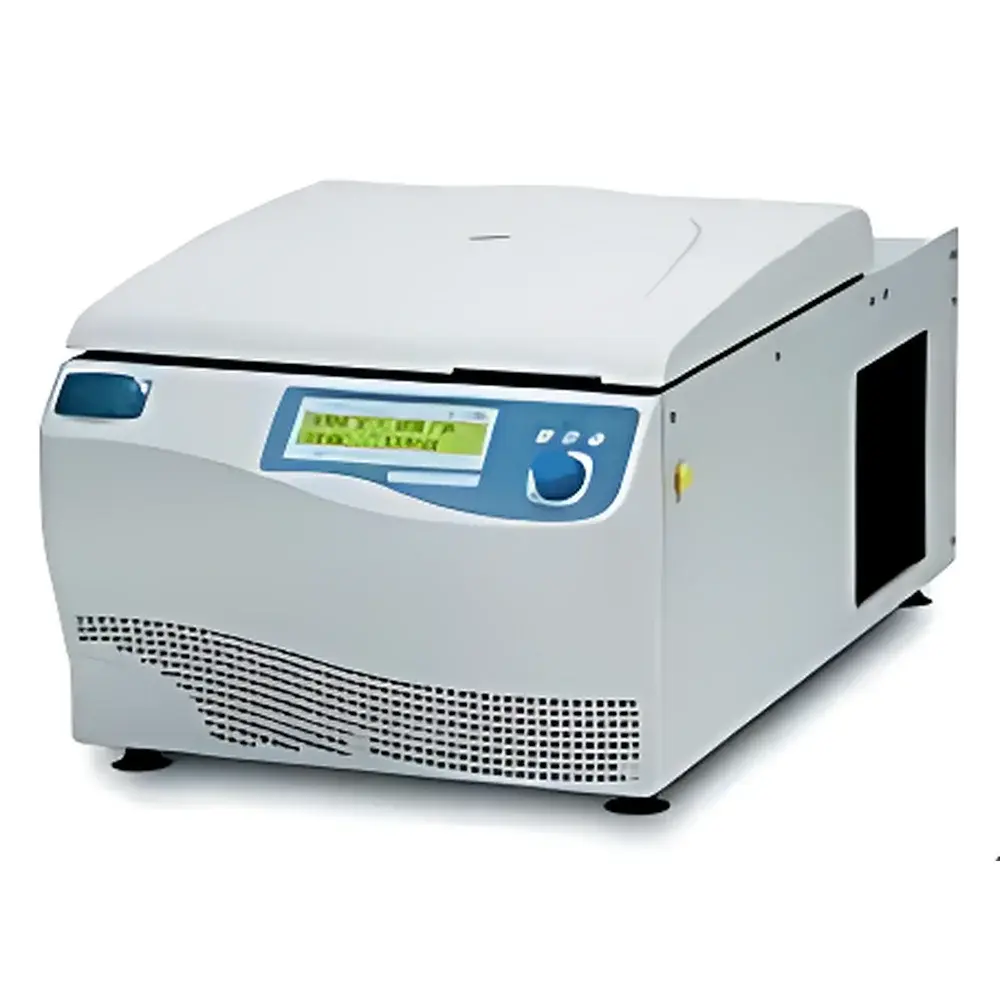
Centrofriger BL-II Benchtop Refrigerated Centrifuge
| Brand | JP |
|---|---|
| Origin | Spain |
| Model | Centrofriger BL-II |
| Type | Benchtop Refrigerated Centrifuge |
| Max Speed | 6,000 rpm |
| Max RCF | 1,000 × g |
| Max Capacity | 400 mL (horizontal rotor configuration) |
| Dimensions (W×D×H) | 34 × 41 × 54 cm |
| Construction | DUR-Al alloy housing, stainless steel bowl and top plate, steel safety chamber |
| Drive | Maintenance-free induction motor |
| Noise Level | 50–60 dB(A) |
| Control System | Microprocessor-based digital control with rotor auto-recognition, 10 programmable protocols, real-time RCF calculation, timer, acceleration/deceleration profiling, temperature monitoring |
| Airflow | Unidirectional non-recirculating air exhaust system |
| Compliance | Designed for GLP-compliant laboratories |
Overview
The Centrofriger BL-II is a benchtop refrigerated centrifuge engineered for routine separation of biological macromolecules, cell suspensions, and clinical specimens under controlled thermal conditions. Utilizing a precision-engineered induction motor and passive air-cooling architecture, it delivers stable low-speed centrifugation (up to 6,000 rpm) with a maximum relative centrifugal force (RCF) of 1,000 × g — optimized for gentle pelleting of sensitive biomaterials such as mitochondria, nuclei, and large vesicles. Unlike high-speed or ultracentrifuge platforms, the BL-II prioritizes operational robustness, thermal stability, and user safety in shared laboratory environments where reproducibility across shifts and operators is critical. Its non-recirculating airflow design actively expels warm air from the rear chamber, preventing heat accumulation within the rotor cavity and ensuring sample temperature integrity during extended runs.
Key Features
- Maintenance-free induction motor with extended service life and consistent torque delivery across speed ranges
- DUR-Al alloy outer casing combined with stainless steel inner bowl and top plate — corrosion-resistant and compatible with common decontamination agents (e.g., 70% ethanol, 0.5% sodium hypochlorite)
- Integrated steel safety chamber conforming to IEC 61010-2-020 mechanical safety standards for rotating equipment
- Microprocessor-controlled interface supporting real-time RCF calculation, programmable acceleration/deceleration profiles, and 10 stored protocols with timestamped execution logs
- Auto-rotor recognition via embedded transponder system: detects rotor type, maximum speed rating, and capacity upon lid closure — prevents overspeed or overload errors before initiation
- Laser-engraved identification codes on all rotors, buckets, and adapters for traceability and inventory management in regulated environments
- Acoustic enclosure design achieving 50–60 dB(A) at 1 m distance — suitable for open-plan labs without dedicated acoustic isolation
Sample Compatibility & Compliance
The BL-II accommodates standard horizontal rotors supporting up to 400 mL total volume (e.g., 4 × 100 mL conical tubes or 8 × 50 mL Falcon tubes). It is validated for use with polypropylene, polycarbonate, and glass centrifuge vessels meeting ISO 8573-1 purity class 4 requirements. The system complies with essential electrical safety (IEC 61010-1), electromagnetic compatibility (IEC 61326-1), and laboratory equipment ergonomics (EN 614-1) directives. While not certified for Class II biosafety cabinet integration, its sealed rotor chamber and non-recirculating airflow meet baseline containment expectations for BSL-2 workflows. Documentation packages include Factory Acceptance Test (FAT) reports and material declarations compliant with RoHS 2011/65/EU and REACH Annex XIV.
Software & Data Management
The embedded microcontroller records run parameters (start/stop time, speed, RCF, duration, rotor ID, error flags) in non-volatile memory. Data export is supported via USB port in CSV format for integration into LIMS or ELN systems. Audit trail functionality meets GLP documentation requirements, including operator ID tagging (via optional PIN login module), timestamped parameter changes, and immutable event logging. The firmware supports remote diagnostics through RS-232 serial interface (optional adapter), enabling preventive maintenance scheduling based on cumulative runtime and thermal cycle history. No cloud connectivity or proprietary software installation is required — all configuration and review occur locally via the front-panel LCD interface.
Applications
- Preparative isolation of extracellular vesicles and exosomes from serum or conditioned media
- Clarification of bacterial lysates prior to chromatographic purification of recombinant proteins
- Cell fractionation workflows involving differential centrifugation steps (e.g., nuclear pellet vs. cytosolic supernatant)
- Routine clinical specimen processing: serum/plasma separation from whole blood, urine sediment concentration
- Stability testing of formulated biologics under accelerated storage conditions (4 °C to 25 °C ambient range)
- Quality control of vaccine adjuvant suspensions requiring particle settling assessment
FAQ
Does the BL-II support temperature control during operation?
No — the BL-II is a refrigerated centrifuge but does not feature active cooling; it relies on passive thermal management via unidirectional airflow. Ambient lab temperature must be maintained ≤25 °C for optimal thermal performance.
Can third-party rotors be used with the auto-recognition system?
No — only original Centrofriger-certified rotors with embedded RFID tags are recognized. Unauthorized rotors will trigger an interlock and prevent start-up.
Is the BL-II compliant with FDA 21 CFR Part 11?
The base unit provides audit-trail-capable data logging but requires supplementary validation documentation (IQ/OQ/PQ) and electronic signature implementation to achieve full Part 11 compliance.
What is the expected service interval for the induction motor?
The motor is rated for 20,000 hours of continuous operation under nominal load; no scheduled lubrication or brush replacement is required.
How is calibration verified for RCF accuracy?
RCF is calculated in real time using the formula RCF = 1.118 × 10⁻⁵ × r × N², where r is rotor radius (cm) and N is rotational speed (rpm); calibration verification is performed annually using traceable tachometry and radius measurement per ISO 15195:2018.



