
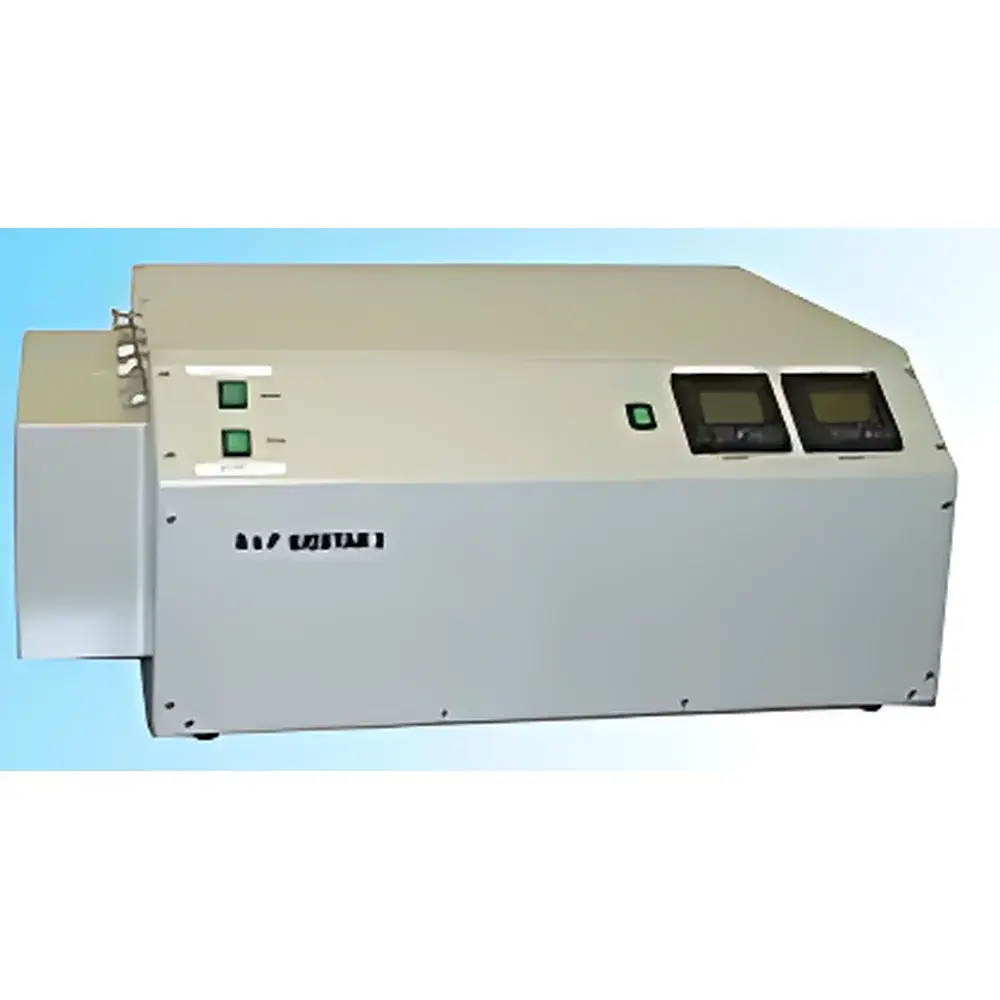
R&P OXISTAR Series Oxidative Aging Tester for Elastomers and Rubber
| Brand | R&P |
|---|---|
| Origin | Germany |
| Model | OXISTAR |
| Chamber Configuration | Single (310-0003) or Dual (310-0001) |
| Max Operating Pressure | 21 bar |
| Oxygen Pre-Pressure | 25 ± 1 bar |
| Compressed Air Pre-Pressure | 7 ± 0.5 bar |
| Burst Disc Rating | 32 ± 7.5% bar |
| Max Temperature | 150 °C |
| Temperature Control Accuracy | ±0.2 °C |
| Temp Uniformity | ±0.1 °C at 70 °C, ±0.2 °C at 150 °C |
| Pressure Sensor Range | 0–25 bar, ±0.5% FS |
| Chamber Volume | 4 L per cavity |
| Heating Power (Single) | 330 VA |
| Total Power Consumption | 720 VA (Dual), 360 VA (Single) |
| Dimensions (W×D×H) | 87 × 66 (45) × 42 cm |
| Weight | 58 kg (Dual), 42 kg (Single) |
| Electrical Supply | 230 V ±10% |
Overview
The R&P OXISTAR Series Oxidative Aging Tester is a precision-engineered benchtop system designed to accelerate the oxidative degradation of elastomeric and polymeric materials under controlled high-pressure, elevated-temperature conditions. Based on the pressure vessel (autoclave) method, it replicates long-term aging effects in compressed timeframes—enabling quantitative assessment of material stability without requiring months or years of natural exposure. The instrument operates in strict compliance with DIN 53 508, DIN VDE 0472, and IEC 60811-1-2 standards, making it a reference-grade tool for cable insulation, automotive sealing compounds, medical tubing, and aerospace-grade rubber formulations. Its core principle relies on exposing test specimens to defined gaseous environments—either pure oxygen at 70 °C and 21 bar or compressed air at 127 °C or 150 °C and 5.5 bar—within sealed, thermostatically regulated chambers. Subsequent mechanical property evaluation (e.g., tensile strength, hardness, elongation at break) before and after exposure provides statistically traceable aging indices critical for material qualification and lifetime prediction.
Key Features
- Dual independent 4 L pressure chambers (OXISTAR II model) enabling simultaneous testing under divergent oxidative conditions—e.g., one chamber at 70 °C/21 bar O₂, the other at 150 °C/5.5 bar air—maximizing throughput and experimental flexibility.
- High-fidelity electronic control architecture with real-time monitoring and logging of temperature and pressure across each chamber, supporting ISO/IEC 17025-compliant data integrity requirements.
- PT100 resistance thermometers mounted directly inside each chamber wall for true internal temperature measurement; certified uniformity of ±0.1 °C at 70 °C and ±0.2 °C at 150 °C.
- Integrated 0–25 bar pressure transducers with ±0.5% full-scale accuracy and direct cavity mounting for minimal hysteresis and drift.
- Low-flow capillary gas inlet/outlet system ensuring stable, laminar gas exchange—critical for maintaining stoichiometric consistency and minimizing thermal shock during pressurization or venting.
- Burst disc safety system rated at 32 ± 7.5% bar, independently certified to PED 2014/68/EU and ASME Section VIII Division 1 design criteria.
- Modular electrical architecture: dual-chamber configuration draws 720 VA peak (360 VA per chamber), compatible with standard 230 V ±10% laboratory supply without dedicated circuitry.
Sample Compatibility & Compliance
The OXISTAR platform accommodates standard ASTM D412 dumbbell specimens, ISO 37 Type 2 test pieces, and custom-cut strips up to 100 mm length × 20 mm width × 5 mm thickness. It is routinely deployed for cross-linked polyethylene (XLPE), ethylene propylene diene monomer (EPDM), silicone rubber, nitrile butadiene rubber (NBR), and fluorocarbon elastomers. All operational protocols align with GLP documentation frameworks and support audit-ready traceability when integrated with validated LIMS or ELN systems. Test reports generated from OXISTAR data satisfy regulatory submission requirements for IECQ QC080000, UL 1581, and EN 50363-1 certification pathways. The system’s pressure and temperature control performance has been verified per ISO 17025 clause 5.4.2 for calibration traceability to national metrology institutes (e.g., PTB, NPL).
Software & Data Management
While the OXISTAR hardware operates via embedded microcontroller-based PID regulation, optional PC connectivity (RS-485 or Ethernet) enables integration with third-party SCADA or laboratory data management platforms. Raw sensor outputs—including timestamped temperature, pressure, and elapsed test duration—are recorded at user-configurable intervals (1–60 s). Export formats include CSV and XML, fully compatible with statistical analysis tools (e.g., JMP, Minitab) and 21 CFR Part 11-compliant electronic signature workflows when paired with validated software layers. Audit trails capture operator ID, parameter changes, chamber status transitions, and alarm events—meeting FDA and EMA expectations for analytical instrument qualification (AIQ) and periodic review.
Applications
- Accelerated aging validation of low-voltage and medium-voltage power cable insulation materials (e.g., XLPE, EPR) per IEC 60502-2 and IEEE 400.2.
- Comparative oxidative stability ranking of antioxidant packages in synthetic rubber compounding.
- Qualification of elastomeric seals for automotive fuel systems exposed to biofuel blends (EN 228, ASTM D7467).
- Stability assessment of silicone-based medical device components under ISO 10993-12 extraction protocols.
- Development support for high-temperature aerospace elastomers requiring extended service life under thermal-oxygen stress.
FAQ
What standards does the OXISTAR tester explicitly support?
It is engineered and verified for DIN 53 508, DIN VDE 0472, and IEC 60811-1-2. Additional method adaptations for ASTM D572 and ISO 188 can be implemented via custom protocol configuration.
Can test parameters be modified beyond the listed default conditions?
Yes—temperature setpoints from ambient to 150 °C and pressure ranges from vacuum to 21 bar are programmable within mechanical and safety limits. Custom ramp-hold profiles require firmware-level configuration by authorized service engineers.
Is the system suitable for hazardous gas handling beyond oxygen and air?
No. The OXISTAR is certified exclusively for oxygen and compressed air. Use with flammable, corrosive, or toxic gases voids CE marking and invalidates insurance coverage.
How is calibration maintained over time?
Annual verification using NIST-traceable PT100 calibrators and deadweight pressure standards is recommended. R&P provides certified calibration kits (Order No. CAL-OXI-KIT) and on-site metrology services compliant with ISO/IEC 17025.
Does the dual-chamber model allow asynchronous operation?
Yes—each chamber operates with independent PID loops, timers, and alarm thresholds. Start/stop sequences, setpoint changes, and emergency venting are fully isolated between cavities.
Related Products





