
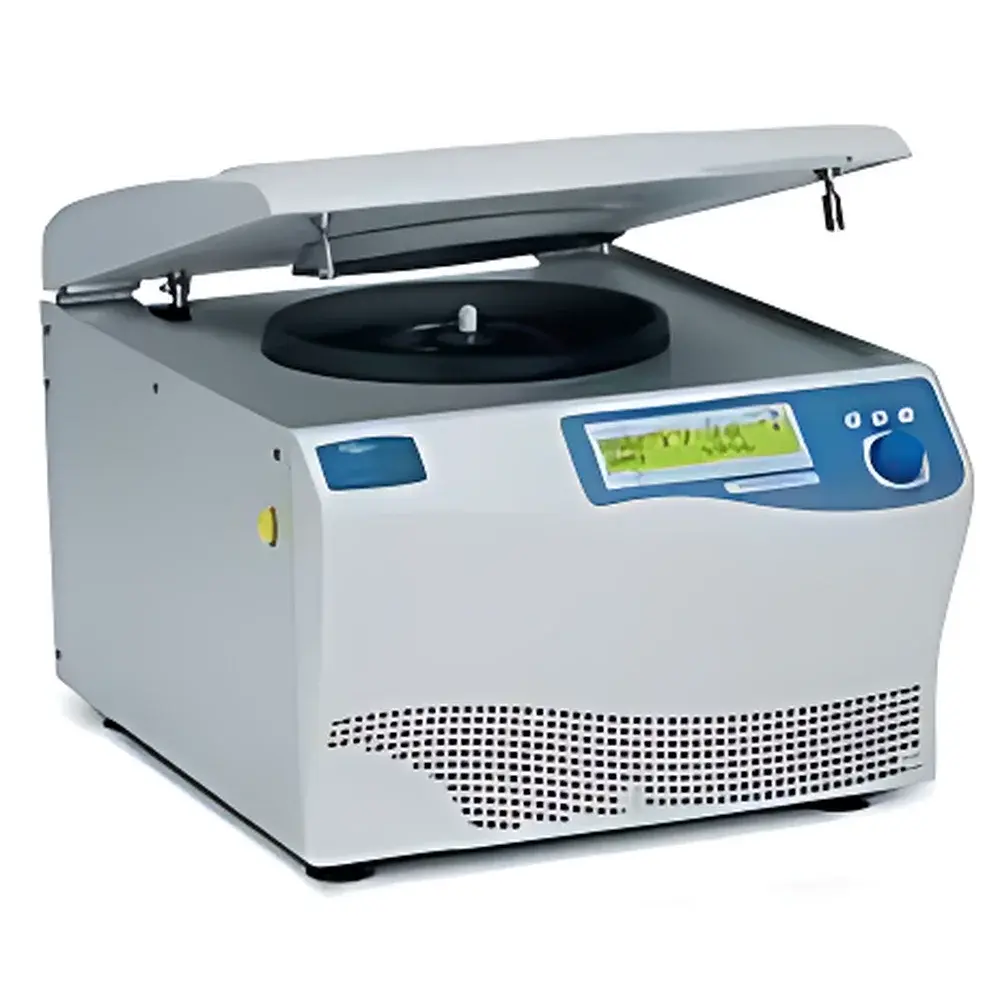
Centronic BL-II Benchtop Refrigerated Centrifuge
| Brand | JP |
|---|---|
| Origin | Spain |
| Model | Centronic BL-II |
| Type | Benchtop Refrigerated Centrifuge |
| Rotor Configuration | Horizontal (Swinging-Bucket) |
| Max Speed | 20,000 rpm |
| Max RCF | 30,000 × g |
| Max Capacity | 4 × 100 mL |
| Temperature Range | -10 °C to +40 °C |
| Noise Level | 50–60 dB(A) |
| Dimensions (H×W×D) | 34 × 41 × 54 cm |
| Power Consumption | 440 W |
| Weight | 22 kg |
| Construction | DUR-Al alloy outer housing, stainless steel inner bowl and top plate, steel-reinforced safety chamber |
| Control System | Microprocessor-based digital control with auto-rotor recognition, 10 programmable protocols, real-time RCF/speed conversion, ramp/deceleration profiling, and thermal management via non-recirculating air exhaust |
Overview
The Centronic BL-II is a high-performance benchtop refrigerated centrifuge engineered for precision separation of biological macromolecules—including proteins, nucleic acids, organelles, and subcellular fractions—in research, clinical, and quality control laboratories. Designed and manufactured in Spain, it operates on the principle of sedimentation under controlled gravitational force (RCF), where rotational motion generates centrifugal acceleration proportional to angular velocity squared and rotor radius. Its microprocessor-controlled architecture ensures repeatable, traceable, and thermally stable operation across demanding workflows—particularly where temperature-sensitive samples (e.g., enzyme complexes or RNA preparations) require sustained cold retention during prolonged runs.
Key Features
- Brushless induction motor with maintenance-free operation and extended service life
- Acoustically optimized mechanical design delivering noise levels between 50–60 dB(A) at rated speed—suitable for shared laboratory environments
- Robust all-metal construction: outer casing fabricated from DUR-Al aerospace-grade aluminum alloy; internal bowl and top plate machined from corrosion-resistant stainless steel; reinforced steel safety chamber integrated within the chassis
- Intelligent rotor recognition system: embedded transponder in each rotor communicates type, max speed, max RCF, and calibration data upon lid closure—preventing unsafe parameter selection and enabling seamless expansion with new rotor families without firmware updates
- Non-recirculating air cooling: ambient air drawn through rear vents passes once through the chamber and exits externally—eliminating heat buildup and ensuring consistent thermal conditions independent of ambient humidity or room temperature fluctuations
- MONO single-button programming interface: intuitive sequential entry for speed/RCF, acceleration/deceleration profiles, run time, setpoint temperature (°C/°F), and temperature calibration offset
- Digital display with real-time feedback on actual RCF, elapsed time, remaining time, temperature deviation, and error codes
Sample Compatibility & Compliance
The BL-II accommodates standard centrifuge tubes up to 100 mL per position (4-position horizontal rotor configuration), supporting common formats including polypropylene conical tubes, glass serum tubes, and sealed PCR tube adapters. All rotors, buckets, and adapters carry permanent laser-engraved identification codes for full traceability—critical for GLP/GMP-compliant environments. The system meets IEC 61010-1:2010 safety standards for laboratory equipment and complies with EN 61326-1 electromagnetic compatibility requirements. Its temperature control architecture supports ISO/IEC 17025 method validation protocols when used in accredited testing laboratories.
Software & Data Management
While the BL-II operates as a standalone instrument, its microprocessor logs operational metadata—including start/stop timestamps, selected protocol ID, final temperature deviation, and rotor ID—for manual audit trail reconstruction. Optional RS-232 or USB serial interfaces (available via accessory module) enable integration with LIMS or custom data acquisition systems. All stored programs retain user-defined ramp/deceleration slopes and temperature stabilization delays—supporting FDA 21 CFR Part 11–aligned workflow documentation when paired with validated electronic record systems.
Applications
- Isolation of mitochondria, lysosomes, and microsomes from mammalian cell homogenates
- Purification of plasmid DNA and genomic DNA using density gradient or pelleting protocols
- Clarification of bacterial lysates prior to chromatographic analysis
- Preparation of exosome-enriched supernatants from conditioned media (100,000 × g equivalent achievable via timed runs at 20,000 rpm with appropriate rotor)
- Routine QC centrifugation of clinical specimens including serum, plasma, and cerebrospinal fluid
- Stabilization of temperature-labile protein formulations during formulation development
FAQ
Does the BL-II support fixed-angle rotors?
No—the BL-II is configured exclusively for horizontal (swinging-bucket) rotors to optimize pelleting uniformity and sample recovery for low-density separations.
What is the minimum operating temperature and how quickly does it stabilize?
The refrigeration system maintains setpoints from –10 °C to +40 °C; thermal equilibrium is typically achieved within 12–15 minutes after initiation of a pre-cool cycle at –10 °C.
Can rotor calibration data be modified by the user?
No—rotor-specific parameters are factory-programmed and read-only; any attempt to override triggers an immediate safety lockout.
Is the centrifuge compatible with third-party rotors?
Only Centronic-certified rotors with authenticated RFID tags are recognized and enabled; non-recognized rotors will not initiate rotation.
How is compliance with ISO 13485 or GMP maintained during routine use?
Routine verification includes daily temperature probe calibration checks, weekly rotor balance audits, and biannual RCF validation using NIST-traceable tachometers—procedures documented in the included Operator Qualification Kit.



