
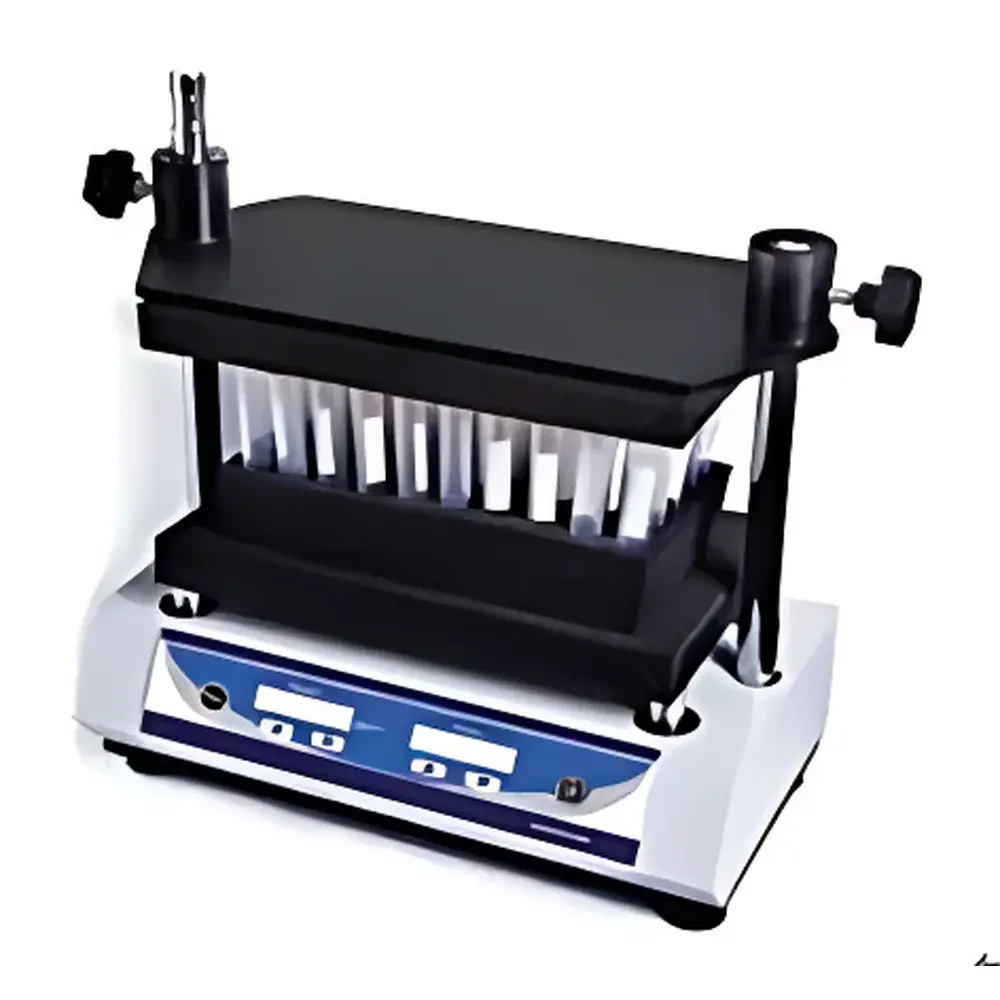
Hercuvan TT-2500-VM Multi-Tube Vortex Mixer
| Brand | Hercuvan |
|---|---|
| Origin | Malaysia |
| Model | TT-2500-VM |
| Speed Range | 500–2500 rpm |
| Timer Range | 1 s – 9999 min |
| Speed Accuracy | ±50 rpm (at 2500 rpm) |
| Vibration Mode | Reciprocating eccentric orbit |
| Amplitude | 4.5 mm |
| Drive Motor | Brushless DC motor |
| Display | LED digital display for speed and timer |
| Sample Capacity | Up to 50 tubes simultaneously |
| Housing Material | Anodized aluminum alloy |
| Operation Modes | Short-pulse mode & programmable timed mode |
| Power Supply | 100–240 VAC, 50/60 Hz |
| Dimensions (W×D×H) | 320 × 270 × 180 mm |
| Weight | 6.2 kg |
Overview
The Hercuvan TT-2500-VM Multi-Tube Vortex Mixer is an engineered solution for high-throughput sample homogenization in clinical diagnostics, pharmaceutical quality control, molecular biology, and environmental testing laboratories. Unlike single-tube vortexers, this instrument employs a precisely calibrated reciprocating eccentric orbital motion—generated by fixed upper tray anchoring and dynamically offset lower tray displacement—to induce uniform, reproducible vortexing across up to 50 standard microcentrifuge tubes (0.2–15 mL) in parallel. Its brushless DC motor ensures consistent torque delivery across the full 500–2500 rpm range, minimizing thermal drift and mechanical wear while eliminating electromagnetic interference common in brushed motors. Designed for continuous-duty operation under ISO 13485-aligned lab environments, the TT-2500-VM delivers stable rotational energy transfer without requiring manual tube repositioning or operator intervention during extended mixing cycles.
Key Features
- High-capacity parallel processing: Simultaneous vortexing of up to 50 tubes—including 0.2 mL PCR strips, 1.5 mL Eppendorf tubes, 5 mL snap-cap vials, and 15 mL conical tubes—via interchangeable adapter plates.
- Dual operational paradigms: Select between momentary pulse activation (short-mix mode) for rapid resuspension or fully programmable timing (1 second to 9999 minutes) with auto-shutdown and audible end-of-cycle alert.
- Microprocessor-based closed-loop control: Real-time feedback regulation maintains setpoint accuracy within ±50 rpm at maximum speed (2500 rpm), compensating for load variance and voltage fluctuations.
- Low-noise, maintenance-free drive system: Brushless DC motor with thermal protection circuitry operates below 52 dB(A) at 2500 rpm—compatible with open-bench placement in shared analytical suites.
- Robust anodized aluminum chassis: Corrosion-resistant housing provides structural rigidity for vibration isolation and long-term dimensional stability under daily use.
- Intuitive LED interface: Dual-line display shows real-time rpm and remaining time; backlight remains active during operation and dims after 30 seconds of inactivity to conserve power.
Sample Compatibility & Compliance
The TT-2500-VM supports standardized tube formats compliant with ANSI/SLAS microplate footprint specifications and ISO 8655 volumetric accuracy requirements. Adapter plates are certified for autoclaving (121°C, 20 min) and chemical resistance to 70% ethanol, 10% sodium hypochlorite, and common organic solvents. The device meets IEC 61010-1:2010 safety standards for laboratory electrical equipment and carries CE marking per EU Directive 2014/30/EU (EMC) and 2014/35/EU (LVD). It is validated for use in GLP-compliant workflows where traceable mixing parameters (speed, duration, date/time stamp) are required for audit readiness.
Software & Data Management
While the TT-2500-VM operates as a standalone instrument, its programmable timer and stable speed output enable integration into automated lab workflows via optional RS-232 or USB-to-serial interface (sold separately). When connected to LIMS or ELN platforms, mixing logs—including start time, duration, target rpm, and completion status—can be exported in CSV format for electronic record retention. All internal firmware adheres to ALCOA+ principles (Attributable, Legible, Contemporaneous, Original, Accurate, Complete, Consistent, Enduring, Available), supporting FDA 21 CFR Part 11 compliance when deployed with validated electronic signature protocols.
Applications
- Routine DNA/RNA extraction workflows requiring uniform lysis buffer dispersion across multi-well plate-derived samples.
- Pre-analytical preparation of blood serum, urine, or saliva specimens prior to HPLC, ELISA, or mass spectrometry analysis.
- Homogenization of bacterial cell suspensions for colony-forming unit (CFU) enumeration in microbiological quality assurance.
- Reconstitution of lyophilized reagents and calibration standards in reference material production labs.
- Accelerated dissolution testing of solid dosage forms in pharmaceutical development per USP .
FAQ
What tube sizes are supported without adapter modification?
Standard configuration accommodates 0.2–2.0 mL PCR tubes and 1.5 mL microcentrifuge tubes. Adapters for 5 mL, 10 mL, and 15 mL tubes are available as optional accessories.
Can the TT-2500-VM be used for viscous samples such as glycerol-based solutions or cell lysates?
Yes—its constant-torque brushless motor maintains speed stability across viscosity ranges up to 10,000 mPa·s when operated within the 500–1800 rpm band; optimal performance is achieved using low-amplitude settings (≤1500 rpm) for high-viscosity loads.
Is firmware upgrade capability built into the unit?
Yes—the embedded microcontroller supports field-upgradable firmware via UART interface using Hercules-provided utility software; version history and release notes are published on the official support portal.
Does the device include validation documentation for GMP environments?
A Factory Acceptance Test (FAT) report is supplied with each unit. IQ/OQ documentation templates aligned with ASTM E2500-13 are available upon request for qualified customers undergoing facility qualification.
What is the expected service life under continuous 8-hour/day operation?
Rated for ≥20,000 hours of cumulative runtime based on accelerated life testing of motor windings and bearing assemblies; mean time between failures (MTBF) exceeds 15,000 hours under typical lab ambient conditions (15–30°C, ≤70% RH).



