
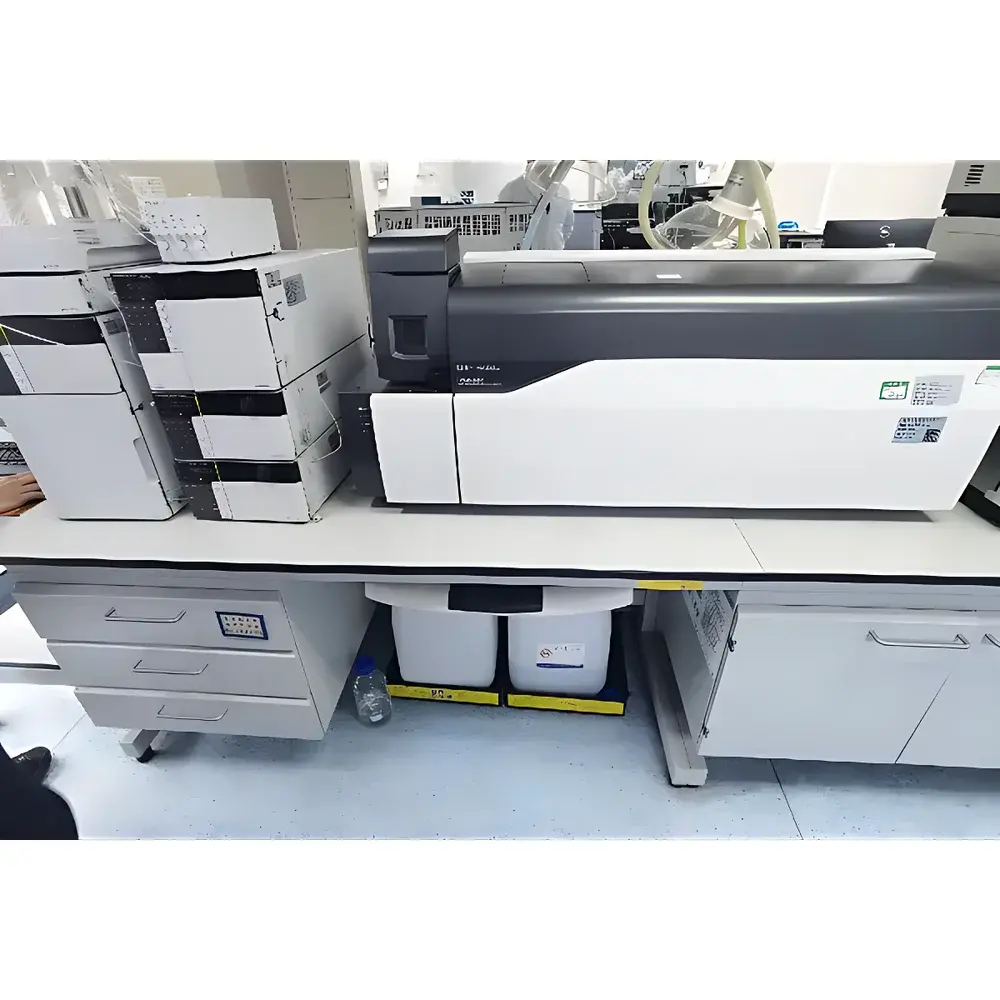
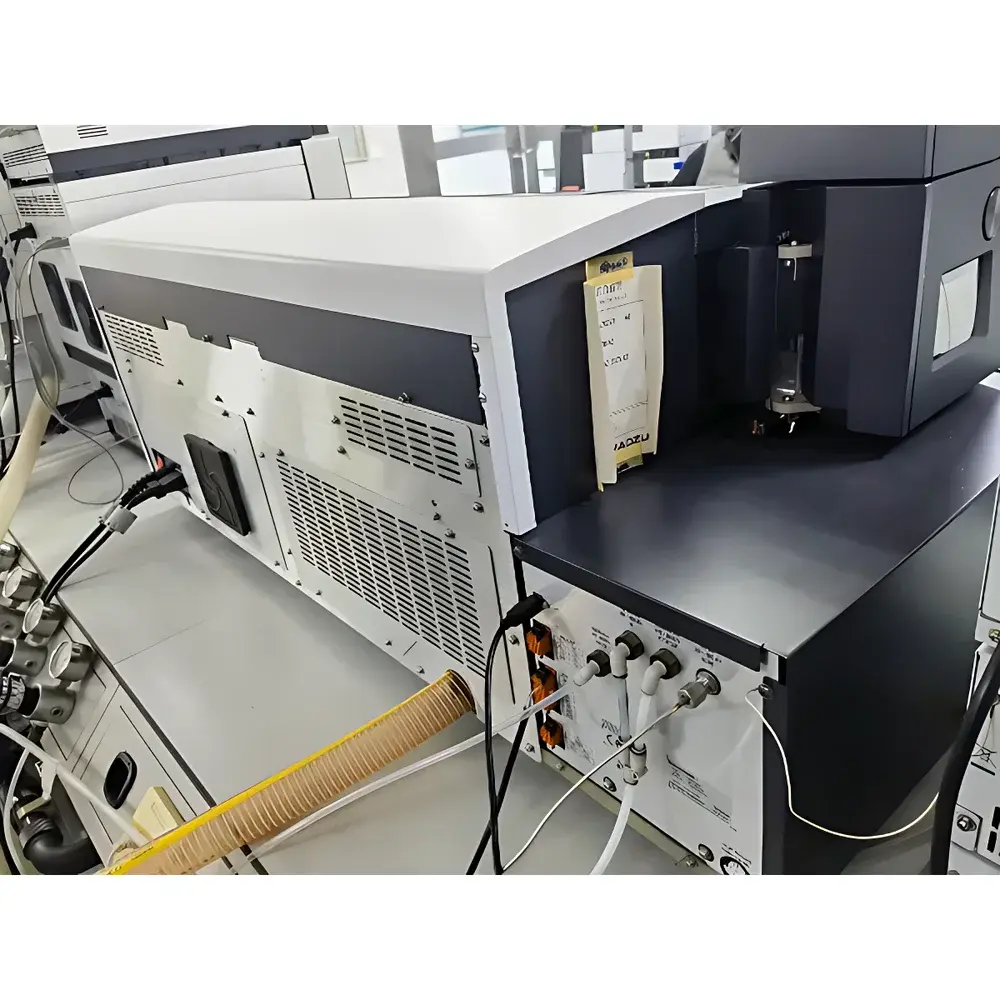
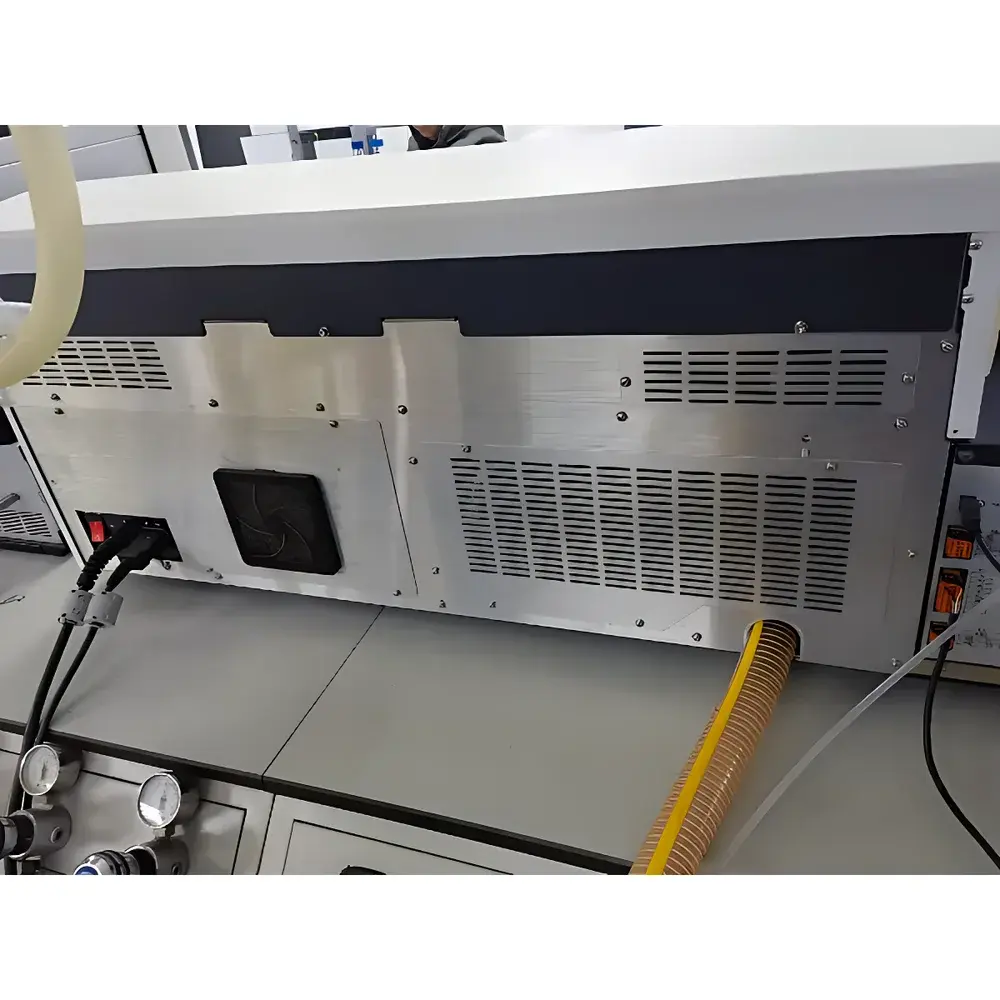
Shimadzu LCMS-8050 Triple Quadrupole Liquid Chromatography Mass Spectrometer
| Brand | Shimadzu |
|---|---|
| Origin | Japan |
| Instrument Type | Triple Quadrupole (TQ) |
| Mass Range | 10–2,000 m/z |
| Sensitivity | ≥100:1 S/N (for reserpine, ESI+, MRM) |
| Resolution | Full Width at Half Maximum (FWHM) ≤0.5 Da |
| Mass Accuracy | ≤0.1 Da (internal calibration) |
| Pressure Range | Up to 1200 bar (UHPLC-compatible) |
| Polarity Switching Time | ≤5 ms |
| Scan Speed | Up to 30,000 u/sec (UF Scanning) |
| MRM Transition Rate | Up to 555 transitions/sec |
| Ion Source | Heated Electrospray Ionization (H-ESI II) with Active Solvent Removal |
| Collision Cell | UFsweeper III RF-only octapole |
| Software | LabSolutions LCMS Version 5.60 (21 CFR Part 11 compliant audit trail, method validation support, GLP/GMP-ready reporting) |
Overview
The Shimadzu LCMS-8050 is a high-performance triple quadrupole liquid chromatography mass spectrometer engineered for demanding quantitative and qualitative analysis in regulated and research environments. Operating on the principle of tandem mass spectrometry (MS/MS), the instrument employs three quadrupole mass filters—Q1 (mass selection), Q2 (collision-induced dissociation cell), and Q3 (mass analysis)—to deliver exceptional selectivity, sensitivity, and reproducibility in multiple reaction monitoring (MRM) and product ion scanning modes. Designed specifically for ultra-high-performance liquid chromatography (UHPLC) coupling, the LCMS-8050 supports gradient elution with sub-2-µm particle columns and flow rates up to 2 mL/min, enabling rapid separation of complex matrices without compromising detection limits. Its architecture integrates hardware-level optimizations—including a thermally stabilized electrospray ion source (H-ESI II), an optimized collision cell (UFsweeper III), and real-time polarity switching—to ensure robust performance across diverse sample types, from biological fluids to environmental water extracts.
Key Features
- Ultra-Fast Scanning (UF Scanning): Achieves scan speeds up to 30,000 u/sec while maintaining full-spectrum fidelity and stable peak shape—even during high-speed MRM acquisition.
- Sub-5 Millisecond Polarity Switching (UF Switching): Enables simultaneous positive- and negative-ion mode quantitation within a single run, critical for multi-analyte assays where ionization efficiency varies significantly by compound class.
- High-Speed MRM Acquisition: Supports up to 555 transitions per second, allowing comprehensive multi-residue screening (e.g., 29 pesticides in drinking water) without sacrificing dwell time or signal-to-noise ratio.
- Enhanced Ion Transmission & Stability: The H-ESI II source incorporates active solvent removal and precise temperature control across three independently regulated heating zones, improving desolvation efficiency and reducing matrix suppression effects.
- Durability & Reproducibility: Demonstrated stability over 1,000 consecutive injections of protein-precipitated plasma (e.g., alprazolam), yielding ≤4.59% RSD for peak area—meeting stringent ICH Q2(R2) repeatability requirements for bioanalytical methods.
- Integrated Hardware-Software Optimization: LabSolutions LCMS v5.60 automatically manages gas flows, heater temperatures, and voltage parameters; supports batch file generation with embedded method variants and scheduled blank injections for system suitability monitoring.
Sample Compatibility & Compliance
The LCMS-8050 accommodates a broad range of sample matrices including plasma, serum, urine, tissue homogenates, food extracts, soil leachates, and aqueous environmental samples—with minimal or no pre-concentration required for trace-level analytes (e.g., ng/L pesticide residues). It complies with international regulatory frameworks governing analytical instrumentation: data integrity features include 21 CFR Part 11-compliant electronic signatures, immutable audit trails, user-access controls, and method versioning. The platform supports validation workflows aligned with ISO/IEC 17025, USP , and FDA Bioanalytical Method Validation Guidance. Routine operation meets GLP and GMP documentation standards for contract research organizations (CROs), pharmaceutical QC labs, and environmental testing facilities.
Software & Data Management
LabSolutions LCMS Version 5.60 provides a unified interface for instrument control, data acquisition, processing, and reporting. Its method editor allows parameter optimization across multiple dimensions—retention time windows, collision energies, declustering potentials, and dwell times—with automated interpolation for intermediate values. Quantitative workflows include internal standard correction, calibration curve fitting (linear/non-linear with weighting), and outlier detection based on residual analysis. All raw and processed data are stored in vendor-neutral .lcd format, compatible with third-party software for secondary review or statistical modeling. Audit logs record every user action—including parameter changes, reprocessing events, and report exports—with timestamps and operator IDs. Backup and archive functions support long-term data retention per ALCOA+ principles.
Applications
- Clinical Toxicology: Simultaneous quantification and identification of 12 drugs and toxins in a single 1-minute UHPLC-LCMS-8050 run, supporting emergency department triage and forensic casework.
- Pharmaceutical Development: CYP450 inhibition profiling via rapid polarity-switched MRM, capturing both substrate and metabolite signals across enzyme isoforms with <5 ms switching latency.
- Environmental Monitoring: Multi-residue analysis of 29 pesticides in drinking water at sub-ng/L levels—without solid-phase extraction—demonstrating compliance with EU Directive 2020/2184 and EPA Method 1694.
- Food Safety: Detection of veterinary drug residues (e.g., sulfonamides, macrolides, β-agonists) in meat and dairy products using isotope-dilution MRM with <0.5 Da resolution and ≤0.1 Da mass accuracy.
- Metabolomics & Biomarker Discovery: Targeted quantitation of polar and non-polar endogenous metabolites across broad chemical space, leveraging dual-polarity acquisition and dynamic MRM scheduling.
FAQ
What is the maximum number of MRM transitions that can be acquired per second?
Up to 555 transitions per second, with dwell times dynamically allocated to maintain optimal signal-to-noise across all channels.
Does the LCMS-8050 support internal mass calibration during analysis?
Yes—real-time lock-mass correction is available using a dedicated reference channel, ensuring ≤0.1 Da mass accuracy throughout extended runs.
Can the instrument perform both quantitative and qualitative analysis in one injection?
Yes—simultaneous MRM quantitation and enhanced product ion (EPI) scanning enable confident compound identification and precise concentration measurement within a single chromatographic run.
Is LabSolutions LCMS v5.60 validated for use in regulated laboratories?
Yes—the software includes built-in validation packages, IQ/OQ documentation templates, and full 21 CFR Part 11 compliance for electronic records and signatures.
What UHPLC pressure rating is supported by the LCMS-8050 interface?
The system is rated for continuous operation at pressures up to 1200 bar, fully compatible with modern sub-2-µm particle columns and ultra-fast gradients.





