
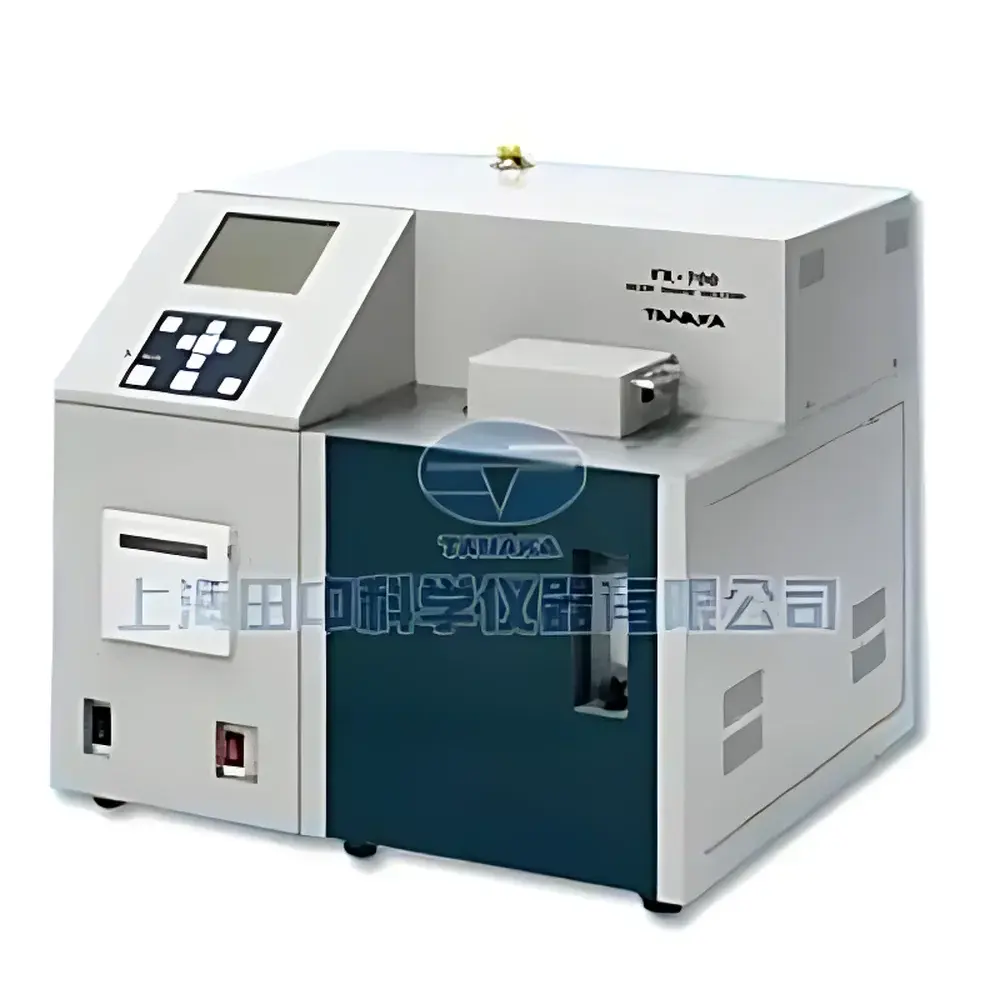
Tanaka FX-700 Wavelength Dispersive X-ray Fluorescence (WDXRF) Sulfur Analyzer
| Brand | Tanaka |
|---|---|
| Origin | Japan |
| Model | FX-700 |
| Measurement Principle | Wavelength Dispersive X-ray Fluorescence (WDXRF) |
| Compliance Standards | JIS K 2541-1, ISO 20884, ASTM D2622 |
| Detection Limit | 1.5 ppm |
| Measurement Range | 0–990 ppm |
| Sample Volume | ~5 mL |
| Power Requirement | AC 220 V, 50/60 Hz, 3 A (300 VA) |
| Ambient Conditions | 10–30 °C, ≤75 % RH |
| X-ray Source | Air-cooled micro-focus X-ray tube (22 kV, 1.8 mA) |
| Analyzing Crystal | Germanium (Ge) |
| Detector | Sealed proportional counter |
| Purge Gas | Helium (>99.9% purity, 100 mL per analysis) |
| Sample Form | Liquid petroleum fuels (diesel, kerosene, gasoline) |
| Sample Holder | Disposable paper cup (no polyester film required) |
| Dimensions (W×D×H) | 600 × 500 × 520 mm |
| Weight | 66 kg |
| Repeatability (300 s integration) | ≤1.5 ppm SD at 0 ppm |
Overview
The Tanaka FX-700 is a dedicated wavelength dispersive X-ray fluorescence (WDXRF) analyzer engineered for trace-level sulfur quantification in light petroleum fractions—specifically diesel, kerosene, and gasoline—where regulatory compliance demands sub-10 ppm measurement capability. Unlike energy-dispersive (EDXRF) systems, the FX-700 employs high-resolution WDXRF optics with a germanium (Ge) analyzing crystal to achieve superior spectral separation of the sulfur Kα line (2.308 keV) from interfering matrix emissions (e.g., Cl, Ca, Fe), minimizing background noise and enhancing detection sensitivity. Its design adheres strictly to internationally recognized test methods—including JIS K 2541-1 (petroleum products), ISO 20884 (automotive fuels), and ASTM D2622 (standard test method for sulfur in petroleum products by WDXRF)—ensuring method-equivalent data for regulatory reporting, refinery process control, and quality assurance laboratories operating under ISO/IEC 17025 or API RP 950 frameworks.
Key Features
- Optimized WDXRF architecture with air-cooled micro-focus X-ray tube (22 kV, 1.8 mA), delivering stable excitation without water cooling or high-power infrastructure.
- Germanium (Ge) single-crystal monochromator enabling high peak-to-background ratio and resolving power essential for low-Z element analysis in hydrocarbon matrices.
- Sealed proportional counter detector with helium-purge gas path (≥99.9% purity, 100 mL per analysis), eliminating moisture absorption and ensuring long-term detector stability.
- Disposable paper sample cups eliminate film-handling steps, reduce contamination risk, and support rapid sample turnover—critical for high-throughput refinery QC labs.
- Compact benchtop footprint (600 × 500 × 520 mm) and modest power draw (300 VA, 220 V AC) enable deployment in constrained lab spaces without dedicated HVAC or grounding upgrades beyond standard D-type Class III earth (<100 Ω).
- Calibration flexibility: supports up to eight calibration curves (linear or quadratic), facilitating multi-range quantification across ultra-low (0–10 ppm), low (10–100 ppm), and mid-range (100–990 ppm) sulfur concentrations.
Sample Compatibility & Compliance
The FX-700 is validated exclusively for liquid hydrocarbon samples with low viscosity and minimal heteroatom interference—primarily automotive diesel (EN 590, ASTM D975), jet fuel (ASTM D1655), kerosene (JIS K 2203), and reformulated gasoline (ASTM D4814). Samples must be homogeneous, free of particulates, and introduced via 5 mL aliquots into standardized paper cups. The instrument complies with radiation safety requirements per IEC 61010-1 and meets electromagnetic compatibility (EMC) standards EN 61326-1. Its analytical output satisfies reporting criteria under EPA 40 CFR Part 80 (fuel sulfur standards), EU Directive 2009/30/EC, and China GB 17930–2016, provided calibration is traceable to NIST SRM 2721 or equivalent certified reference materials (CRMs).
Software & Data Management
The embedded firmware supports audit-ready operation under GLP/GMP environments. All analyses record full metadata—including operator ID, timestamp, sample ID, integration time, tube current/voltage, helium flow status, and raw spectrum file—stored locally with optional export to CSV or XML. Calibration parameters and curve coefficients are digitally signed and version-controlled. While the system does not include FDA 21 CFR Part 11-compliant electronic signature modules as standard, its data structure aligns with LIMS integration protocols (e.g., ASTM E1578, ANSI/NIST ITL 1-2022), enabling secure transfer to enterprise QA/QC platforms. Firmware updates are performed via USB interface with checksum verification.
Applications
- Refinery hydrotreater effluent monitoring to verify desulfurization efficiency against <10 ppm targets.
- Batch release testing of finished gasoline and diesel prior to distribution, per ASTM D7039 or ISO 20884 protocols.
- Investigation of sulfur breakthrough in adsorbent beds or catalyst deactivation studies.
- Verification of blending accuracy when introducing ultra-low-sulfur components into pool streams.
- Supporting R&D of next-generation fuel formulations where sulfur speciation (e.g., thiophenes vs. mercaptans) is inferred indirectly via total-S trends under controlled oxidation pretreatment.
FAQ
What sample preparation is required prior to analysis?
No derivatization, digestion, or solvent extraction is needed. Homogenized liquid samples are directly pipetted (~5 mL) into disposable paper cups. No polyester film covering is required.
Is helium gas mandatory—and what grade is specified?
Yes. High-purity helium (>99.9%) is required to maintain detector efficiency and prevent X-ray absorption by atmospheric nitrogen/oxygen. Each analysis consumes approximately 100 mL of helium.
Can the FX-700 analyze viscous or heavy fuels such as bunker oil or residual fuel?
No. The FX-700 is designed exclusively for light distillates with kinematic viscosity below 8 mm²/s at 40 °C. Heavy fuel oils require alternative techniques (e.g., combustion UV fluorescence per ASTM D5453).
How is calibration verified during routine operation?
Daily verification uses a check standard (e.g., 5 ppm S in toluene) analyzed before sample batches. Drift correction is applied if deviation exceeds ±10% of certified value; otherwise, recalibration with primary CRMs is scheduled weekly or after maintenance.
Does the instrument provide elemental speciation (e.g., organic vs. inorganic sulfur)?
No. The FX-700 reports total sulfur concentration only. Speciation requires complementary techniques such as GC-SCD or XANES spectroscopy.




