
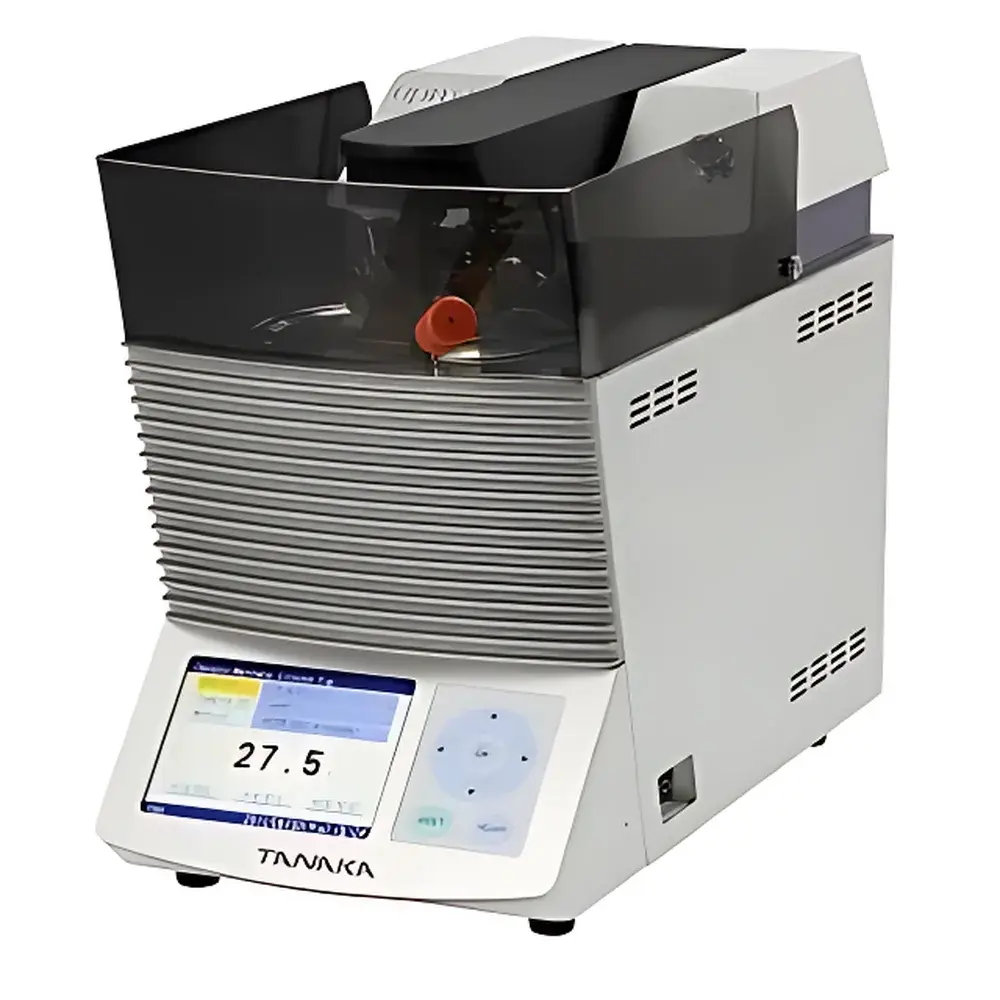
Tanaka APM-8 Pensky-Martens Closed Cup Flash Point Tester
| Brand | Tanaka |
|---|---|
| Origin | Japan |
| Model | APM-8 |
| Standards Compliance | ASTM D93, ISO 2719, GB/T 261 |
| Temperature Range | Ambient to 370 °C |
| Heating Method | Band Heater |
| Cooling | Forced Air |
| Stirring Speed | 100 / 250 rpm (selectable) |
| Temperature Sensor | PT-100 with Stainless Steel Sheath |
| Flash Detection | CRC-type Detector |
| Ignition Sources | Dual Gas (LPG/Natural Gas ≤10 kPa) and Electric (EI-8 Igniter) |
| Atmospheric Pressure Compensation | Integrated Pressure Sensor |
| Display | 5.7″ Color LCD |
| Data Storage | 200 Test Records |
| Interfaces | RS-232C × 1, USB × 1 |
| Power Supply | 220–240 VAC, 50/60 Hz |
| Max Power Consumption | 720 W |
| Energy per Test | ~170 Wh |
| Dimensions | 230 × 470 × 390 mm (W×D×H) |
| Weight | 17 kg |
| Safety Interlocks | Overtemperature (>370 °C or >20 °C above preset FP), Sensor Faults, Fuse Open, Arm Position Error, Stirrer Stall, Microcontroller Failure, Low Backup Battery |
Overview
The Tanaka APM-8 Pensky-Martens Closed Cup Flash Point Tester is a microprocessor-controlled analytical instrument engineered for precise, repeatable flash point determination of petroleum products, solvents, biodiesel blends, and other flammable liquids in accordance with internationally recognized standard test methods — specifically ASTM D93 (Method A and B), ISO 2719, and GB/T 261. It operates on the fundamental principle of closed-cup equilibrium flash point measurement: a defined volume of sample is heated at a controlled rate inside a sealed test cup; at predetermined temperature intervals, a standardized ignition source is introduced across the vapor space. The lowest temperature at which a momentary flash occurs — indicating sufficient vapor concentration to support transient combustion — is recorded as the flash point. This thermally constrained, draft-protected methodology ensures high reproducibility and regulatory acceptability for quality control, safety classification (e.g., UN GHS Category 1–4), and specification conformance in refining, distribution, and regulatory laboratories.
Key Features
- Integrated Swing-Arm Detection Assembly: The flash detector ring and PT-100 temperature sensor are rigidly mounted on a single pivoting arm, enabling simultaneous, geometrically consistent positioning over the test cup — eliminating manual alignment errors and reducing setup time.
- Dual Ignition System: Factory-equipped with both gas (LPG or natural gas, ≤10 kPa supply pressure) and electric (EI-8 ceramic igniter) sources. Switching between modes requires no tools and takes under two minutes, supporting method flexibility and operational continuity during gas supply interruptions.
- FMA-Compliant Draft Protection Shield: The windscreen meets FM4910 requirements for flame propagation resistance (FPI ≤6) and smoke generation (SDI ≤0.4), ensuring stable ignition conditions and minimizing environmental interference without compromising accessibility.
- Automated Atmospheric Correction: An integrated absolute pressure sensor continuously monitors ambient barometric pressure and applies real-time compensation to flash point results per ASTM D93 Annex A1 and ISO 2719 Clause 8.2 — critical for labs operating at non-sea-level elevations.
- Intelligent Safety Architecture: Twelve independent hardware and firmware interlocks monitor system integrity — including thermal runaway (>370 °C or >20 °C above user-input expected FP), stirrer motor stall, detector arm mispositioning, thermofuse open-circuit, backup battery depletion, and microcontroller watchdog timeout. All faults trigger audible alarm, display alert, and immediate thermal shutdown.
- Lightweight All-in-One Design: At 17 kg and 230 × 470 × 390 mm, the APM-8 represents a 30% mass reduction versus its predecessor (APM-7), achieving the smallest volumetric footprint in its class while maintaining structural rigidity and thermal stability.
Sample Compatibility & Compliance
The APM-8 is validated for use with transparent and opaque petroleum distillates (e.g., diesel, kerosene, jet fuel), lubricating oils, residual fuels, biofuels (B5–B20), and industrial solvents meeting viscosity limits specified in ASTM D93 (typically <50 mm²/s at 40 °C). It is not intended for highly volatile, low-boiling materials (e.g., gasoline, acetone) requiring Tag or Abel-Pensky open-cup methods. Regulatory compliance extends beyond method adherence: the instrument’s password-protected parameter configuration supports GLP and GMP environments by preventing unauthorized test condition modification. Audit trails are maintained via timestamped data storage (200 records), and optional RS-232 or USB export enables traceable integration into LIMS platforms compliant with FDA 21 CFR Part 11 requirements when paired with appropriate electronic signature protocols.
Software & Data Management
No external PC software is required for operation; all test execution, calculation, and display occur onboard. The embedded firmware implements full method logic per ASTM D93 Section 7 (Standard Mode) and Section 8 (Special Mode for viscous samples), including ramp rate control (5–6 °C/min), ignition frequency (every 1 °C or 2 °C), and final verification steps. Test results include flash point (°C), atmospheric pressure (kPa), test mode, date/time stamp, and operator ID (if entered via optional USB keyboard). Data export options include direct printing via optional BS2-80TS thermal printer, ASCII-formatted CSV transfer to USB memory stick, or serial transmission to LIMS via RS-232. Firmware updates are performed via USB using signed binary files provided by Tanaka Technical Support — ensuring version control and integrity verification.
Applications
- Quality assurance testing of finished petroleum products prior to shipment (ASTM D93 Pass/Fail verification)
- Batch release testing in refinery QC labs under ISO/IEC 17025-accredited procedures
- Safety data sheet (SDS) compilation per GHS criteria for hazard classification
- Regulatory submission testing for EPA, DOT, and customs authorities requiring ISO 2719-compliant data
- R&D evaluation of additive effects on flash point stability in lubricant formulations
- Third-party certification testing for fuel distributors and blending facilities
FAQ
What standards does the APM-8 fully comply with?
The APM-8 is designed and verified to meet the procedural, hardware, and performance requirements of ASTM D93 (Methods A and B), ISO 2719:2016, and GB/T 261–2021.
Can the APM-8 be used for gasoline or ethanol blends?
No — gasoline, ethanol, and other highly volatile liquids with initial boiling points below 40 °C require open-cup methods (e.g., ASTM D56 or D3828) and are outside the validated scope of the Pensky-Martens closed-cup design.
Is calibration traceable to national standards?
Yes — Tanaka provides NIST-traceable calibration certificates for the PT-100 sensor and certified reference materials (CRM) for flash point validation upon request; annual recalibration is recommended per ISO/IEC 17025 clause 6.5.
How is data integrity ensured during export to LIMS?
RS-232 and USB exports transmit unaltered ASCII records containing raw sensor values, calculated flash point, and metadata; no post-processing occurs in the instrument firmware — preserving audit-ready provenance.
What maintenance is required for routine operation?
Daily cleaning of the test cup and ignition tip with solvent; quarterly verification of stirrer speed accuracy and annual replacement of thermofuse (APM-02-001) and EI-8 igniter (ABL-01-003) per usage logs — documented in the included maintenance log sheet.





