
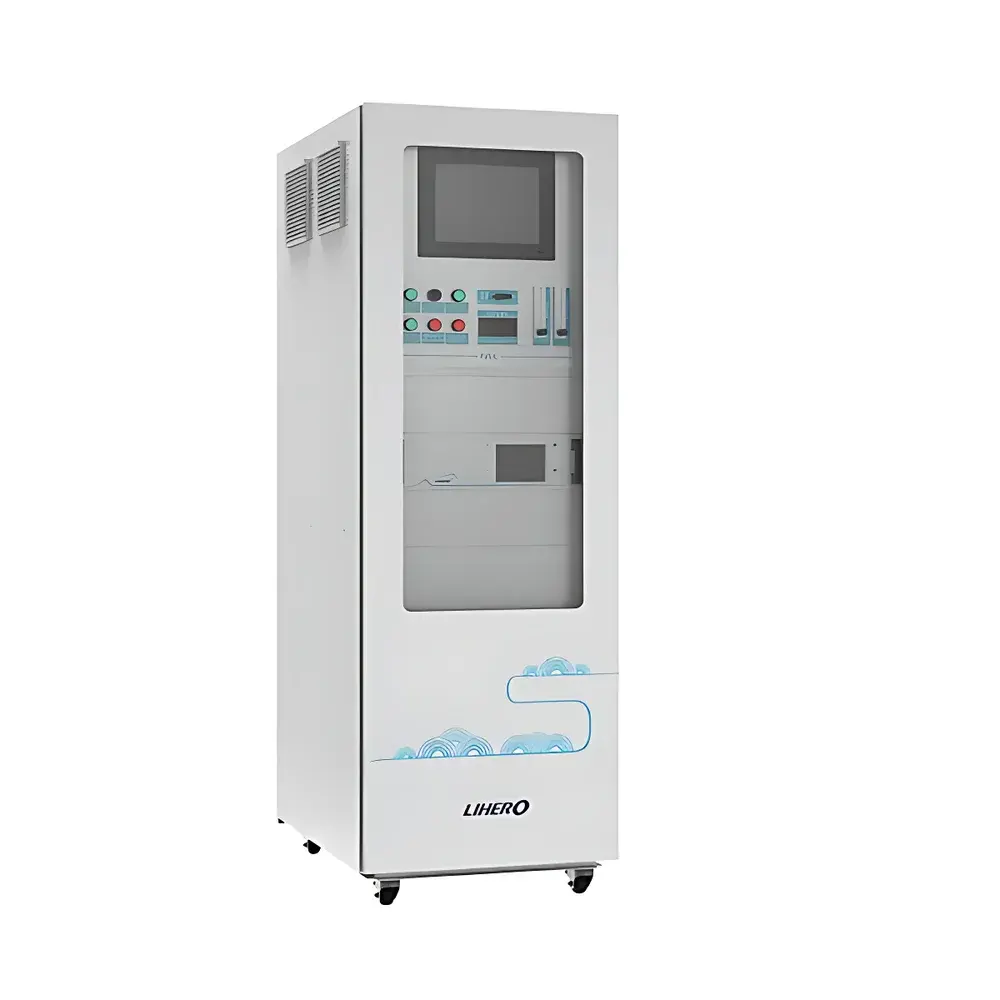
Lihero Fixed Pollution Source CEMS Online Monitoring System
| Brand | Lihero |
|---|---|
| Origin | Hunan, China |
| Manufacturer Type | Authorized Distributor |
| Product Origin | Domestic (China) |
| Model | Fixed Pollution Source CEMS Online Monitoring System |
| Pricing | Available Upon Request |
Overview
The Lihero Fixed Pollution Source CEMS Online Monitoring System is an integrated continuous emission monitoring solution engineered for regulatory compliance and long-term operational stability in industrial stack and duct applications. It employs standardized physical and electrochemical measurement principles—including laser scattering for particulate matter (PM), non-dispersive infrared (NDIR) or ultraviolet differential optical absorption spectroscopy (UV-DOAS) for gaseous pollutants (SO₂, NOₓ, CO, VOCs), and paramagnetic or zirconia-based O₂ sensing—to deliver real-time, traceable concentration data aligned with China’s HJ 75–2017 and HJ 76–2017 technical specifications for CEMS performance verification and quality assurance.
Key Features
- Automated, unattended operation with 24/7 continuous sampling, analysis, and data logging—designed for ≥90% system uptime under ISO 5800:2021 environmental monitoring service benchmarks.
- Modular architecture supporting scalable parameter configuration: base system covers PM₁₀/PM₂.₅, SO₂, NOₓ, CO, O₂, and flue gas temperature/pressure/flow; optional add-ons include NH₃, HCl, HF, and total hydrocarbon (THC) analyzers.
- Integrated quality control (QC) framework compliant with HJ 75–2017 Section 7.3: automatic zero/span calibration every 24 hours, standard gas injection for multi-point drift verification, and real-time diagnostic logging of critical subsystems (sample probe, heated line, conditioning unit, analyzer optics).
- Robust mechanical design for harsh stack environments: IP65-rated enclosure, 120°C high-temperature sampling probe, corrosion-resistant stainless-steel wetted parts, and anti-condensation heated sample transport lines (maintained at ≥180°C).
- Redundant data transmission pathways: dual-channel Ethernet + 4G LTE fallback, with local SD card backup (≥30 days of raw second-level data) and encrypted TLS 1.2 communication to provincial environmental monitoring platforms (e.g., China’s National Emission Permit Management Information Platform).
Sample Compatibility & Compliance
The system is validated for use across coal-fired power plants, cement kilns, steel sintering facilities, waste incinerators, and chemical manufacturing stacks. All measurement modules undergo factory calibration against NIST-traceable reference standards and are subject to quarterly on-site performance audits per HJ 75–2017 Annex B. Data integrity meets GLP-aligned audit trail requirements: full timestamped logs of calibration events, maintenance interventions, fault codes, and user access records are retained for ≥18 months. The system supports electronic signatures and role-based access control to align with internal QA/QC policies and regional environmental enforcement mandates.
Software & Data Management
Embedded firmware runs on a Linux-based real-time OS with deterministic I/O scheduling. The web-accessible CEMS Manager software (v4.2+) provides browser-based configuration, remote diagnostics, and automated report generation—including hourly/daily/monthly summary reports formatted per MEP Order No. 20 (2020) and HJ 212–2017 data transmission protocols. All raw analog and digital sensor outputs are archived in CSV and SQLite formats with SHA-256 checksum validation. Audit logs are exportable in XML for third-party verification and support FDA 21 CFR Part 11–compatible electronic record retention when deployed in pharmaceutical or fine chemical production settings.
Applications
- Real-time compliance monitoring for national and provincial emission permit reporting (e.g., SO₂ annual cap tracking, NOₓ hourly average limits).
- Process optimization support via correlation analysis between flue gas composition and boiler/furnace operating parameters (excess air ratio, combustion temperature).
- Early fault detection in pollution control devices (e.g., sudden O₂ rise indicating baghouse leakage; NOₓ spike signaling SCR catalyst deactivation).
- Support for carbon accounting initiatives through synchronized CO₂ concentration and volumetric flow rate integration—enabling mass emission rate calculation per ISO 14064-3 guidance.
- Integration with enterprise-level EMS (Environmental Management Systems) and DCS/SCADA platforms via Modbus TCP and OPC UA interfaces.
FAQ
Does the system meet China’s mandatory CEMS certification requirements (HJ 75/HJ 76)?
Yes—the entire system has passed third-party type approval testing by CNAS-accredited laboratories and is listed in the Ministry of Ecology and Environment’s CEMS Equipment Catalog (2023 Edition).
Can historical data be retrieved if network connectivity is interrupted?
Yes—local edge storage retains full-resolution data (1-second intervals) for up to 30 days. Upon reconnection, all buffered data is automatically synchronized with time-stamped integrity verification.
Is remote software update supported?
Yes—firmware and application updates are delivered via signed OTA packages with rollback capability and pre-update compatibility checks.
What maintenance intervals are recommended for field components?
Probe cleaning: quarterly; filter replacement: monthly; calibration gas cylinder: every 3–6 months depending on usage frequency and ambient conditions.
Is English-language interface and documentation available?
Yes—full bilingual (Chinese/English) user manuals, calibration SOPs, and cybersecurity configuration guides are provided with each system shipment.
Related Products







