
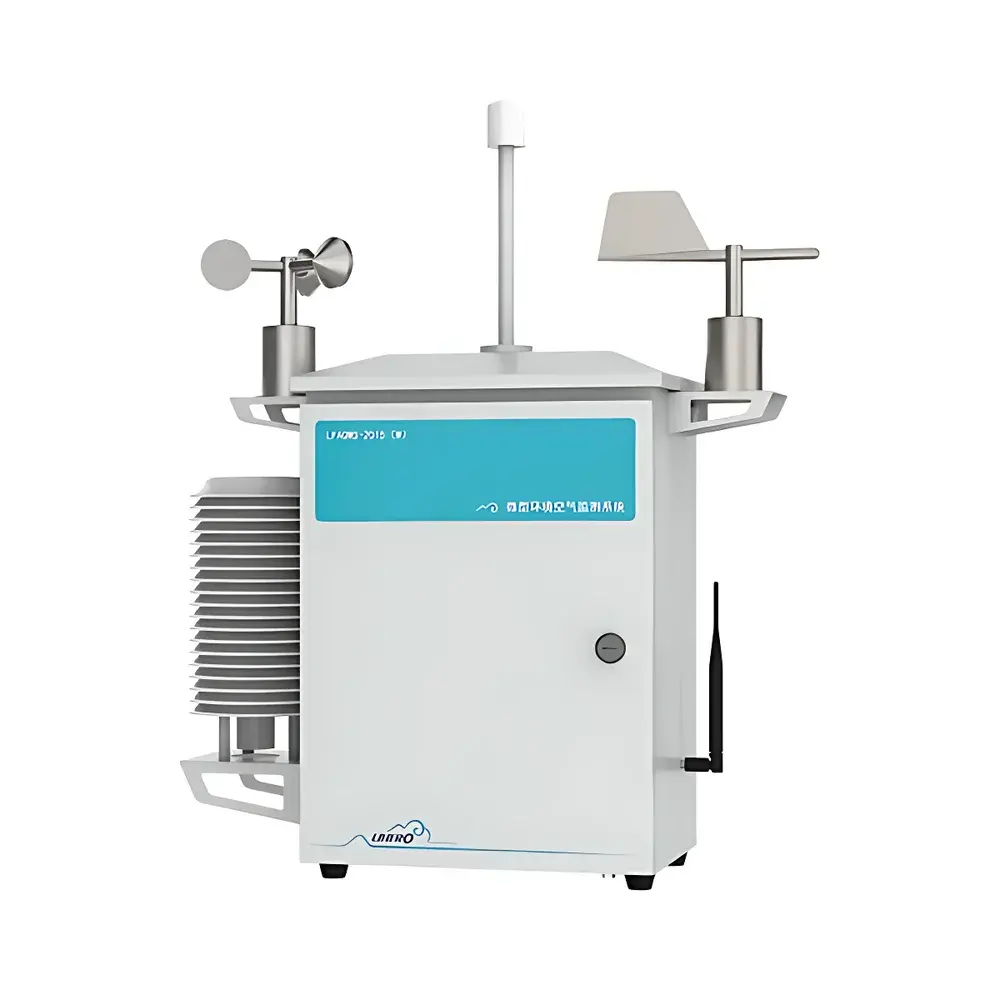
Lihero LFAQMS-2015(M) Miniature Environmental Air Monitoring System
| Brand | Lihero |
|---|---|
| Origin | Hunan, China |
| Manufacturer Type | Authorized Distributor |
| Country of Manufacture | China |
| Model | LFAQMS-2015(M) |
| Pricing | Available Upon Request |
| Measurement Parameters | PM₂.₅, PM₁₀, TVOC, CO, NOₓ, SO₂, O₃, H₂S, HCl, Meteorological Five-Parameter (Wind Speed, Wind Direction, Temperature, Humidity, Atmospheric Pressure) |
| Expandable Capabilities | Noise, Radiation |
| Data Transmission | Ethernet / 4G LTE |
| Power Supply | 220 VAC ±10%, with Lightning Protection & Leakage Current Protection |
| Calibration | Automatic Zero Calibration |
Overview
The Lihero LFAQMS-2015(M) Miniature Environmental Air Monitoring System is a compact, integrated ambient air quality monitoring terminal engineered for continuous, real-time measurement of regulated and emerging atmospheric pollutants in urban, industrial, roadside, and community-level environments. Built upon a modular architecture, the system implements standardized electrochemical (EC), metal oxide semiconductor (MOS), and laser scattering detection principles—compliant with ISO 12103-1 for particulate mass concentration determination and aligned with EPA Reference and Equivalent Methods where applicable. Unlike large-scale reference-grade stations, the LFAQMS-2015(M) delivers field-deployable performance without sacrificing metrological traceability, making it suitable for high-density sensor network deployment, regulatory gap-filling, and localized exposure assessment studies.
Key Features
- Modular, space-efficient design (W × D × H ≤ 600 × 450 × 850 mm) enables rapid installation on utility poles, building façades, or mobile platforms.
- Simultaneous real-time acquisition of core air quality parameters: PM₂.₅ and PM₁₀ via 90° light-scattering nephelometry; CO, NOₓ, SO₂, O₃, H₂S, and HCl via certified electrochemical sensors; TVOC via calibrated MOS array.
- Integrated meteorological suite measures wind speed (0–60 m/s, ±0.3 m/s), wind direction (0–360°, ±3°), ambient temperature (−30 to +60°C, ±0.5°C), relative humidity (0–100% RH, ±3% RH), and barometric pressure (300–1100 hPa, ±0.5 hPa).
- Dual operational modes: fully autonomous scheduled measurement (configurable time constants from 1 min to 1 hr) and manual trigger mode for on-demand sampling.
- Onboard data logging with ≥32 GB internal storage supports >12 months of second-level resolution data retention at default 5-minute averaging intervals.
- Multi-layer alarm logic: threshold-based pollutant exceedance alerts (user-definable per parameter), hardware fault diagnostics (sensor drift, power anomaly, communication timeout), and event-triggered notifications via SMS/email/API webhook.
- Robust electrical safety architecture includes Class II insulation, 20 kA lightning surge protection (IEC 61643-11 compliant), and residual-current circuit breaker (RCCB) rated at 30 mA trip current.
- Standard digital I/O interface (RS-485, 4–20 mA analog outputs, dry contact relays) and bidirectional remote command support (Modbus TCP/RTU, HTTP RESTful API) enable seamless integration into SCADA, EMS, or municipal IoT platforms.
- Automatic zero-point calibration routine executed daily using built-in clean-air purge mechanism—no consumables or manual intervention required.
Sample Compatibility & Compliance
The LFAQMS-2015(M) is validated for ambient air sampling under ISO 14644-1 Class 8 cleanroom-equivalent inlet conditions and conforms to EN 14625:2012 for open-path gaseous pollutant analyzers. Sensor modules are factory-calibrated against NIST-traceable gas standards (e.g., CO in N₂, O₃ in synthetic air) and particulate reference aerosols (Arizona Test Dust, A2). While not designated as a Federal Reference Method (FRM) or Federal Equivalent Method (FEM) device per U.S. EPA 40 CFR Part 53, its data output meets QA/QC requirements for supplementary monitoring networks under EPA’s AirNow-Tech framework and aligns with EU Directive 2008/50/EC Annex VI technical specifications for indicative measurements. All firmware and data handling routines support audit-ready metadata tagging (timestamp, GPS coordinates, sensor status flags) required for GLP-compliant environmental reporting.
Software & Data Management
Data acquisition and visualization are managed through Lihero’s cloud-native AirSight™ Platform—a secure, role-based web application accessible via TLS 1.2+ browsers. Raw sensor outputs undergo on-device signal conditioning (baseline subtraction, temperature/humidity compensation, outlier filtering per ASTM D6245), then transmit via encrypted MQTT or HTTPS to AES-256-encrypted cloud storage. The platform provides configurable dashboards, automated compliance report generation (daily/weekly/monthly summaries per local regulatory templates), and CSV/NetCDF export for third-party statistical analysis (R, Python, MATLAB). Audit trails—including user login history, configuration changes, and calibration logs—are retained for ≥18 months and comply with FDA 21 CFR Part 11 electronic record requirements when enabled with digital signature modules.
Applications
- Urban air quality mapping and hotspot identification in smart city infrastructure projects.
- Industrial fence-line monitoring for fugitive emissions tracking near petrochemical, pharmaceutical, and waste treatment facilities.
- Indoor-outdoor air exchange studies in schools, hospitals, and public transit hubs.
- Short-term campaign monitoring during construction, demolition, or agricultural burning events.
- Baseline ambient monitoring for EIA (Environmental Impact Assessment) and post-remediation verification.
- Academic research on spatial-temporal pollutant dispersion modeling and source apportionment.
FAQ
Is the LFAQMS-2015(M) certified as an EPA Federal Equivalent Method (FEM) device?
No—it is designed for indicative monitoring and supplementary data collection, not regulatory compliance measurement. Users requiring FEM-grade validation should deploy reference analyzers alongside this system for co-location correlation studies.
What maintenance intervals are recommended for long-term operation?
Sensor modules require annual recalibration against traceable standards; particulate inlets need bi-weekly cleaning in high-dust environments; firmware updates are released quarterly and applied remotely.
Can the system operate reliably in extreme temperatures or high-humidity conditions?
Yes—the enclosure meets IP55 ingress protection rating, and internal thermal management maintains sensor operating range between −25°C and +55°C ambient, with humidity tolerance up to 95% RH non-condensing.
Does the system support integration with existing municipal air quality dashboards?
Yes—via standard protocols including Modbus TCP, HTTP REST API, and CSV over SFTP; custom middleware development support is available through Lihero’s OEM integration services.
How is data integrity ensured during network outages?
All measurements are buffered locally on industrial-grade microSD card with wear-leveling; data sync resumes automatically upon connection restoration, with no loss of timestamped records.







