
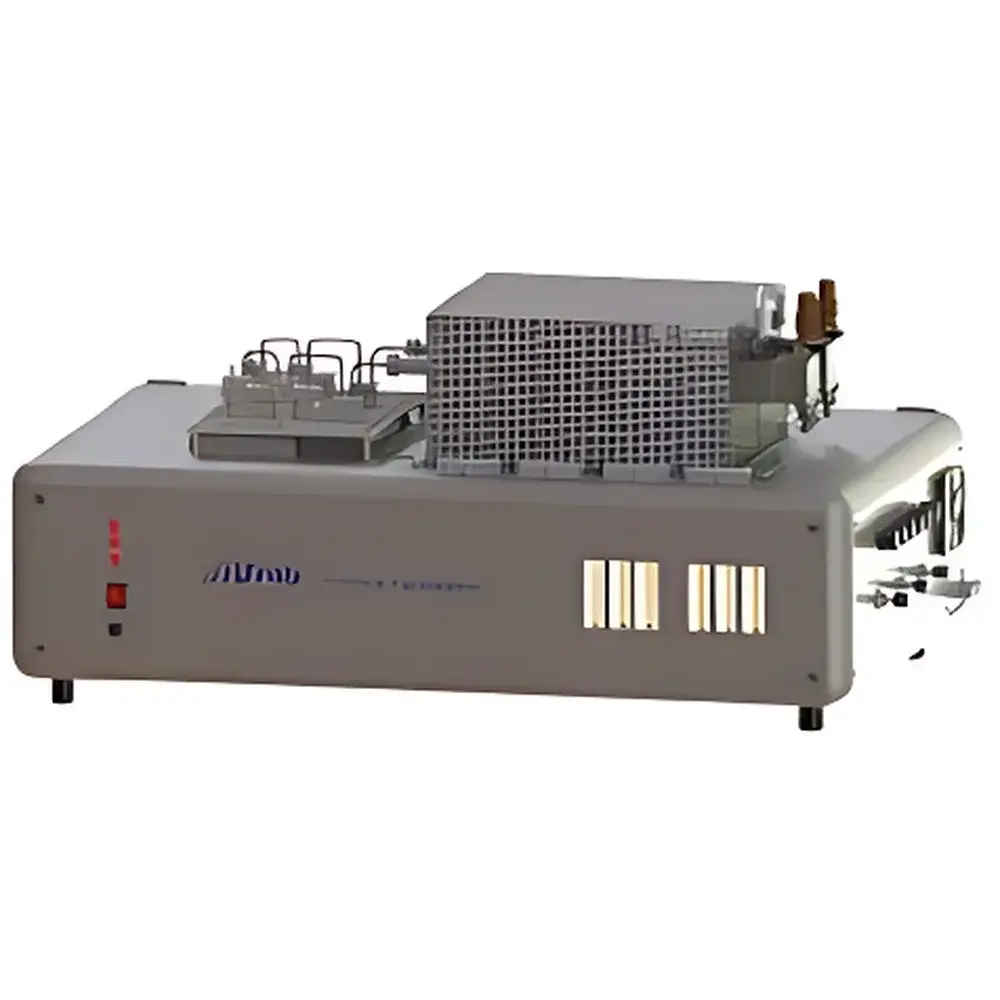
ERALYTICS Tri-Fours Triple-Tube Pyrolyzer
| Brand | ERALYTICS |
|---|---|
| Origin | France |
| Model | Tri-Fours |
| Power Supply | 230 V – 50 Hz (110 V optional) |
| Configuration | 3 independent or coupled sample tubes |
| Sample Volume Capacity | 8–250 cm³ (dry matrix) |
| Operating Modes | Programmable pyrolysis–oxidation sequence |
| Gas Requirements | High-purity O₂ + inert gas (Ar, N₂, or He) |
| Max. Throughput | Up to 7 samples per tube per day |
| ³H & ¹⁴C Capture Efficiency | >97% |
| Detection Limit for ³H in Combustion Water | ~1 Bq·L⁻¹ (1000-min LSC counting) |
| Dimensions (W×H×D) | 80 cm × 52 cm × 40 cm |
| Total Power Consumption | 1200 W (single-phase) or 3 × 800 W (three-phase) |
Overview
The ERALYTICS Tri-Fours Triple-Tube Pyrolyzer is a laboratory-grade, fully programmable thermal decomposition system engineered for high-fidelity extraction and quantitative recovery of tritium (³H) and carbon-14 (¹⁴C) from complex solid and semi-solid environmental, biological, and industrial matrices. It operates on a validated two-stage thermochemical principle: controlled inert-atmosphere pyrolysis followed by high-efficiency oxidative conversion—enabling complete transformation of organically bound ³H and ¹⁴C into measurable gaseous species (HTO and ¹⁴CO₂), which are subsequently trapped in cryogenically cooled collection media. Unlike single-tube combustion systems, the Tri-Fours architecture integrates three parallel, thermally isolated reaction tubes—each independently controllable via dedicated heating zones, gas manifolds, and valve logic—thereby supporting comparative studies, method validation, or staggered batch processing under identical thermal profiles. Its design adheres to ISO/IEC 17025-aligned operational rigor and supports trace-level radiometric quantification compliant with ASTM D7684 (Standard Test Method for Determination of Tritium in Environmental Water by Liquid Scintillation Counting) and IAEA Technical Reports Series No. 421 (Radiocarbon Dating Protocols for Environmental Samples).
Key Features
- Triple-tube modular configuration with independent temperature control (up to 1000 °C) and programmable ramp/soak profiles per tube
- Automated gas sequencing: precision-switched inert (Ar/N₂/He) purging → pyrolysis → O₂ injection → oxidation → product transfer
- Dedicated cryogenic water trap assembly (-80 °C) ensuring quantitative condensation of evolved HTO with <3% vapor loss
- Integrated memory-effect mitigation: automated valve flushing, cold-arm purge cycles, and thermal soak protocols between runs
- Full software-driven operation via ERALYTICS PyroControl Suite—supporting method storage, real-time thermal/gas logging, and audit-trail generation
- Compliance-ready architecture: configurable electronic logs, user-access levels, and timestamped event records aligned with GLP and 21 CFR Part 11 data integrity requirements
Sample Compatibility & Compliance
The Tri-Fours accommodates heterogeneous dry samples ranging from 8 to 250 cm³ in volume—including soils, sediments, plant tissues (leaves, chlorophyll extracts), animal biomass (fish tissue, insect exoskeletons), construction materials (concrete, ceramics), polymers, and foodstuffs. Sample mass is typically 15–40 g dry weight, yielding ≥10 g of combustion-derived water—optimal for liquid scintillation counting (LSC) with minimal quench interference. All wet chemistry interfaces (e.g., distillation modules for HTO purification prior to LSC) are compatible with standard ASTM D5792 and ISO 15663-2 workflows. The system’s gas-handling manifold meets EN 61000-6-3 EMC standards; electrical safety conforms to IEC 61010-1. Documentation includes full CE marking dossier, Factory Acceptance Test (FAT) report, and calibration certificates traceable to national metrology institutes (LNE, France).
Software & Data Management
PyroControl Suite v4.x provides deterministic, deterministic control of all hardware subsystems—including PID-regulated furnace zones, mass-flow-controlled gas delivery, cryo-trap temperature monitoring, and interlock status tracking. Each run generates a structured .CSV log containing time-stamped temperature curves, gas flow rates, valve actuation events, and error flags. Raw data files are write-protected upon acquisition and stored in a hierarchical directory structure with SHA-256 checksum verification. Optional integration with LIMS platforms (e.g., LabVantage, Thermo Fisher SampleManager) is supported via ASTM E1578-compliant API. Audit trails include operator ID, method version, instrument firmware revision, and electronic signatures—fully satisfying FDA 21 CFR Part 11 Subpart B requirements for electronic records and signatures.
Applications
- Environmental radioecology: quantifying ³H/¹⁴C inventories in soil cores, sediment stratigraphy, and bioaccumulation studies
- Nuclear decommissioning: characterization of activated concrete, graphite moderators, and legacy waste forms
- Food safety & authenticity: detection of illicit irradiation treatment or origin verification via ¹⁴C natural abundance profiling
- Pharmaceutical metabolism studies: recovery of ³H-labeled drug residues in preclinical tissue distribution assays
- Climate science: high-precision ¹⁴C dating of paleobotanical remains where conventional acid–base–acid pretreatment is unsuitable
- Regulatory compliance testing: routine monitoring of effluent streams, landfill leachates, and nuclear facility perimeter groundwater
FAQ
What sample preparation is required prior to loading?
Samples must be dried to constant mass at 60 °C and homogenized. No acid washing or chemical pretreatment is needed—organic and exchangeable hydrogen are retained for total ³H quantification.
Can the system process wet or high-moisture samples directly?
No. All samples must be pre-dried to avoid uncontrolled steam generation, condensation in gas lines, and dilution of captured HTO. Moisture content is determined gravimetrically and used to normalize final activity to dry mass (Bq·kg⁻¹dry).
How is cross-contamination between runs prevented?
Memory effects are suppressed through automated post-run Ar flushes, 30-minute 800 °C tube bake-outs, and real-time monitoring of residual HTO signal in the trap effluent stream.
Is method validation support available from ERALYTICS?
Yes—application notes, certified reference material (CRM) test protocols (e.g., IAEA-3, IAEA-4), and on-site IQ/OQ documentation packages are provided with each installation.
What maintenance intervals are recommended?
Quarterly inspection of quartz tube integrity, O-rings, and cryo-trap coolant level; annual recalibration of thermocouples and mass flow controllers using NIST-traceable standards.







