
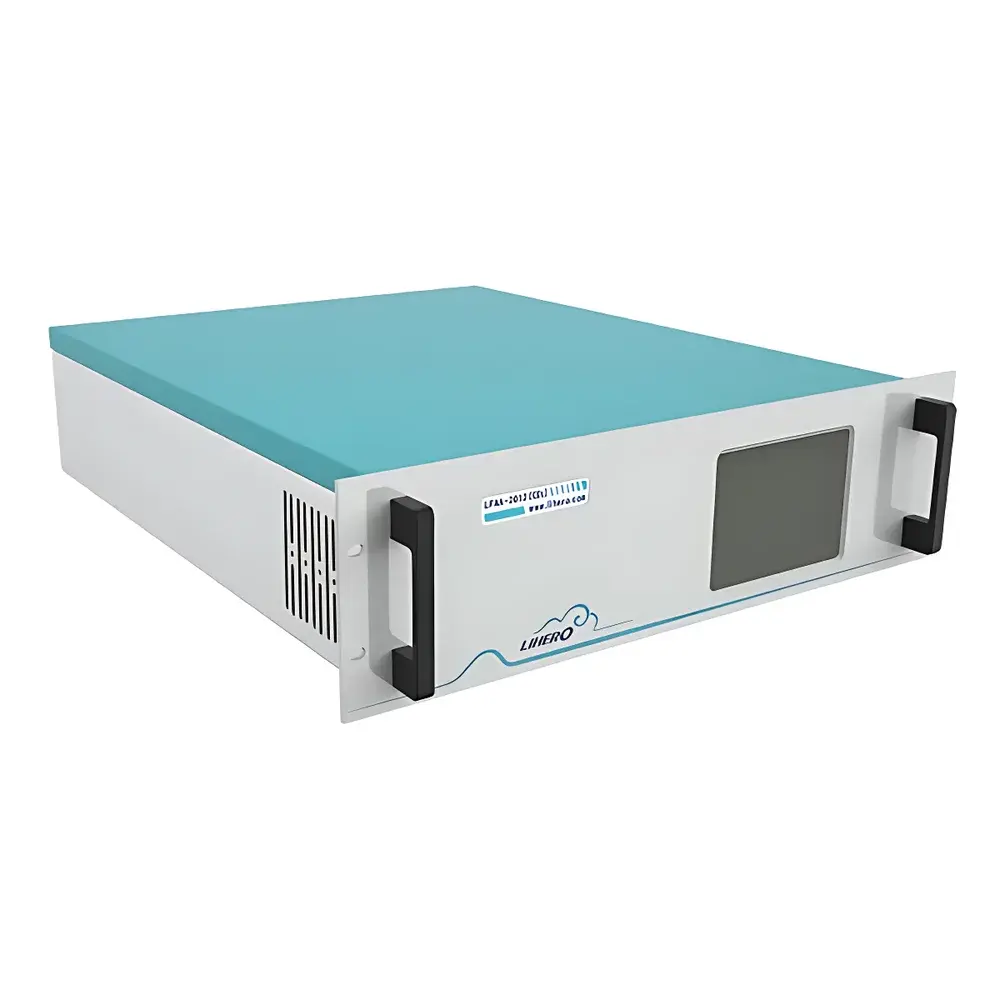
Lihero LFAA-2012 Carbon Dioxide Analyzer
| Brand | Lihero |
|---|---|
| Model | LFAA-2012 (CO₂) |
| Detection Principle | NDIR (Nondispersive Infrared) with Gas Filter Correlation |
| Optical Path | Long-path Absorption Cell |
| Output Interfaces | RS232, TCP/IP, 4–20 mA |
| Configuration | Online Fixed-mount Analyzer |
| Power Supply | Standard AC Input |
| Environmental Rating | Industrial Indoor Use |
| Compliance | Designed for continuous ambient air and stack gas monitoring per EPA Method 405 / ISO 8573-1 (gas purity class reference), supports GLP/GMP data integrity requirements via audit-trail-capable firmware |
Overview
The Lihero LFAA-2012 Carbon Dioxide Analyzer is an online, fixed-installation gas analyzer engineered for continuous, high-stability measurement of carbon dioxide (CO₂) concentration in ambient air, indoor environments, industrial process streams, and flue gas applications. It employs the gas filter correlation (GFC) variant of nondispersive infrared (NDIR) spectroscopy — a mature, field-proven technique that enhances selectivity and long-term stability in complex gas matrices. Unlike conventional single-beam NDIR systems, the LFAA-2012 integrates a mechanically rotating optical filter wheel to alternately direct infrared radiation through dark (zero-reference), sample, and reference gas channels at high frequency. This synchronized acquisition enables real-time subtraction of thermal drift, background emission, and spectral interference from water vapor (H₂O), methane (CH₄), and other common IR-active gases. The core optical architecture features a custom-designed long-path absorption cell, increasing effective path length to improve detection sensitivity while maintaining compact mechanical footprint. Measurement output adheres to the Lambert–Beer law, with concentration calculated from differential absorbance at the characteristic CO₂ absorption band near 4.26 µm.
Key Features
- Gas Filter Correlation (GFC) NDIR optics with rotating filter wheel for dynamic background compensation and interference rejection
- Long-path absorption cell optimized for enhanced signal-to-noise ratio and sub-ppm-level resolution in ambient monitoring
- Dual-channel thermopile infrared detector assembly — one channel dedicated to sample absorption, the other to reference beam stabilization — minimizing temperature-induced baseline drift
- High-reliability infrared source with extended operational lifetime (>5 years typical) and mechanical robustness against vibration and thermal shock
- Automated onboard quality control routines including zero/span validation, optical path diagnostics, and detector response monitoring
- Integrated data tagging system: each recorded CO₂ value carries embedded metadata (timestamp, QC status flag, optical health index), supporting traceability and data validity assessment
- Large-format graphical LCD interface with intuitive menu navigation, real-time trend plotting, and multilingual support (English default)
Sample Compatibility & Compliance
The LFAA-2012 is validated for use with dry or moderately humid gas samples (dew point ≤ 5 °C). For high-moisture or particulate-laden streams, optional heated sampling lines and particulate filters are recommended. It meets electromagnetic compatibility (EMC) requirements per IEC 61326-1 for industrial environments and operates within an ambient temperature range of 0–45 °C and relative humidity up to 90% non-condensing. While not certified to UL/CSA safety standards, its enclosure complies with IP20 for indoor panel mounting. Firmware supports configurable alarm thresholds, event logging, and time-synchronized data export — enabling alignment with ISO 14001 environmental management systems and facilitating regulatory reporting under local air quality directives. Data handling protocols are compatible with FDA 21 CFR Part 11 expectations when deployed with external audit-trail-enabled SCADA or LIMS integration.
Software & Data Management
The analyzer includes embedded firmware with dual-mode communication: serial (RS232) for local configuration and diagnostics, Ethernet (TCP/IP) for remote monitoring via Modbus TCP or HTTP-based JSON API, and analog 4–20 mA output for PLC interfacing. Historical data storage retains ≥30 days of 1-minute averaged CO₂ values, system status flags, and diagnostic logs. All stored records include UTC timestamps and integrity checksums. Optional PC-based configuration utility provides advanced calibration management, spectral diagnostics visualization, and firmware update capability. Export formats include CSV and XML, structured to align with EPA’s CEMS data formatting conventions. Audit trail functionality logs all user-initiated parameter changes, calibration events, and maintenance actions with operator ID and timestamp — satisfying GLP documentation requirements.
Applications
- Ambient air quality monitoring networks (urban, rural, and roadside stations)
- Indoor air quality (IAQ) assessment in offices, schools, hospitals, and smart buildings
- Continuous emissions monitoring (CEMS) for combustion sources where CO₂ serves as a diluent or mass flow proxy
- Greenhouse gas flux studies using eddy covariance or chamber-based methodologies
- Control feedback in HVAC demand-controlled ventilation (DCV) systems
- Biological process monitoring in fermentation, composting, and controlled-environment agriculture
FAQ
What is the typical measurement range and accuracy specification?
The LFAA-2012 is factory-configured for 0–5000 ppm CO₂ full scale, with ±(2% of reading + 10 ppm) accuracy under calibrated conditions. Custom ranges (e.g., 0–10,000 ppm or 0–100% vol) are available upon request.
Does the analyzer require periodic calibration with certified gas standards?
Yes — initial factory calibration is traceable to NIST-certified CO₂ standards. Field recalibration is recommended every 6–12 months depending on operating environment; automated zero checks reduce dependency on span gas for routine verification.
Can it operate unattended for extended periods?
Yes — designed for 24/7 operation with redundant power input options and built-in watchdog timer. Mean time between failures (MTBF) exceeds 12,000 hours under nominal conditions.
Is remote firmware update supported?
Yes — secure over-the-air (OTA) updates via Ethernet connection are enabled through authenticated HTTPS upload, preserving configuration integrity during upgrade.
How is cross-sensitivity to water vapor managed?
The GFC architecture inherently suppresses H₂O interference at the optical level; additionally, integrated temperature/pressure compensation and optional Nafion™-based sample drying further minimize residual moisture effects.







