
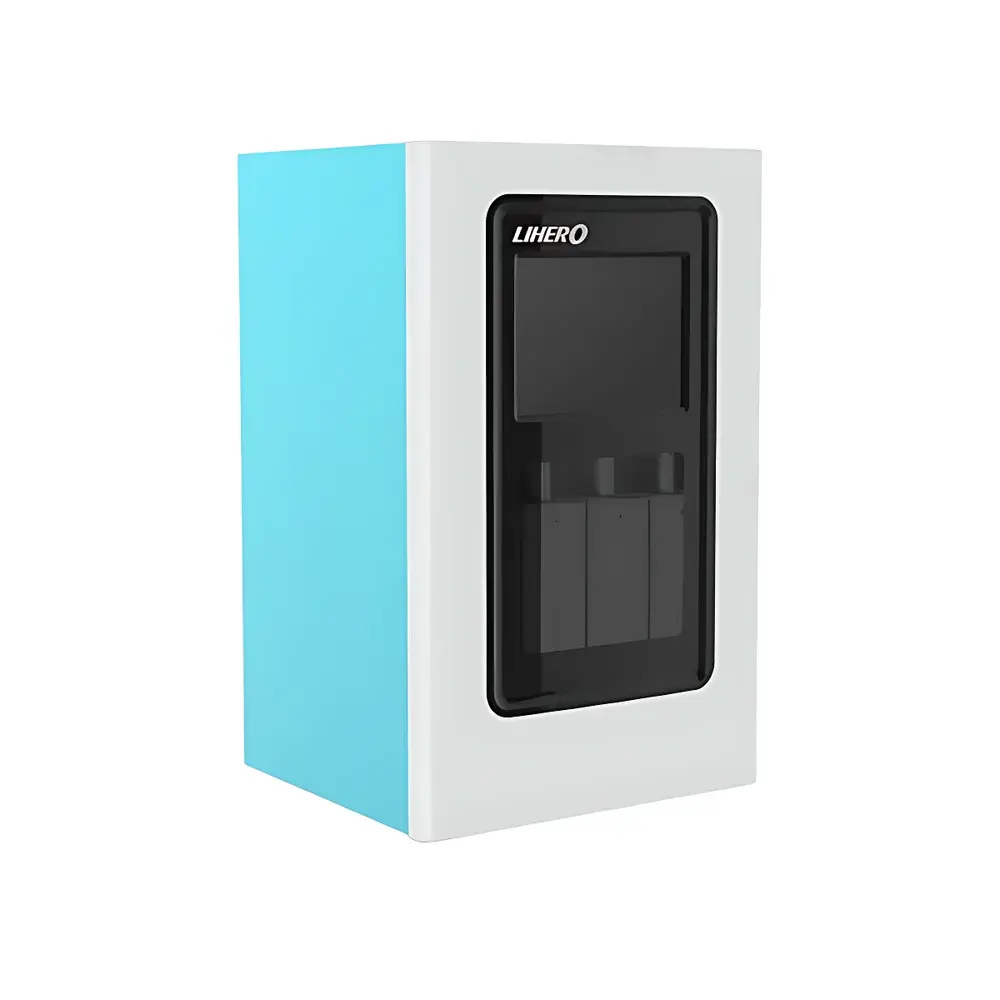
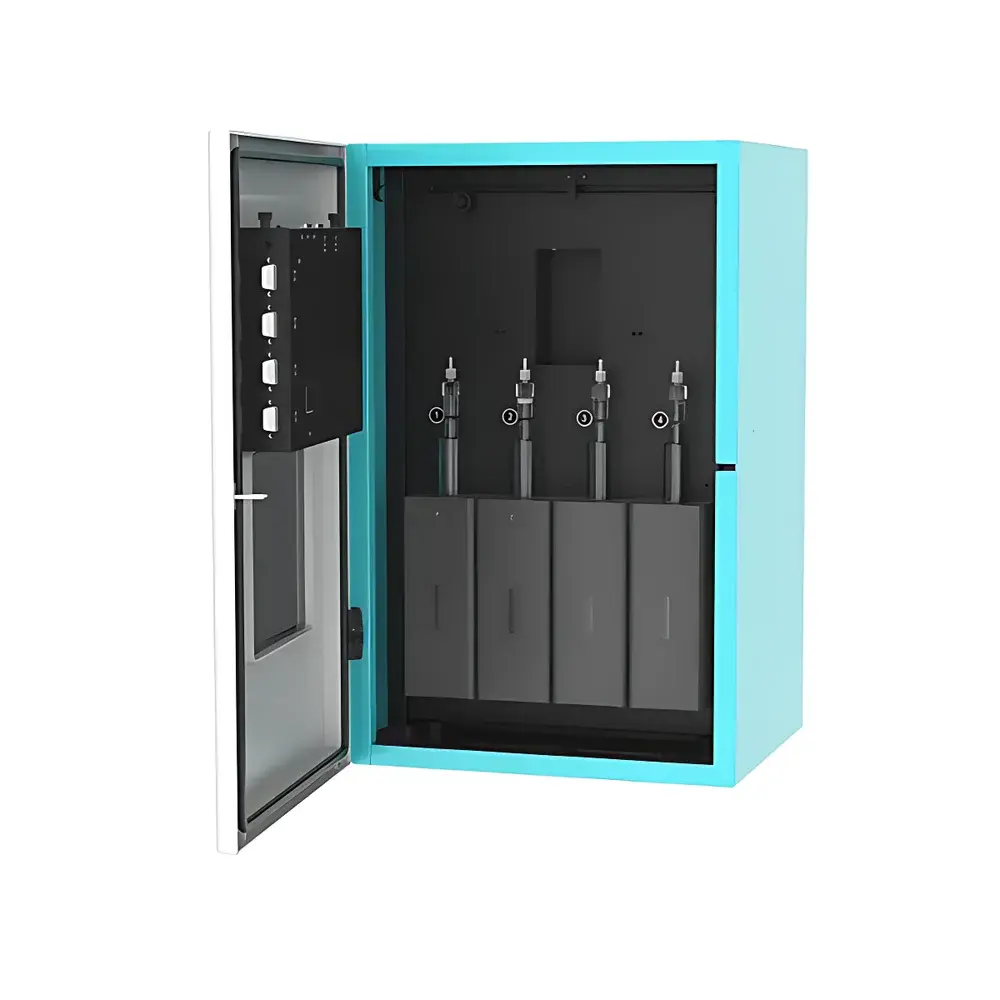
Lihero LFTColi-2016 Total Coliform Analyzer
| Brand | Lihero |
|---|---|
| Model | LFTColi-2016 |
| Detection Principle | Enzyme-Substrate Method (ONPG/MUG) |
| Detection Target | Total Coliforms and Escherichia coli |
| Detection Limit | 1 MPN/100 mL |
| Analysis Time | 4–18 h (online, incubation-dependent) |
| Operating Temperature Range | 35 ± 0.5 °C (incubation) |
| Sample Turbidity Compensation | Integrated optical turbidity correction |
| Reagent Delivery | Automated, multi-channel peristaltic pumping |
| System Architecture | Modular, dual- or quad-chamber independent incubation units |
| Data Output | RS485/Modbus TCP, optional 4G/LTE remote transmission |
| Compliance Basis | GB/T 5750.12–2023, ISO 9308-1:2014, APHA Standard Methods 9221 |
Overview
The Lihero LFTColi-2016 Total Coliform Analyzer is an automated, on-site water quality monitoring instrument engineered for regulatory-grade detection of total coliform bacteria and Escherichia coli in drinking water, surface water, wastewater effluent, and distribution system samples. It implements the internationally recognized enzyme-substrate method—specifically utilizing ortho-nitrophenyl-β-galactoside (ONPG) for total coliform enumeration and 4-methylumbelliferyl-β-D-glucuronide (MUG) for E. coli confirmation—within a closed, temperature-controlled incubation environment. Unlike membrane filtration or multiple-tube fermentation, this method enables real-time metabolic signal generation (colorimetric ONPG hydrolysis and fluorescent MUG cleavage), allowing quantification without colony isolation. The system is designed for unattended operation in fixed-site installations or mobile monitoring trailers, delivering results compliant with China’s GB/T 5750.12–2023 and aligned with ISO 9308-1:2014 performance criteria for presence/absence and most probable number (MPN) determination.
Key Features
- Multi-mode operational flexibility: supports standalone manual assay, standalone automated cycle (with pre-set incubation and read intervals), and network-synchronized continuous monitoring via SCADA or LIMS integration.
- Dual-layer fault management: hardware-level alerts for incubation temperature deviation (>±0.5 °C), reagent depletion, tubing occlusion, photometric saturation, and power interruption—with event logging and configurable relay outputs.
- Independent parallel incubation chambers: configurable as 2- or 4-channel modules, each maintaining precise 35 °C ±0.5 °C control, enabling staggered sampling and overlapping assays to achieve up to 6 analyses per 24-hour period.
- Optical turbidity compensation: integrated 850 nm LED nephelometric sensor corrects absorbance-based ONPG readings in samples with turbidity up to 50 NTU, minimizing false negatives from particulate interference.
- Autonomous fluid-path hygiene: programmable sodium hypochlorite (≤500 ppm) disinfection followed by deionized water rinse cycles between samples—validated per ASTM D5465-22 for residual bioburden reduction in sample delivery lines.
- Remote diagnostics & data telemetry: embedded Linux controller with TLS-secured HTTP API, Modbus TCP server, and optional LTE fallback; supports scheduled CSV/JSON export and alarm-triggered push notifications.
Sample Compatibility & Compliance
The LFTColi-2016 accepts raw, filtered (0.45 µm), or clarified water samples within pH 6.0–8.5 and conductivity <5 mS/cm. It accommodates municipal tap water, river/lake intake points, secondary clarifier effluents, and groundwater sources—provided free chlorine residual is <0.5 mg/L prior to analysis. All assay protocols align with GB/T 5750.12–2023 Annex A (enzyme-substrate method) and demonstrate method equivalence to ISO 9308-1:2014 under interlaboratory validation conditions. Instrument firmware includes audit-trail functionality meeting GLP data integrity requirements (ALCOA+ principles), with user-accessible logs covering reagent lot tracking, calibration timestamps, and incubation thermal profiles.
Software & Data Management
The embedded HMI provides touchscreen navigation for assay initiation, chamber status review, and historical result browsing (up to 10,000 records stored locally). Remote configuration is enabled via web interface supporting role-based access control (administrator, operator, viewer). Data exports include MPN tables with 95% confidence intervals, incubation time-stamped fluorescence/absorbance curves, and QC flag annotations (e.g., “turbidity-corrected”, “reagent expiry warning”). For regulated environments, optional 21 CFR Part 11-compliant software add-on delivers electronic signatures, immutable audit trails, and e-signature workflows—validated per IQ/OQ protocols upon installation.
Applications
- Drinking water utilities: continuous compliance monitoring at entry points, storage reservoirs, and zone boundary valves per GB 5749–2022.
- Wastewater treatment plants: real-time verification of disinfection efficacy post-chlorination or UV exposure.
- Environmental protection agencies: mobile deployment for emergency response (e.g., post-flood source water screening).
- Industrial pretreatment facilities: effluent verification prior to municipal sewer discharge.
- Research institutions: longitudinal studies requiring high-frequency coliform trend analysis across seasonal hydrological shifts.
FAQ
What sample volume is required per analysis?
100 mL of representative water sample is drawn automatically; no manual pipetting is needed.
Does the system require daily maintenance?
Routine tasks are limited to weekly reagent cartridge replacement and monthly optical window cleaning; disinfection cycles execute autonomously.
Can it distinguish E. coli from other coliforms?
Yes—simultaneous ONPG (total coliform) and MUG (E. coli-specific β-glucuronidase) detection enables differential enumeration within the same assay run.
Is field calibration supported?
Yes—portable NIST-traceable calibration modules (certified coliform suspensions) allow on-site verification per GB/T 5750.12–2023 Section 8.3.
How is data security ensured during remote transmission?
All network communications use TLS 1.2+ encryption; local storage employs AES-256 full-disk encryption with tamper-evident log rotation.
Related Products







