
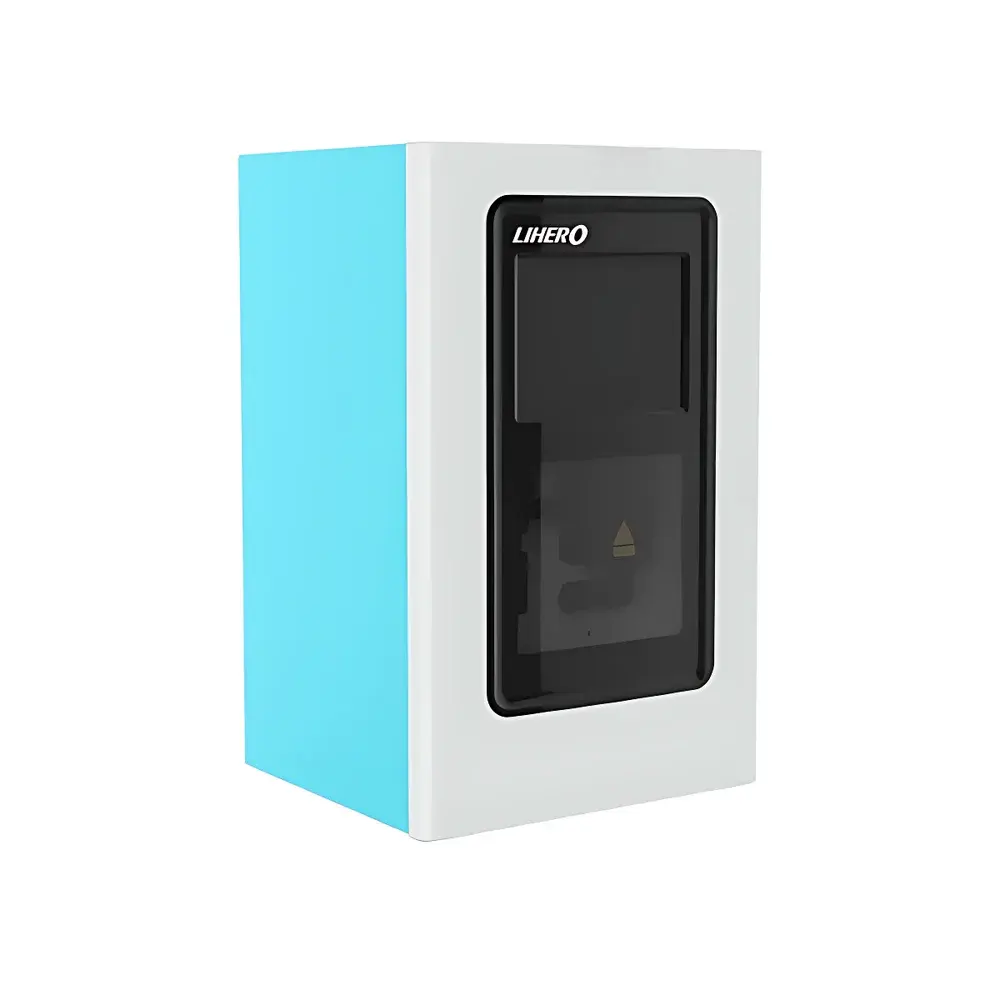
Lihero LFS-2002(NO₃) Nitrate Nitrogen Water Quality Analyzer
| Brand | Lihero |
|---|---|
| Model | LFS-2002(NO₃) |
| Measurement Principle | UV Spectrophotometry at 220 nm and 275 nm |
| Wavelength Accuracy | ±1 nm |
| Detection Range | 0.05–20 mg/L as N (configurable extension available) |
| Detection Limit | ≤0.02 mg/L as N |
| Repeatability | ≤±2% RSD |
| Sample Throughput | 1 sample per 12–15 minutes (including digestion and measurement) |
| Digestion Method | High-Temperature High-Pressure Closed-Vessel Digestion (121 °C, 0.11 MPa) |
| Turbidity & Color Compensation | Dual-wavelength dynamic correction (220/275 nm) |
| Calibration Modes | Zero check, span check, standard calibration, curve auto-standardization, spike recovery test |
| Data Logging | Internal SD card + remote upload via MODBUS TCP / RS485 / 4–20 mA analog output |
| Operating System | Embedded Linux real-time OS |
| Compliance | Designed to meet ISO 7890-3, HJ/T 346–2007, and ASTM D3867–18 requirements for nitrate nitrogen determination in surface water, groundwater, and wastewater |
Overview
The Lihero LFS-2002(NO₃) Nitrate Nitrogen Water Quality Analyzer is an automated, laboratory-grade or continuous monitoring–capable instrument engineered for precise quantification of nitrate nitrogen (NO₃–N) in natural waters, drinking water sources, wastewater effluents, and industrial process streams. It operates on the principle of dual-wavelength ultraviolet spectrophotometry—measuring absorbance at 220 nm (primary absorption peak of nitrate ion) and 275 nm (reference wavelength for organic interference)—to compute corrected nitrate nitrogen concentration using the established A220 − 2×A275 algorithm. This methodology conforms to internationally recognized analytical protocols including ISO 7890-3 (Water quality — Determination of nitrate — Part 3: Spectrometric method using ultraviolet absorption), ASTM D3867–18 (Standard Test Method for Nitrate Nitrogen in Water by UV Spectrophotometry), and China’s HJ/T 346–2007 (Determination of Nitrate Nitrogen in Water by Ultraviolet Spectrophotometry). The system integrates high-pressure, high-temperature closed-vessel digestion to ensure complete conversion of complex nitrogen species into measurable nitrate, thereby enhancing accuracy in matrices with particulate-bound or refractory nitrogen forms.
Key Features
- Automated dual-wavelength UV photometric detection with real-time optical path self-balancing, eliminating drift from lamp aging or detector sensitivity variation.
- Integrated high-efficiency digestion module operating at 121 °C and 0.11 MPa, achieving >95% oxidation efficiency for nitrite, organic nitrogen, and ammonium under standardized conditions.
- Dynamic turbidity and color compensation using simultaneous 220 nm and 275 nm measurements, enabling reliable analysis in colored or suspended-solid–rich samples without pre-filtration.
- Comprehensive self-diagnostic architecture: onboard sensor health monitoring, reagent level sensing, flow path integrity verification, and photometric signal validation.
- Full calibration lifecycle support—including zero-point verification, multi-point span checks, automatic calibration curve generation, and integrated spike recovery assessment per EPA Method 300.0 guidelines.
- Embedded Linux-based control system ensuring deterministic timing, secure firmware updates, and seamless integration into SCADA or LIMS environments via MODBUS TCP, RS485, or 4–20 mA analog outputs.
Sample Compatibility & Compliance
The LFS-2002(NO₃) accepts raw, filtered, or centrifuged aqueous samples with total suspended solids (TSS) up to 100 mg/L and turbidity ≤500 NTU. It accommodates pH ranges from 4.0 to 9.5 and chloride concentrations up to 1,000 mg/L without interference. All operational parameters—including digestion time, photometric integration period, and calibration frequency—are configurable to align with site-specific QA/QC requirements. The analyzer meets design criteria for GLP-compliant laboratories and supports audit-trail logging (time-stamped events, operator ID, parameter changes) required under ISO/IEC 17025 and FDA 21 CFR Part 11 when deployed with validated software configurations. It is certified for use in municipal water utilities complying with China’s GB 5749–2022 and EU Drinking Water Directive (2020/2184) monitoring frameworks.
Software & Data Management
The embedded firmware provides a web-accessible interface (HTTPS-enabled) for remote configuration, real-time status monitoring, and historical data retrieval. All measurements are timestamped and stored locally on a removable industrial-grade SD card (≥16 GB) with cyclic overwrite protection. Data export formats include CSV and XML, compatible with common environmental data management platforms (e.g., EQuIS, ArcGIS Water, or custom SQL databases). Alarm logs—covering reagent depletion, flow interruption, optical fault, over-range detection, and calibration deviation—trigger SNMP traps or email notifications via SMTP relay. Firmware updates follow signed package verification to ensure integrity and traceability.
Applications
- Regulatory compliance monitoring for surface water bodies under national and provincial environmental protection agencies’ reporting mandates.
- Influent/effluent nitrate tracking in municipal and industrial wastewater treatment plants (WWTPs) for process optimization and discharge permit adherence.
- Source water surveillance in reservoirs and groundwater wells to assess agricultural runoff impact and eutrophication risk.
- Research applications in hydrological studies, nutrient cycling modeling, and climate-related water quality trend analysis.
- Integration into automated river basin monitoring networks where low-maintenance, long-term unattended operation is required.
FAQ
What regulatory standards does the LFS-2002(NO₃) comply with?
It is designed to fulfill performance criteria specified in ISO 7890-3, ASTM D3867–18, HJ/T 346–2007, and supports validation pathways aligned with ISO/IEC 17025 for accredited testing laboratories.
Can the instrument operate unattended for extended periods?
Yes—configured with scheduled calibration cycles, remote diagnostics, and alarm-driven maintenance alerts, it supports continuous operation for ≥30 days without manual intervention under typical reagent supply conditions.
Is digestion required for all sample types?
Digestion is mandatory for samples containing nitrite, organic nitrogen, or suspended particulates; however, direct UV measurement mode (bypassing digestion) is available for clean, nitrate-only matrices such as treated drinking water.
How is data integrity ensured during transmission?
All communication channels support TLS 1.2 encryption (web interface), CRC-16 checksums (MODBUS), and hardware-level watchdog timers to prevent data corruption or loss during network latency or power fluctuation.
Does the system support multi-point calibration curves?
Yes—up to six-point calibration curves can be defined, stored, and automatically invoked based on concentration range selection or sample origin metadata.







