
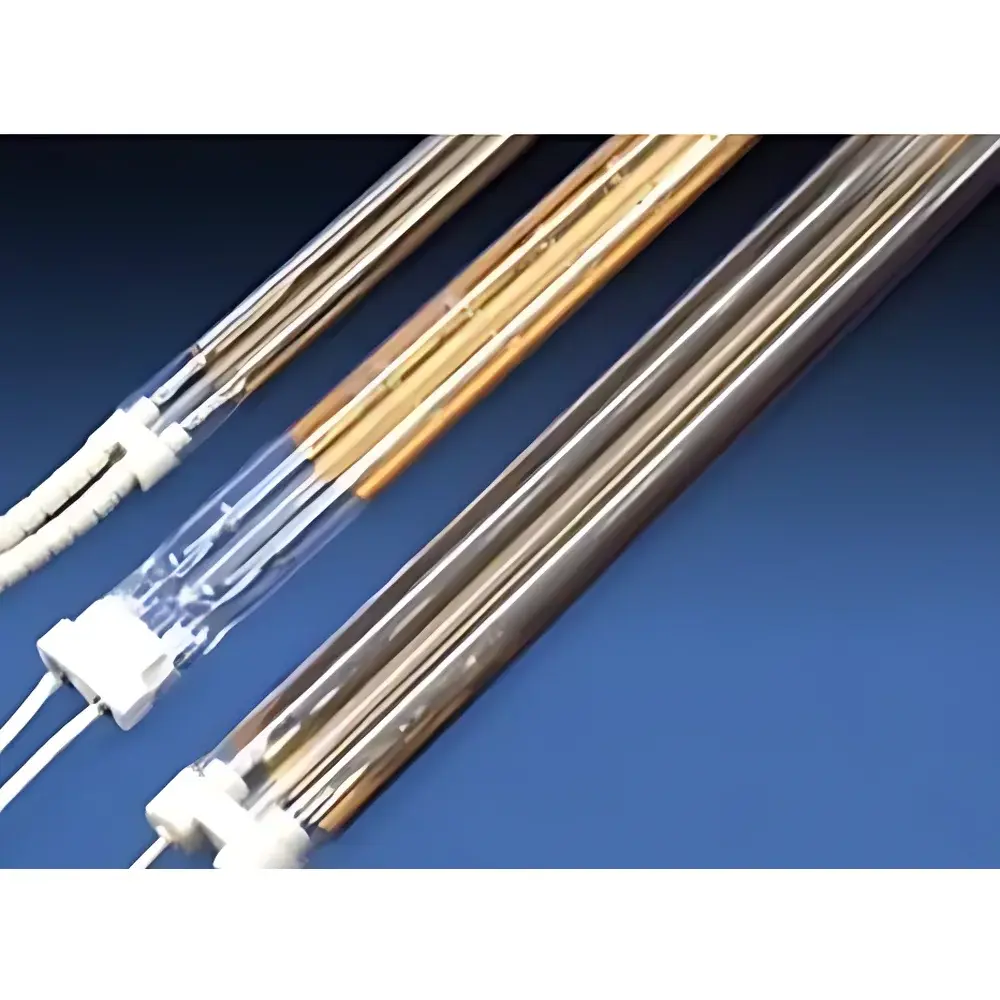
Hoenle IR Lamp Tube
| Brand | Hoenle |
|---|---|
| Origin | Germany |
| Type | Industrial Infrared Emitter Tube |
| Wavelength Options | NIR (3000 K filament), Short-Wave IR (2300 K), Medium-Wave IR (900 K), Fast Medium-Wave IR (1600 K) |
| Max Length | 3000 mm |
| Custom Configurations | Single- or dual-end termination, twin-tube modules |
| Compliance | CE-marked, RoHS-compliant, designed for integration into industrial heating systems |
Overview
Hoenle IR Lamp Tubes are high-intensity, electrically heated infrared emitters engineered for precision thermal processing in continuous and batch industrial systems. Based on tungsten-halogen filament technology operating in vacuum or halogen-filled quartz envelopes, these lamps emit broadband infrared radiation across defined spectral bands—NIR (near-infrared), short-wave IR, fast medium-wave IR, and standard medium-wave IR—each optimized for specific absorption characteristics of substrates such as inks, coatings, polymers, glass, and thin-film layers. Unlike convective or conductive heating methods, IR irradiation delivers rapid, contactless energy transfer with high spatial and temporal control, enabling selective heating of surface layers while minimizing thermal stress on underlying materials. These tubes are not standalone appliances but core components of engineered IR drying, curing, and preheating systems deployed in high-speed converting lines, printing presses, coating stations, and semiconductor manufacturing environments.
Key Features
- Tungsten-halogen filament design with precise filament temperature control (900–3000 K), ensuring reproducible spectral output and stable radiant power over rated lifetime
- Quartz envelope options: fused silica (for NIR/short-wave applications requiring high transmission above 1.1 µm) and doped quartz (for enhanced medium-wave emission and thermal shock resistance)
- Customizable mechanical configurations: single- or dual-pin base variants, axial or lateral lead-out arrangements, and lengths up to 3000 mm for seamless integration into wide-format dryers
- Modular compatibility: engineered for direct mounting in twin-tube reflector assemblies, multi-lamp arrays, and hybrid IR–hot-air combi-units
- Robust thermal architecture: capable of rapid thermal cycling (cold start to full output in <5 s) and stable operation at ambient temperatures up to 60°C without forced cooling
- Electrical interface: standardized 230 V AC / 400 V AC input; optional dimming via phase-angle or burst-fire SCR controllers compatible with PLC-based process automation
Sample Compatibility & Compliance
Hoenle IR Lamp Tubes are selected based on the spectral absorption profile of the target material. NIR lamps (3000 K) deliver peak emission near 1.0 µm—ideal for rapid drying of solvent-based inks and UV-curable formulations where surface heating dominates. Short-wave IR (2300 K) offers deeper penetration into water-based coatings and adhesives. Medium-wave (900 K) and fast medium-wave (1600 K) variants provide balanced surface-to-bulk heating for thermosensitive substrates including PET films, paperboard, and printed electronics. All lamps comply with EU Directive 2014/30/EU (EMC), 2011/65/EU (RoHS), and carry CE marking. They are designed for use in equipment meeting IEC 60529 (IP rating), IEC 60204-1 (safety of machinery), and ISO 12232 (radiant efficiency testing protocols). When integrated into validated production lines, they support compliance with ISO 9001, ISO 14001, and GMP-aligned documentation requirements for traceable thermal process parameters.
Software & Data Management
While the lamp tube itself is a passive emitter, its performance is fully controllable and monitorable within modern IR system architectures. Integration with industrial PLCs (Siemens S7, Rockwell ControlLogix) enables real-time regulation of lamp voltage, current, and duty cycle via analog 0–10 V or 4–20 mA signals. Optional digital interfaces (RS-485 Modbus RTU, EtherNet/IP) allow centralized logging of operational hours, thermal cycles, and fault events—critical for preventive maintenance scheduling and audit-ready process records. For systems requiring regulatory traceability (e.g., medical device packaging or pharmaceutical coating lines), lamp operation data can be synchronized with SCADA platforms supporting FDA 21 CFR Part 11-compliant electronic signatures and audit trails.
Applications
- Web-fed and sheetfed offset printing: instant drying of UV and conventional inks without set-off or blocking
- Inkjet curing: stabilization of aqueous pigment dispersions prior to post-processing
- PCB manufacturing: low-thermal-mass sintering of silver nanoparticle inks and conductive pastes
- Functional coating: crosslinking of acrylic, epoxy, and silicone release layers on release liners
- Film and foil processing: preheating of PET, BOPP, and aluminum laminates prior to metallization or extrusion lamination
- Photovoltaic cell production: edge isolation firing and anti-reflective coating annealing
- Textile finishing: moisture evaporation from dye baths and thermofixation of disperse dyes on polyester
FAQ
What is the typical service life of a Hoenle IR lamp tube under continuous operation?
Rated lifetime ranges from 5,000 to 10,000 hours depending on filament temperature class, thermal cycling frequency, and electrical supply stability. NIR lamps operated at 3000 K exhibit shorter lifespans than medium-wave variants due to higher filament evaporation rates.
Can these lamps be dimmed without spectral shift?
Yes—phase-controlled dimming maintains filament temperature and thus spectral distribution within ±5% across 20–100% power range. Pulse-width modulation below 20% is not recommended due to thermal hysteresis effects.
Are custom spectral filters available for narrow-band emission?
Hoenle does not supply integrated optical filters; however, external dichroic reflectors and bandpass interference filters (e.g., 1.2–1.6 µm for polyolefin activation) can be specified through authorized system integrators.
Do these lamps require special disposal procedures?
As RoHS-compliant devices containing no mercury or leaded glass, they may be disposed of as non-hazardous electronic waste per local regulations—but quartz envelope fragments must be handled as sharp industrial debris.
Is thermal imaging calibration supported?
Each lamp model is supplied with factory-measured radiant exitance curves (W/sr·m²) referenced to NIST-traceable blackbody standards; calibration certificates are available upon request for metrology-grade installations.
Related Products





