
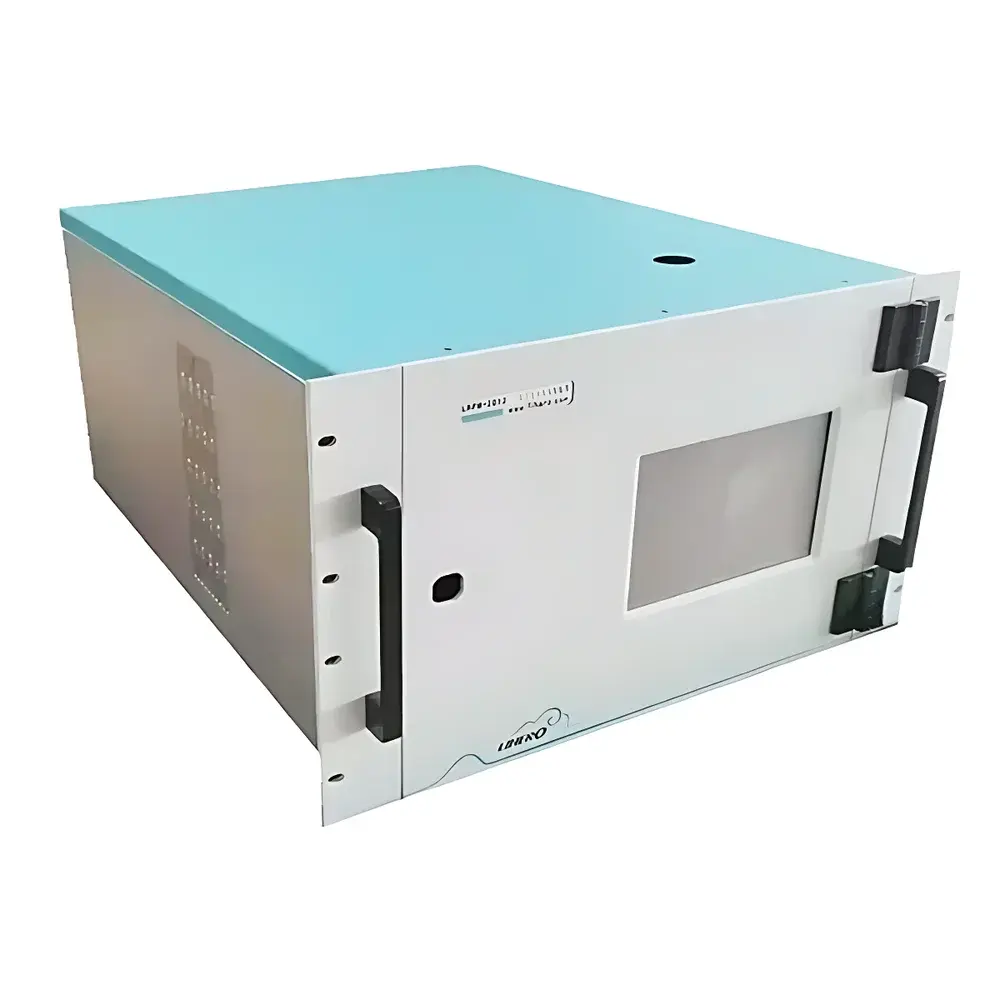
Lihero LHPM-2012 Continuous Ambient Air Particulate Matter Monitoring System
| Brand | Lihero |
|---|---|
| Model | LHPM-2012 |
| Origin | Hunan, China |
| Measurement Principle | Beta-ray Absorption (β-ray) |
| Compliance Basis | Equivalent to Gravimetric Method per Chinese National Standards (e.g., HJ 653–2013, HJ 93–2013) |
| PM Fraction Capability | PM₁₀ and PM₂.₅ (with optional size-selective inlets) |
| Operating Autonomy | >90 days unattended |
| Calibration Frequency | Automatic hourly zero/span check |
| Environmental Tolerance | High-humidity operation supported |
| Flow Control | Precision mass flow controller with user-definable setpoint |
| Radiation Source | Low-energy ¹⁴C beta emitter (activity compliant with national regulatory limits for Class V sealed sources) |
Overview
The Lihero LHPM-2012 Continuous Ambient Air Particulate Matter Monitoring System is a regulatory-grade, fixed-site environmental monitoring instrument engineered for long-term, unattended quantification of airborne particulate mass concentration. It operates on the beta-ray absorption principle—a physically traceable, reference-equivalent methodology standardized under China’s Ministry of Ecology and Environment (MEE) technical specifications (HJ 653–2013, HJ 93–2013). As the beta particles traverse a filter tape loaded with collected aerosol, attenuation is measured by a solid-state scintillation detector; the mass concentration is derived from the exponential relationship between attenuation and areal mass loading, calibrated against gravimetric reference filters. This physical basis ensures metrological equivalence to manual high-volume gravimetric sampling—the definitive benchmark for regulatory compliance—while eliminating operator-dependent variability inherent in field-based weighing protocols.
Key Features
- Regulatory-compliant beta-ray absorption measurement with traceability to national gravimetric standards.
- Integrated precision mass flow controller enabling stable, user-configurable sampling flow rates (typically 16.7 L/min for PM₂.₅ or 1 m³/h for PM₁₀), with real-time flow monitoring and automatic pressure/temperature compensation.
- Automated hourly zero and span verification using internal clean air purge and reference attenuation path—no external gas cylinders or manual intervention required.
- Robust filter tape transport mechanism with dual-tape redundancy, supporting continuous operation exceeding 90 days without maintenance under typical urban ambient conditions.
- Humidity-resilient optical path design and heated sample line (optional) mitigating condensation artifacts in high-relative-humidity environments (up to 95% RH, non-condensing).
- Low-activity ¹⁴C beta source (≤37 kBq) classified as exempt under GB 18871–2002, requiring no radiation safety officer on-site and enabling simplified installation in municipal or roadside monitoring stations.
- Patented tape alignment and optical alignment algorithm ensuring consistent beam geometry across extended deployments, contributing to inter-unit reproducibility <±2% RSD over 30-day field trials.
Sample Compatibility & Compliance
The LHPM-2012 accepts standard 40-mm diameter quartz or Teflon-coated glass fiber filter tapes compatible with ISO 12103-1 A2 test dust calibration protocols. When coupled with certified PM₁₀ or PM₂.₅ sharp-cut cyclones (e.g., WINS impactor or BGI SCC 1.062), it meets the performance criteria defined in EN 12341:2014 and US EPA EQPM-0805-172 for equivalent method designation. Data output conforms to MEE’s “Environmental Air Quality Monitoring Data Transmission Technical Specification” (HJ 212–2017), enabling seamless integration into provincial and national air quality monitoring networks (e.g., CNEMC platform). The system architecture supports audit-ready data logging—including raw attenuation counts, flow parameters, temperature, pressure, and diagnostic flags—with timestamped records stored locally for ≥180 days.
Software & Data Management
Embedded firmware provides local web-based configuration via HTTPS-secured interface (TLS 1.2), supporting remote parameter adjustment, firmware updates, and diagnostic log export. Raw and processed data are exported in CSV format with ISO 8601 timestamps and UTC synchronization via NTP. Optional Lihero Cloud Connect module enables encrypted MQTT transmission to centralized data platforms, with configurable alarm thresholds (e.g., flow deviation >5%, zero drift >10 µg/m³) triggering SMS/email alerts. All data handling complies with GLP-aligned principles: full electronic audit trail, immutable record retention, and role-based access control (admin/operator/viewer tiers). While not FDA 21 CFR Part 11-certified (as not intended for pharmaceutical release testing), its data integrity framework satisfies ISO/IEC 17025:2017 Clause 7.5.2 requirements for environmental testing laboratories.
Applications
- Continuous regulatory monitoring at national ambient air quality monitoring stations (AAQMS) and urban background sites.
- Source apportionment support through co-location with elemental analyzers (e.g., XRF) or gas-phase monitors (O₃, NO₂, SO₂).
- Long-term trend analysis for PM exposure assessment in epidemiological cohort studies.
- Verification of emission reduction effectiveness near industrial zones or traffic corridors.
- Calibration transfer and field validation of low-cost sensor networks using collocated reference-grade measurements.
- Compliance reporting for local environmental protection bureaus under China’s “Blue Sky Defense Campaign” implementation metrics.
FAQ
What regulatory standards does the LHPM-2012 meet?
It complies with HJ 653–2013 (Technical Requirements for Ambient Air PM Monitoring Instruments) and HJ 93–2013 (Technical Requirements for PM Sampler Inlets), and is designated as an “equivalent method” under China’s Ambient Air Quality Standard (GB 3095–2012).
Is radioactive source licensing required for installation?
No—its ¹⁴C source activity falls below exemption thresholds defined in GB 18871–2002 and requires only routine registration with provincial ecological environment departments.
Can the system operate reliably in coastal or monsoon-prone regions?
Yes—the optical chamber is sealed and temperature-stabilized, and the sampling line includes optional heating to prevent hygroscopic artifact formation at relative humidity up to 95%.
How is data integrity ensured during power interruptions?
Internal supercapacitors sustain critical memory and clock functions for ≥72 hours; upon power restoration, the system resumes sampling without data loss and auto-synchronizes timestamps via NTP.
What maintenance is required beyond tape replacement?
Annual verification of flow calibration against a primary standard (e.g., dry gas meter) and biannual inspection of optical window cleanliness—no routine source recalibration is needed due to inherent stability of the ¹⁴C isotope.







