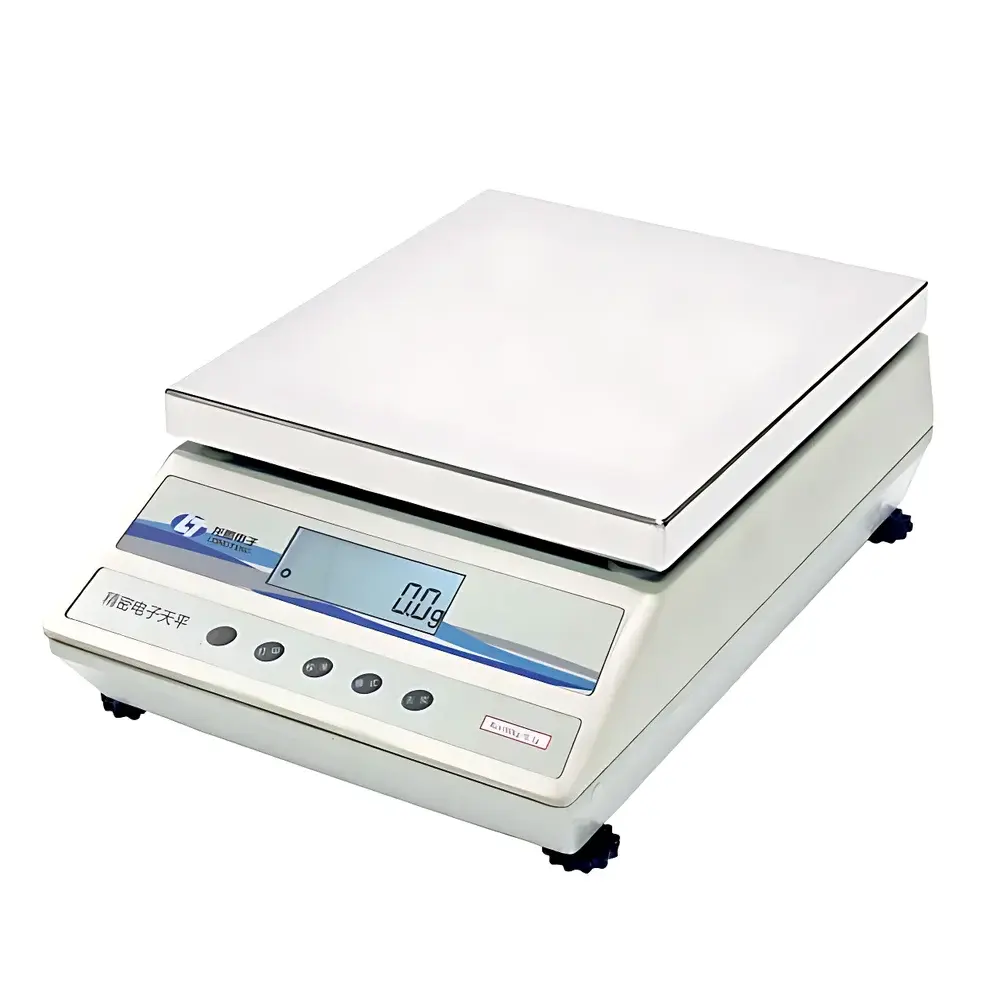
Longteng ES10K-2D Precision Heavy-Duty Electronic Balance
| Brand | Longteng |
|---|---|
| Origin | Liaoning, China |
| Model | ES10K-2D |
| Maximum Capacity | 10 kg |
| Readability | 0.01 g |
| Repeatability | ≤ ±0.02 g |
| Linearity Error | ±0.04 g |
| Pan Size | 340 × 300 mm |
| Interface | RS232 |
| Calibration | Automatic External Calibration |
| Weighing Units | g, ct, oz, %, pcs |
| Functions | Counting, Percentage Weighing, Accumulation, Tare, Overload/Underload Alert, Temperature Compensation |
Overview
The Longteng ES10K-2D Precision Heavy-Duty Electronic Balance is an industrial-grade analytical balance engineered for high-accuracy mass measurement in demanding laboratory and production environments. Designed around a high-stability electromagnetic force compensation (EMFC) transducer system, the ES10K-2D delivers consistent, drift-resistant performance across its full 10 kg capacity range. Unlike strain-gauge-based platforms, the EMFC architecture ensures superior linearity, minimal hysteresis, and long-term calibration stability—critical attributes for applications requiring traceable metrological integrity. The balance operates under ISO/IEC 17025-aligned weighing principles and supports routine verification per ASTM E898 and OIML R76 recommendations for non-automatic weighing instruments. Its robust mechanical construction—featuring a corrosion-resistant stainless-steel weighing pan (340 × 300 mm) and reinforced load-cell housing—enables reliable operation in workshops, foundries, and QC labs where vibration, thermal fluctuation, and mechanical shock are common.
Key Features
- Electromagnetic force compensation (EMFC) sensor technology for high resolution (0.01 g) and low drift over time
- Large 340 × 300 mm stainless-steel weighing pan optimized for bulky or irregular samples—including cast iron weights, alloy ingots, and machined components
- Backlit LCD display with adjustable contrast; readable under both ambient light and low-illumination conditions
- Automatic external calibration with built-in calibration sequence—compatible with standard Class M1 or Class F1 reference weights (optional)
- Real-time temperature compensation algorithm mitigates thermal influence on zero point and sensitivity
- Comprehensive overload/underload detection with audible and visual alerts to prevent sensor damage
- Full-range tare, accumulation (sum), subtraction, and piece counting modes with configurable sample size input
- RS232 serial interface compliant with standard ASCII protocol for seamless integration with LIMS, ERP, or statistical process control (SPC) systems
Sample Compatibility & Compliance
The ES10K-2D accommodates heterogeneous sample types—from dense metallic specimens and ceramic tiles to packaged raw materials and calibration artifacts—without compromising repeatability (≤ ±0.02 g). Its wide pan geometry and low center-of-gravity design minimize off-center loading errors, supporting GMP-compliant weighing practices in manufacturing settings. The instrument meets OIML R76-1 (2021) requirements for Class II accuracy at capacities up to 10 kg and conforms to national metrological verification regulations JJG 1036–2022 (People’s Republic of China). While not certified to FDA 21 CFR Part 11 out-of-the-box, audit-ready data logging (via external PC) and user-accessible calibration logs support GLP/GMP documentation workflows when paired with validated software.
Software & Data Management
Data output follows standard RS232 framing (9600 baud, 8N1), enabling direct connection to Windows- or Linux-based terminals, label printers, or industrial PLCs. Optional terminal emulation software allows real-time capture of weight values, timestamps, operator IDs, and event flags (e.g., tare, calibration, overload). All transmitted records include metadata required for traceability: date/time stamp, net/gross/tare status, unit code, and stability indicator. For regulated environments, third-party SPC tools (e.g., Minitab Connect, InfinityQS) can ingest ASCII-formatted streams to generate control charts, capability indices (Cp/Cpk), and trend analyses—facilitating continuous improvement in material dispensing, batching, and certification processes.
Applications
- Verification and calibration of cast iron and stainless-steel test weights per ISO/IEC 17025 accredited procedures
- Batch formulation and raw material dispensing in metallurgical, polymer, and pharmaceutical excipient production
- Quality control of forged and machined parts—including dimensional correlation via mass-density validation
- Percentage composition analysis of multi-component alloys (e.g., Al-Si-Cu, Ni-Cr-Fe)
- Inventory management and piece counting of standardized hardware (bolts, washers, connectors)
- Educational use in university physics and materials science laboratories for gravimetric experiments requiring sub-centigram resolution at kilogram-scale loads
FAQ
What calibration standards are recommended for the ES10K-2D?
Class F1 or M1 stainless-steel weights conforming to OIML R111, with nominal values matching 10%, 50%, and 100% of full scale (1 kg, 5 kg, 10 kg), are advised for routine external calibration.
Does the balance support internal calibration?
No—the ES10K-2D performs automatic external calibration only; it does not include a motorized internal weight mechanism.
Can the RS232 interface be used with modern USB-equipped computers?
Yes—standard USB-to-RS232 adapters (FTDI chipset recommended) enable plug-and-play connectivity with current-generation workstations.
Is the weighing pan removable for cleaning?
The stainless-steel pan is fixed but fully accessible; surface cleaning with isopropyl alcohol and lint-free wipes is permitted without disassembly.
How is temperature drift compensated during extended operation?
A dual-sensor thermal monitoring system continuously adjusts zero and sensitivity coefficients using a pre-characterized polynomial model derived from factory thermal profiling.