
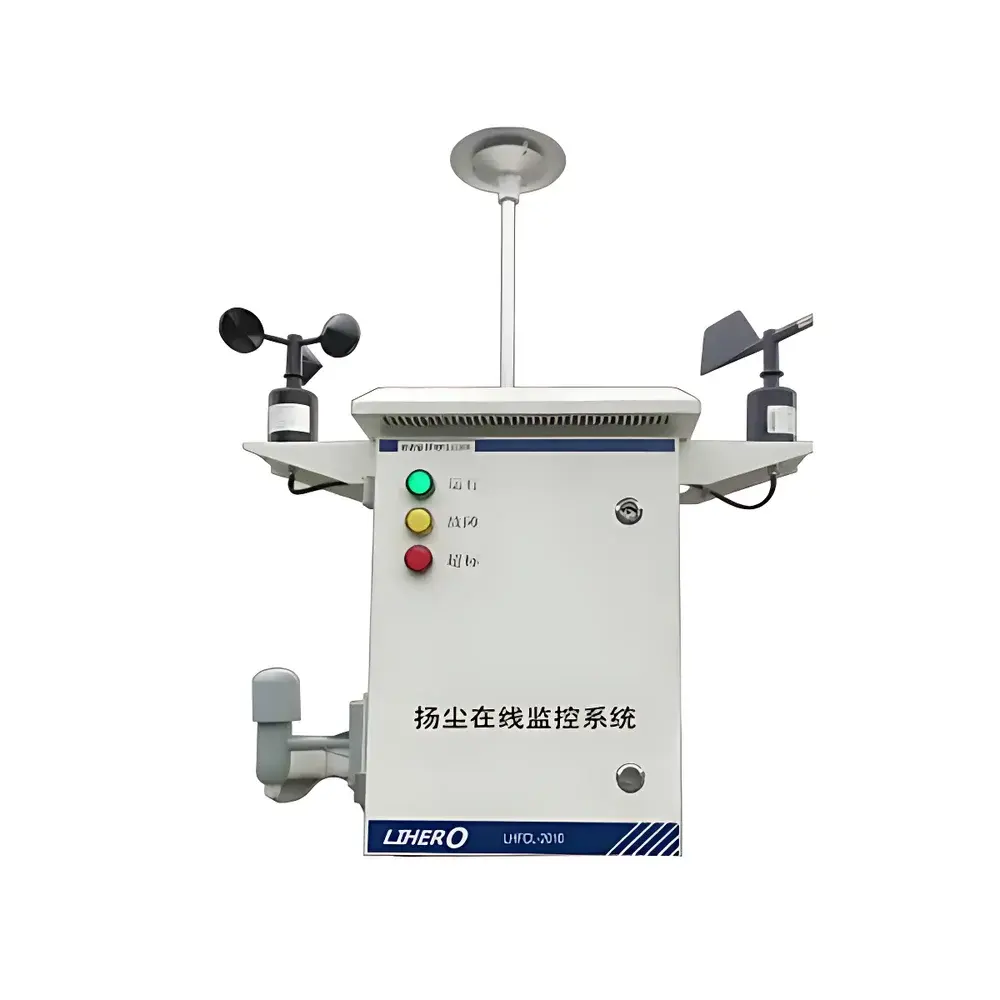
Lihero LHFCL-2010 Online Dust Monitoring System
| Brand | Lihero |
|---|---|
| Model | LHFCL-2010 |
| Detection Principle | Optical Scattering (Nephelometry) |
| Measured Parameters | TSP, PM₁₀, PM₂.₅, Wind Speed, Wind Direction, Ambient Temperature, Relative Humidity, Atmospheric Pressure, Rainfall |
| Installation Type | Outdoor Fixed-Station |
| Compliance | Designed to meet Chinese HJ 653–2013 and HJ 93–2013 technical requirements for particulate matter monitoring instruments |
| Data Output | RS485 / 4–20 mA / GPRS / NB-IoT / Ethernet |
| Environmental Rating | IP65 |
| Operating Temperature | −20 °C to +50 °C |
| Power Supply | AC 220 V ±10% or DC 12 V (with solar option) |
Overview
The Lihero LHFCL-2010 Online Dust Monitoring System is an integrated ambient air quality monitoring platform engineered for continuous, unattended measurement of airborne particulate matter and key meteorological parameters in outdoor environments. Based on the principle of optical scattering (nephelometry), the system quantifies particle concentration by detecting the intensity of light scattered at defined angles when a collimated light beam interacts with suspended aerosols. This method provides real-time, high-temporal-resolution data essential for regulatory compliance, source apportionment studies, and early-warning pollution event detection. The LHFCL-2010 is configured as a fixed-site monitoring station and meets the core functional and performance specifications outlined in China’s HJ 653–2013 (Technical Requirements for Continuous Ambient Air Quality Monitoring Systems) and HJ 93–2013 (Technical Requirements for Particulate Matter Samplers). It is not a portable or laboratory-grade instrument but a field-deployable environmental sensor node designed for long-term operational stability under variable climatic conditions.
Key Features
- Multi-parameter integration: Simultaneous measurement of total suspended particulates (TSP), PM₁₀, and PM₂.₅ mass concentrations using calibrated optical sensors with internal flow control and particle-cutting inlets.
- Integrated meteorological suite: Onboard anemometer, wind vane, temperature/humidity probe, barometric pressure sensor, and tipping-bucket rain gauge—enabling correlation analysis between particulate levels and local atmospheric dynamics.
- Active thermal management: Built-in temperature stabilization module minimizes drift induced by ambient thermal fluctuations, improving baseline stability and inter-day reproducibility.
- Automated zero-point calibration: Periodic self-calibration using clean-air reference cycles ensures long-term accuracy without manual intervention or external calibration gases.
- Modular architecture: Standardized electrical and mechanical interfaces allow seamless addition of optional modules—including SO₂, NO₂, O₃, CO, VOCs, or noise sensors—without hardware redesign or firmware reflash.
- Robust enclosure: IP65-rated weatherproof housing with UV-resistant polycarbonate and stainless-steel mounting hardware supports deployment in industrial perimeters, construction sites, urban traffic corridors, and municipal boundary zones.
Sample Compatibility & Compliance
The LHFCL-2010 is validated for use in ambient outdoor air matrices compliant with ISO 12103-1 A2 test dust and ISO 12103-1 A4 fine dust reference standards. Its optical sensing path is optimized for particles ranging from 0.3 µm to 100 µm aerodynamic diameter. While not certified to EU EN 12341 or US EPA EQPM designations, the system adheres to the metrological traceability framework specified in HJ 653–2013, including mandatory 7-day field precision testing, 24-hour zero/span drift verification, and documented maintenance logs. Data acquisition conforms to national environmental information transmission protocols (HJ 212–2017), enabling direct ingestion into provincial-level Environmental Monitoring Information Platforms (EMIP).
Software & Data Management
Data is logged locally at 1-minute intervals and transmitted via dual-path redundancy: primary GPRS/NB-IoT cellular uplink and secondary Ethernet or RS485 Modbus RTU interface. The embedded firmware supports TLS 1.2 encrypted communication and configurable data packet integrity checks. Remote configuration, firmware updates, and diagnostic reporting are accessible through a web-based administration portal (HTTPS) and a dedicated Android/iOS mobile application. All data timestamps are synchronized via NTP servers or GPS time signals. Audit trails—including sensor status flags, calibration events, power interruptions, and communication timeouts—are stored in non-volatile memory for GLP-aligned record retention. Export formats include CSV, JSON, and XML; API endpoints support integration with SCADA systems and third-party environmental dashboards.
Applications
- Real-time compliance monitoring at construction sites, demolition zones, and material stockpiles per local dust control ordinances.
- Urban air quality surveillance networks operated by municipal environmental protection bureaus.
- Industrial fence-line monitoring for cement plants, coal terminals, and aggregate processing facilities.
- Research-grade longitudinal studies on diurnal/seasonal PM patterns in relation to traffic volume, wind regimes, and precipitation events.
- Baseline assessment and post-mitigation verification for environmental impact assessments (EIA) and sustainability reporting (GRI 305).
FAQ
Does the LHFCL-2010 comply with U.S. EPA or European Union regulatory standards?
No—it is engineered and validated for deployment within China’s national ambient air monitoring framework (HJ series standards). It is not EPA EQPM-listed or CE-marked for conformity with EN 12341 or EN 14907.
Can the system operate independently during grid power outages?
Yes—optional solar panel + deep-cycle battery configuration enables continuous operation for ≥72 hours without AC mains, with intelligent power management prioritizing critical sensor functions.
Is remote firmware update supported over cellular networks?
Yes—over-the-air (OTA) firmware updates are implemented via signed binary packages with SHA-256 verification and rollback capability in case of failed installation.
What is the recommended maintenance interval?
Optical windows require cleaning every 30 days in high-dust environments; full preventive maintenance—including flow rate verification, zero-check, and inlet inspection—is recommended quarterly.
How is data security ensured during transmission?
All telemetry uses TLS 1.2 encryption; device authentication employs X.509 client certificates; no credentials or raw sensor data are exposed in plaintext at any layer of the communication stack.
Related Products







