
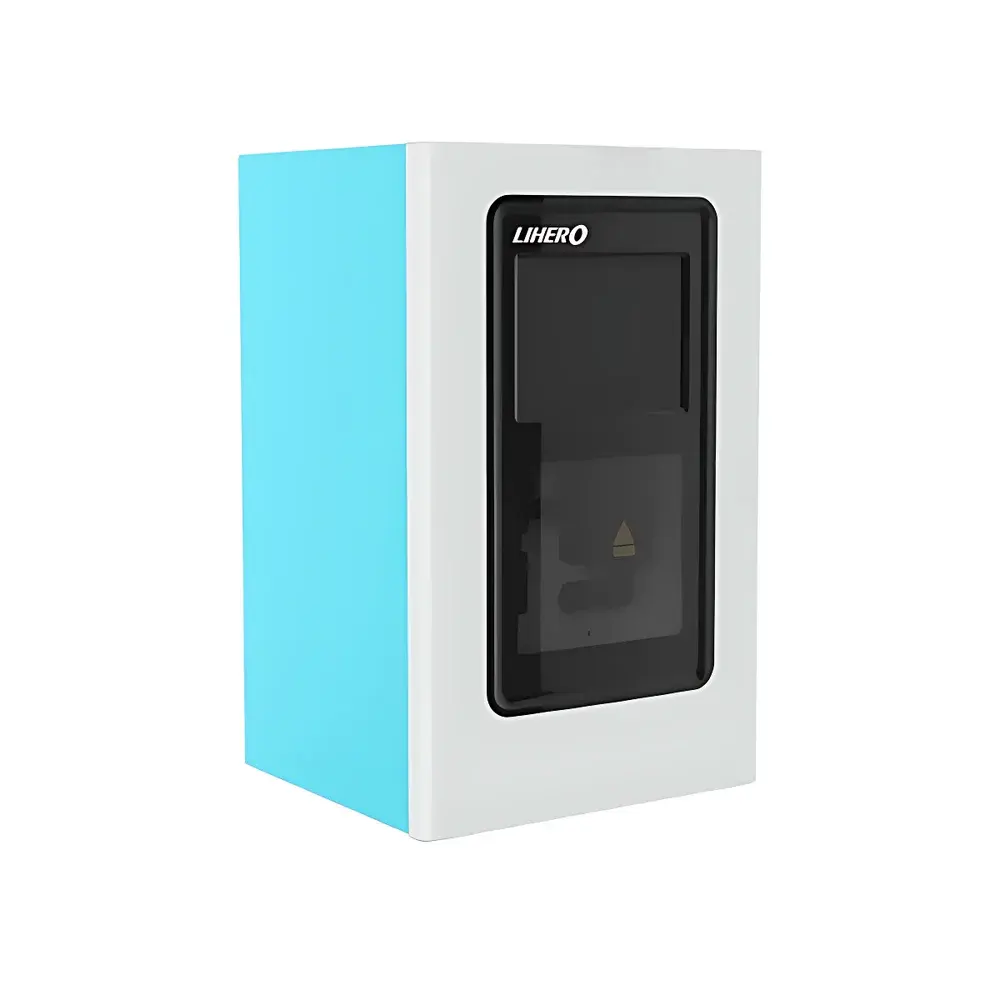
Lihero LFS-2002 Oil in Water Analyzer
| Brand | Lihero |
|---|---|
| Model | LFS-2002 (Oil) |
| Measurement Principle | UV Fluorescence |
| Detection Limit | Low (ppb-level typical for UVF oil analyzers) |
| Light Source | Pulsed Xenon Lamp |
| Sample Types | Floating, Dispersed, Emulsified & Dissolved Oil |
| Auto-sampling | Integrated |
| Auto-calibration & Auto-cleaning | Yes |
| Background Correction | Real-time Stray Light Compensation |
| QC Functions | Duplicate Analysis, Standard Verification, Spike Recovery, Event Logging, Alarm Notification |
| Range Switching | Automatic |
| Compliance | Designed per HJ 637–2018 (China), Compatible with ASTM D7678 & ISO 9562 Principles |
| Origin | Hunan, China |
| Distributor Type | Authorized Distributor |
Overview
The Lihero LFS-2002 Oil in Water Analyzer is a laboratory and field-deployable instrument engineered for quantitative determination of total petroleum hydrocarbons (TPH) in aqueous matrices using ultraviolet fluorescence (UVF) detection. It operates on the photophysical principle wherein polycyclic aromatic hydrocarbons (PAHs) and aliphatic components present in crude oil, diesel, lubricants, and other petroleum derivatives absorb UV radiation (typically 220–300 nm) and re-emit energy as characteristic molecular fluorescence in the visible range (300–450 nm). The intensity of this emitted signal is linearly proportional to analyte concentration within defined dynamic ranges—enabling rapid, reagent-free quantification without solvent extraction or pre-concentration steps. Unlike gravimetric or infrared methods, UVF delivers high selectivity for native petroleum compounds while minimizing interferences from humic substances or chlorophyll, provided spectral overlap is managed via optical filtering and background correction algorithms.
Key Features
- UV fluorescence detection optimized for broad-spectrum petroleum hydrocarbon response—including floating, dispersed, emulsified, and dissolved oil phases—without phase separation or chemical digestion.
- Pulsed xenon lamp excitation source ensures stable spectral output, extended operational lifetime (>1×10⁹ pulses), and reduced thermal drift compared to continuous mercury or deuterium lamps.
- Real-time stray light compensation algorithm dynamically corrects for ambient light intrusion and optical path contamination, maintaining measurement integrity in non-controlled environments.
- Integrated auto-sampler supports unattended operation with programmable sampling intervals; maintains hydrodynamic integrity during collection to preserve representative oil-phase distribution.
- Onboard quality control suite includes duplicate sample analysis, certified reference material (CRM) verification, spike recovery assessment (per EPA Method 1664B guidelines), and timestamped event logging for audit readiness.
- Self-maintaining architecture incorporates scheduled ultrasonic cleaning cycles and multi-point calibration validation to sustain long-term accuracy and reduce manual intervention.
- Intelligent range switching adapts gain and integration time automatically across low-ppb to mid-ppm concentration spans—eliminating manual dilution or method reconfiguration.
Sample Compatibility & Compliance
The LFS-2002 is validated for use with surface water, wastewater effluents, produced water, groundwater, and marine samples. It accommodates turbid, colored, or saline matrices where traditional IR-based methods suffer from water vapor absorption or suspended solids interference. While calibrated against national standard HJ 637–2018 (China), its optical design aligns with fundamental performance criteria in ASTM D7678 (Standard Test Method for Determination of Oil and Grease in Water by Solvent Extraction and Infrared Spectrophotometry) and ISO 9562 (Petroleum products — Determination of hydrocarbon types in middle distillates — High-performance liquid chromatography method), particularly regarding detection specificity and linearity. Instrument firmware supports GLP-compliant data handling, including user access controls, electronic signatures, and immutable audit trails meeting FDA 21 CFR Part 11 expectations when deployed in regulated environmental laboratories.
Software & Data Management
The embedded operating system provides intuitive touchscreen navigation and configurable measurement protocols. Raw fluorescence spectra, calibration curves, QC reports, and maintenance logs are exportable in CSV and PDF formats. Optional PC-based software enables remote monitoring, historical trend analysis, automated report generation (including ISO/IEC 17025-style uncertainty statements), and integration with LIMS platforms via OPC UA or Modbus TCP. All data records retain full traceability: operator ID, timestamp, instrument serial number, calibration certificate ID, and environmental metadata (temperature, pressure, sampling depth).
Applications
- Regulatory compliance monitoring at municipal wastewater treatment plants (WWTPs) and industrial discharge points.
- Leak detection and plume delineation in groundwater remediation projects.
- Offshore platform produced water characterization prior to reinjection or discharge.
- Environmental impact assessments (EIA) for pipeline crossings, drilling operations, and port development.
- Research studies on oil biodegradation kinetics and photochemical transformation pathways in aquatic systems.
- Calibration verification of online oil-in-water sensors used in continuous emission monitoring systems (CEMS).
FAQ
What is the typical detection limit for the LFS-2002 in clean freshwater matrices?
The instrument achieves sub-ppb (µg/L) detection limits under optimal conditions—dependent on matrix clarity, lamp stability, and integration time—but formal MDL validation must be performed per EPA Method 40 CFR Part 136 in the user’s laboratory environment.
Does the analyzer require solvent extraction or acidification prior to analysis?
No. The UVF method is direct-read and extractant-free, eliminating hazardous solvent use, disposal costs, and associated regulatory reporting burdens.
Can the LFS-2002 differentiate between crude oil and refined petroleum products?
It quantifies total petroleum hydrocarbons (TPH) as a class; speciation requires complementary techniques such as GC-FID or GC-MS. However, spectral fingerprinting modules (optional add-on) enable semi-quantitative product-type classification based on fluorescence excitation-emission matrices (EEMs).
Is the system compatible with third-party autosamplers or SCADA networks?
Yes—standard 4–20 mA analog outputs, RS-485 Modbus RTU, and Ethernet interfaces support integration into existing process control infrastructure.
How often does the optical path require manual cleaning or lamp replacement?
The pulsed xenon lamp is rated for ≥5 years of typical usage; quartz flow cell cleaning is fully automated every 24 hours or per user-defined schedule—no routine disassembly required.
Related Products







