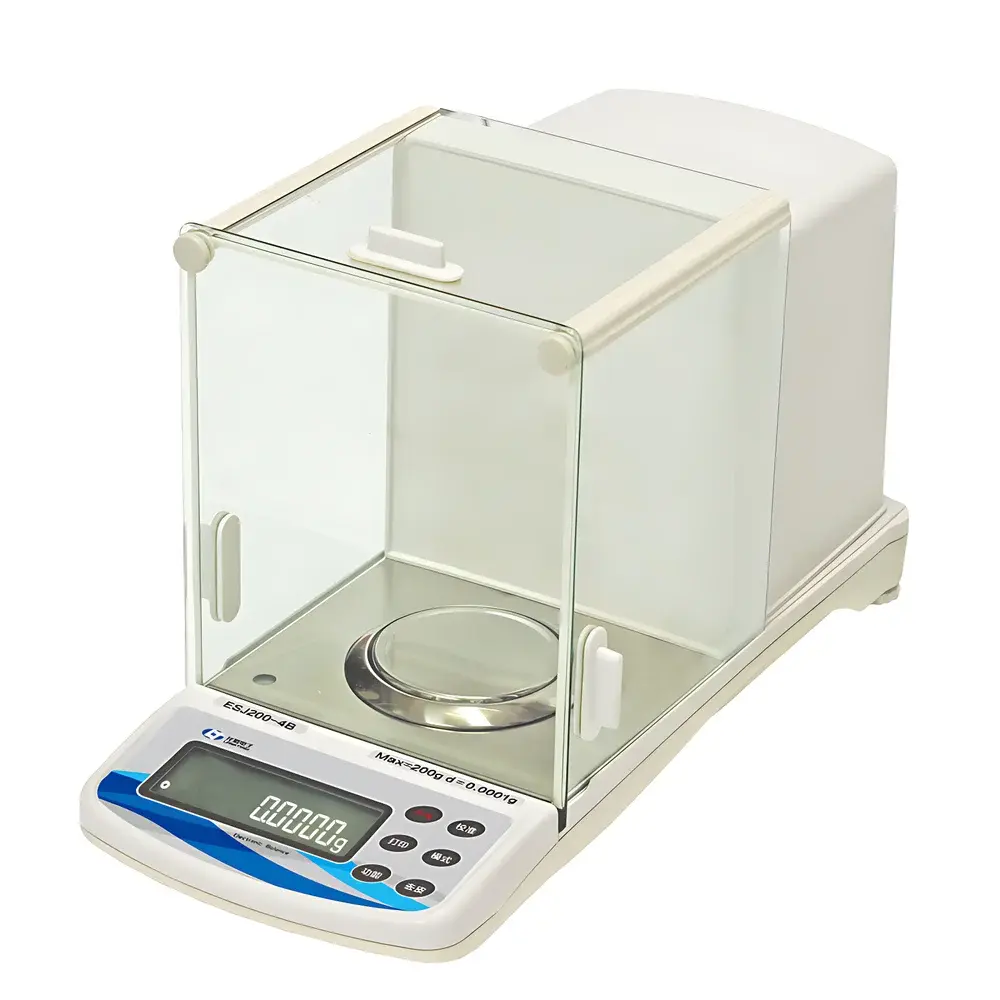
Longteng ESJ110-4B Precision Analytical Balance
| Brand | Longteng |
|---|---|
| Origin | Liaoning, China |
| Manufacturer Type | Authorized Distributor |
| Product Category | Domestic |
| Model | ESJ110-4B |
| Instrument Type | Analytical Balance |
| Maximum Capacity | 110 g |
| Readability | 0.1 mg |
| Repeatability | ±0.1 mg |
| Calibration Method | External Auto-Calibration |
| Pan Diameter | Φ90 mm |
| Interface | RS232 |
| Compliance | ISO/IEC 17025-compatible operation environment, GLP-compliant data logging capability |
Overview
The Longteng ESJ110-4B Precision Analytical Balance is a high-reproducibility mass measurement instrument engineered for routine and regulated laboratory environments requiring consistent 0.1 mg readability. It operates on the principle of electromagnetic force compensation (EMFC), where the downward gravitational force exerted by a sample is counterbalanced by an opposing electromagnetic force generated within a precision coil-magnet assembly. The resulting current required to maintain equilibrium is linearly proportional to mass and digitally converted into a stable, temperature-compensated readout. Designed for ISO/IEC 17025-aligned quality control laboratories, pharmaceutical QC units, academic research facilities, and materials testing labs, the ESJ110-4B delivers metrological reliability under standard ambient conditions (20 ±5 °C, RH <80%, non-condensing) without requiring active climate control.
Key Features
- High-stability rear-mounted electromagnetic force sensor with integrated thermal drift compensation circuitry, minimizing zero-point drift over extended operation cycles.
- Triple-door draft shield with wide-opening front access and side ventilation slots—optimized for rapid sample exchange while maintaining airflow stability during microgram-level weighing.
- Stainless steel weighing pan (Φ90 mm) supporting volumetric vessels up to 100 mL; corrosion-resistant surface compatible with aqueous, organic, and mildly acidic reagents.
- Backlit LCD display with adjustable contrast and auto-brightness adaptation—ensuring legibility in both low-illumination biosafety cabinets and high-glare analytical workstations.
- External auto-calibration function triggered via built-in calibration routine and supplied stainless steel reference weights (class M2 or better), traceable to national metrology institutes.
- Integrated overload/underload detection with audible and visual alerts, preventing sensor saturation and preserving long-term linearity performance.
Sample Compatibility & Compliance
The ESJ110-4B accommodates solid, powdered, and liquid samples within standard laboratory containers—including weighing boats, vials, crucibles, and beakers—provided total mass remains within the 110 g maximum capacity. Its sealed sensor housing and IP42-rated enclosure meet basic environmental protection requirements for non-hazardous lab spaces. While not intrinsically rated for Class I Div 1 hazardous areas, it complies with general electrical safety standards (IEC 61010-1). For regulatory workflows, the balance supports GLP-compliant documentation when paired with RS232-connected PCs running validated data acquisition software. Audit trails, user login logs, and calibration event timestamps can be exported for internal QA review or FDA 21 CFR Part 11–aligned systems (with appropriate third-party software validation).
Software & Data Management
Equipped with a standard RS232 serial interface (configurable baud rates: 9600–115200), the ESJ110-4B enables bidirectional communication with external devices. Raw mass values, unit identifiers (g, ct, oz, %, pcs), and status flags (e.g., “CAL”, “OVER”, “STAB”) are transmitted in ASCII format per NIST-traceable protocol conventions. Optional Windows-based terminal emulation or dedicated balance control software allows real-time data capture, statistical analysis (mean, SD, CV%), and export to CSV, Excel, or LIMS-compatible XML schemas. All firmware operations—including calibration sequence initiation, unit switching, and tare memory recall—are accessible via front-panel keypad without external dependencies.
Applications
- Pharmaceutical formulation: Accurate dispensing of active pharmaceutical ingredients (APIs) and excipients in tablet development per USP <41> requirements.
- Chemical synthesis: Stoichiometric reagent dosing for catalytic reactions where ±0.1 mg error corresponds to sub-0.05% molar deviation at 100 mg scale.
- Materials science: Gravimetric determination of moisture content (ASTM D2298), ash residue (ASTM D3174), or catalyst loading ratios.
- Academic teaching labs: Student training in uncertainty propagation, significant figure handling, and statistical process control using repeat weighings.
- Food & agriculture QC: Nutrient density verification, additive concentration checks, and compliance with Codex Alimentarius mass-based labeling thresholds.
FAQ
What calibration standards are required for routine verification?
A certified class M2 or better external weight (100 g nominal) is recommended for daily verification. Full recalibration should follow manufacturer-specified intervals or after mechanical shock, relocation, or ambient temperature shifts exceeding ±5 °C.
Is density determination supported natively?
Density measurement requires optional accessories: a universal density kit (including sinker, support rod, and liquid bath) and firmware upgrade. The balance calculates density using Archimedes’ principle with user-input reference liquid density.
Can the balance operate in continuous weighing mode for dynamic processes?
No—the ESJ110-4B is optimized for static, stabilized measurements only. It lacks real-time streaming output or analog signal outputs required for inline process monitoring.
Does the RS232 interface support plug-and-play connection with modern laptops?
Yes, provided a USB-to-RS232 adapter with FTDI or Prolific chipset drivers is installed. Terminal settings must match: 9600 baud, 8N1, no flow control.
How is temperature compensation implemented?
An internal thermistor monitors coil and housing temperature in real time; firmware applies empirically derived correction coefficients to offset thermal expansion effects on magnetic field strength and spring constant.