
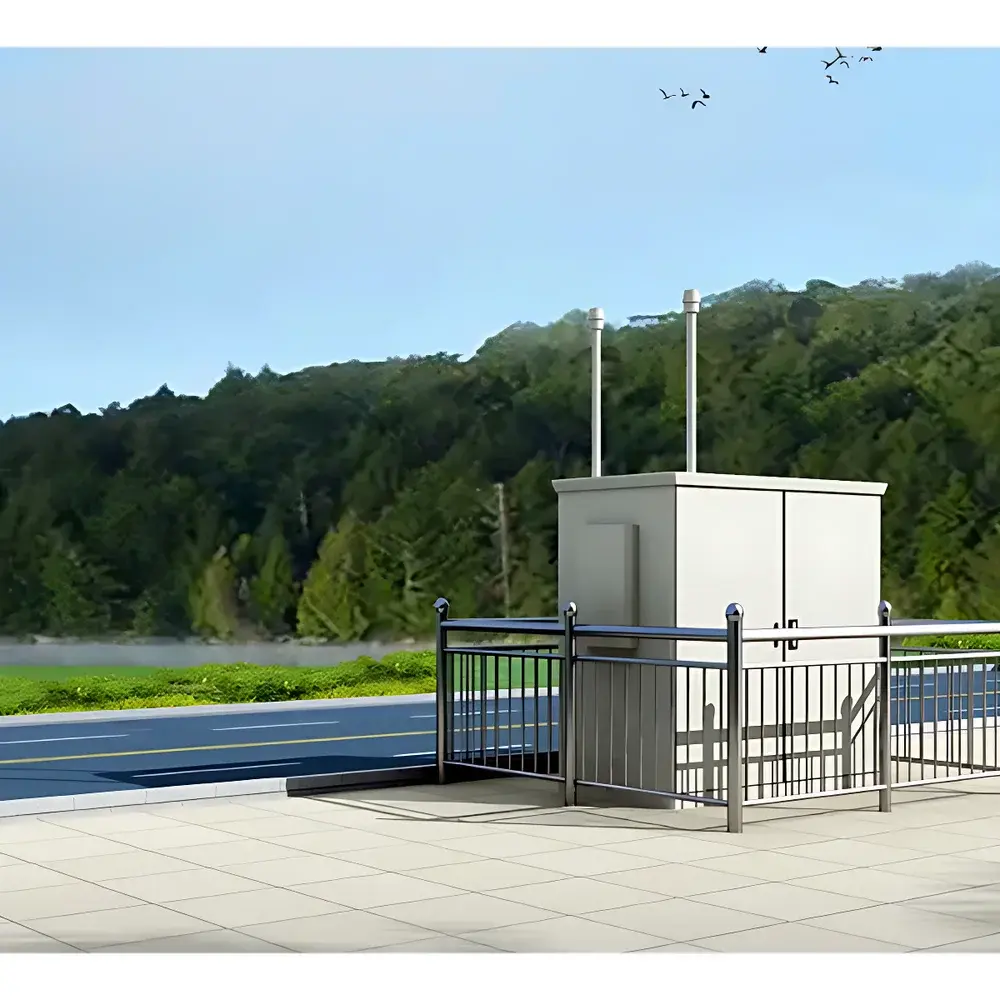
Roadside Mobile Source Monitoring Station (Lihero Model)
| Brand | Lihero |
|---|---|
| Origin | Hunan, China |
| Manufacturer Type | Authorized Distributor |
| Country of Origin | China |
| Model | Roadside Mobile Source Monitoring Station |
| Pricing | Available Upon Request |
Overview
The Lihero Roadside Mobile Source Monitoring Station is an integrated, stationary ambient air quality monitoring platform engineered for real-time, continuous measurement of traffic-related emissions at curbside, tunnel exits, highway interchanges, and urban hotspots. Unlike conventional fixed-site air monitors, this system is specifically optimized for mobile source characterization—capturing transient plumes from passing vehicles with high temporal resolution. It operates on a multi-sensor architecture combining gas-phase analyzers (for NOx, CO, SO2, O3, VOCs via PID or GC-FID), optical particle counters (OPC) and β-attenuation or TEOM-based PM2.5/PM10 mass monitors, and meteorological sensors (wind speed/direction, temperature, humidity, pressure). Data are acquired at 1–10 second intervals, time-stamped with GPS-synchronized UTC, and processed using embedded algorithms compliant with EPA Method TO-15 and ISO 16000-6 for VOC speciation and PM source apportionment.
Key Features
- Automated range switching and zero/span calibration routines—executed hourly or on-demand—ensuring measurement integrity across dynamic concentration gradients typical of roadside environments (e.g., NOx: 0–5,000 ppb; PM2.5: 0–1,000 µg/m³).
- Full data provenance: raw sensor outputs, instrument status flags (e.g., flow fault, lamp intensity decay), diagnostic logs, and QC event timestamps are stored locally on industrial-grade SSD and mirrored to secure cloud storage—fully traceable per ISO/IEC 17025:2017 Clause 7.7.
- Modular mechanical design adhering to EN 17383:2020 mounting dimensions; standardized 19-inch rack interface and IP65-rated enclosure enable rapid deployment in existing traffic cabinets or purpose-built kiosks.
- TCP/IP-native communication stack supporting Modbus TCP, MQTT v3.1.1, and HTTP RESTful APIs—enabling seamless integration with central SCADA systems, third-party GIS platforms, and national air quality data portals (e.g., China’s CNEMC, EU’s AirBase).
- High-sensitivity electrochemical and metal oxide semiconductor (MOS) gas sensors with <5 s T90 response time and sub-ppb detection limits for key aromatic VOCs (e.g., benzene, toluene); OPCs with 0.3–10 µm sizing resolution and ±5% counting efficiency per ISO 21501-4.
- Embedded self-diagnostics including flow rate validation, optical path contamination alerts, pressure drop monitoring across PM filters, and automated alarm escalation via SNMP traps or email/SMS—achieving >95% data capture efficiency over 30-day operational cycles under GLP-compliant audit conditions.
Sample Compatibility & Compliance
The station is validated for ambient air sampling per ISO 12039 (SO2), ISO 6974-4 (VOCs), and EN 14625 (NOx). Its inlet configuration meets EPA Guidance for Roadside Monitoring (EPA-454/R-17-003), including laminar-flow isokinetic sampling at 16.7 L/min and heated sample lines (≥50 °C) to prevent semi-volatile condensation. All firmware and data handling workflows support audit-ready metadata tagging—including operator ID, calibration certificate numbers, and uncertainty budgets—aligned with ISO/IEC 17025 requirements for accredited environmental testing laboratories.
Software & Data Management
Lihero AirView™ software provides unified control of all subsystems via web-based dashboard (HTTPS/TLS 1.2). It supports configurable data validation rules (e.g., spike detection per US EPA QA/G-5), automatic flagging of out-of-spec events, and generation of daily summary reports compliant with China’s HJ 653-2013 and EU Directive 2008/50/EC Annex IX. Raw time-series data are exportable in NetCDF-4 format with CF-1.8 metadata conventions. For regulated environments, optional 21 CFR Part 11-compliant electronic signature module enables role-based access control, audit trail logging, and immutable record retention.
Applications
- Regulatory compliance monitoring at national highway corridors and urban low-emission zones (LEZs)
- Source attribution studies linking PM2.5 organic carbon fractions and VOC reactivity to diesel vs. gasoline fleet contributions
- Validation of traffic emission inventories (e.g., COPERT, MOVES) using observed vs. modeled pollutant ratios (e.g., NO2/NOx, benzene/toluene)
- Real-time exposure assessment for epidemiological cohort studies near schools, hospitals, and residential buffers
- Performance evaluation of retrofit technologies (e.g., DPFs, SCR systems) via paired upstream/downstream monitoring
FAQ
Does the station support remote calibration verification?
Yes—automated zero/span checks can be triggered remotely via AirView™; calibration gas certificates and drift correction factors are logged with digital signatures.
Can it integrate with existing municipal air quality networks?
Yes—standardized JSON/XML API endpoints and pre-certified drivers for common SCADA platforms (e.g., Ignition, Siemens Desigo) ensure interoperability.
What is the minimum recommended maintenance interval?
Bi-weekly visual inspection and quarterly full functional check are advised; sensor modules feature field-replaceable cartridges with plug-and-play calibration memory.
Is particulate matter data corrected for humidity effects?
Yes—integrated relative humidity and temperature compensation is applied per ISO 20988:2008 Annex B for β-attenuation PM monitors.
How is cybersecurity addressed in firmware updates?
All OTA updates require signed firmware images verified via ECDSA-256; update history and rollback capability are retained in tamper-evident logs.
Related Products







