
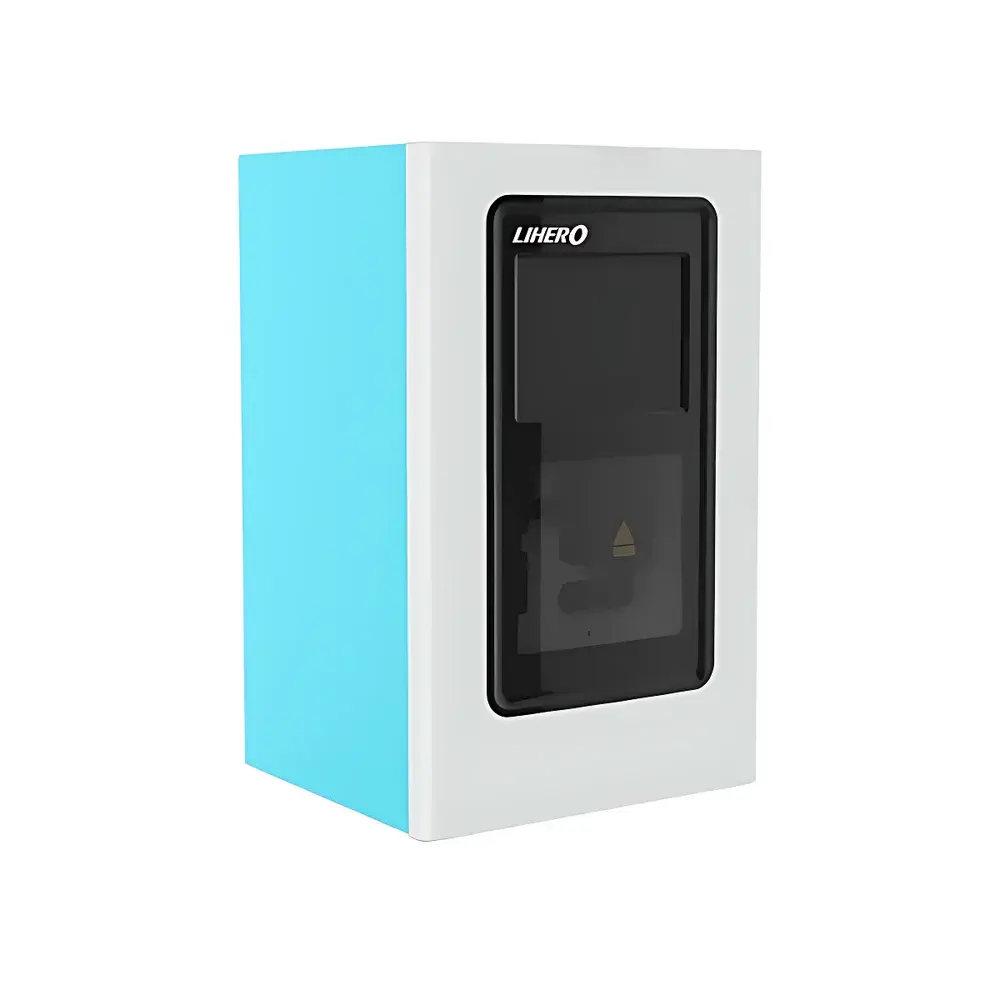
Lihero LFS-2002(TP) Online Total Phosphorus Analyzer
| Brand | Lihero |
|---|---|
| Model | LFS-2002(TP) |
| Type | Online Analyzer |
| Measurement Principle | Peroxysulfate Digestion + Ascorbic Acid-Molybdate Colorimetry |
| Detection Method | Photometric Absorption at 700 nm |
| Compliance | HJ/T 212–2017, GB 11893–1989 |
| Power Supply Insulation Resistance | ≥20 MΩ |
| Communication Interfaces | RS-232 / RS-485 / RJ-45 |
| Operating System | Embedded Linux |
Overview
The Lihero LFS-2002(TP) Online Total Phosphorus Analyzer is an industrial-grade, fully automated water quality monitoring instrument engineered for continuous, unattended measurement of total phosphorus (TP) in municipal wastewater, surface water, effluent discharge streams, and industrial process water. It implements the standardized persulfate oxidation method (per HJ 535–2009 and GB 11893–1989) to convert all phosphorus species—including organic phosphates, condensed phosphates, and orthophosphate—into reactive orthophosphate under high-temperature, high-pressure acidic digestion. Subsequent colorimetric quantification employs the ascorbic acid–molybdate reduction reaction in the presence of antimony potassium tartrate, generating a stable blue heteropoly acid complex with absorbance peak at 700 nm. This photometric detection architecture ensures trace-level sensitivity and long-term baseline stability in field-deployed environments.
Key Features
- High-efficiency sealed digestion module operating at elevated temperature and pressure, achieving >95% oxidation efficiency for refractory phosphorus compounds.
- Real-time turbidity and chromaticity compensation algorithm, dynamically correcting optical path interference without manual intervention or secondary filtration.
- Comprehensive built-in quality control suite: automatic zero-point verification, span calibration, standard sample validation, multi-point working curve auto-generation, and spike recovery assessment per analytical cycle.
- Fault-resilient operational architecture with self-diagnostic capability—detecting reagent depletion (digestion reagent, molybdate solution, ascorbic acid), sample flow interruption, heater failure, photometer drift, and out-of-range absorbance events.
- Intelligent adaptive range switching: automatically selects optimal optical path length and dilution factor based on real-time signal intensity, extending effective measurement range from 0.01 to 10.00 mg/L P without manual configuration.
- Embedded Linux-based control system enabling deterministic real-time task scheduling, secure firmware updates, and robust memory management for 24/7 operation.
Sample Compatibility & Compliance
The LFS-2002(TP) accepts raw influent, clarified effluent, river water, and treated industrial discharge without pre-filtration—provided suspended solids remain below 100 mg/L. It complies with Chinese national environmental monitoring standards including HJ 535–2009 (determination of total phosphorus in water by ammonium molybdate spectrophotometry), GB 11893–1989 (water quality—determination of total phosphorus—ammonium molybdate spectrophotometric method), and data transmission protocol HJ/T 212–2017. Its electrical safety design meets GB 4793.1–2007 (safety requirements for electrical equipment for measurement, control, and laboratory use), with minimum insulation resistance of 20 MΩ between power input and chassis ground.
Software & Data Management
Instrument firmware supports bidirectional communication via RS-232, RS-485, or Ethernet (RJ-45), enabling remote parameter configuration, method selection, and diagnostic query through supervisory SCADA or DCS platforms. All calibration logs, QC results, alarm timestamps, and raw absorbance values are time-stamped and stored locally with non-volatile memory retention exceeding 180 days. Data export adheres to HJ/T 212–2017 frame structure, including mandatory fields for instrument ID, measurement value, validity flag, QC status, and environmental condition metadata. Audit trails record all user-initiated actions—including calibration overrides and range changes—with immutable timestamps for GLP-aligned documentation.
Applications
- Continuous compliance monitoring at wastewater treatment plant (WWTP) discharge points per local TP limits (e.g., ≤0.5 mg/L in Class I-A discharge standards).
- Process control feedback loop in tertiary treatment units utilizing phosphorus removal via coagulation or biological uptake.
- Early-warning surveillance in reservoirs and lakes prone to eutrophication, supporting nutrient load modeling and watershed management.
- Industrial pretreatment verification for electroplating, fertilizer manufacturing, and food processing facilities subject to phosphorus discharge permits.
- Integration into smart water networks where synchronized TP data feeds predictive maintenance algorithms and digital twin simulations.
FAQ
What digestion method does the LFS-2002(TP) employ, and how does it ensure complete phosphorus oxidation?
It uses high-temperature (120–125 °C), high-pressure alkaline persulfate digestion in a sealed quartz reactor, achieving quantitative conversion of organophosphorus, polyphosphates, and particulate-bound phosphorus to orthophosphate per GB 11893–1989.
Does the analyzer support remote calibration and software updates?
Yes—via standard Modbus RTU (RS-485) or TCP/IP (Ethernet), authorized users can initiate zero/span calibrations, upload new calibration curves, and deploy firmware patches without physical access.
How is optical interference from colored or turbid samples mitigated?
A dual-wavelength photometric engine measures both primary (700 nm) and reference (850 nm) absorbance simultaneously; proprietary algorithms subtract non-specific scattering and background chroma in real time.
What maintenance intervals are recommended for routine operation?
Reagent replacement every 30 days (typical), quartz digestion cell cleaning every 90 days, and full optical path inspection annually—automated cleaning cycles occur after each analysis to minimize fouling.
Is the instrument suitable for outdoor installation in variable ambient conditions?
It is rated IP65 for dust and water ingress protection and operates continuously within –10 °C to +50 °C ambient range when installed in a temperature-controlled cabinet or sheltered enclosure.







