
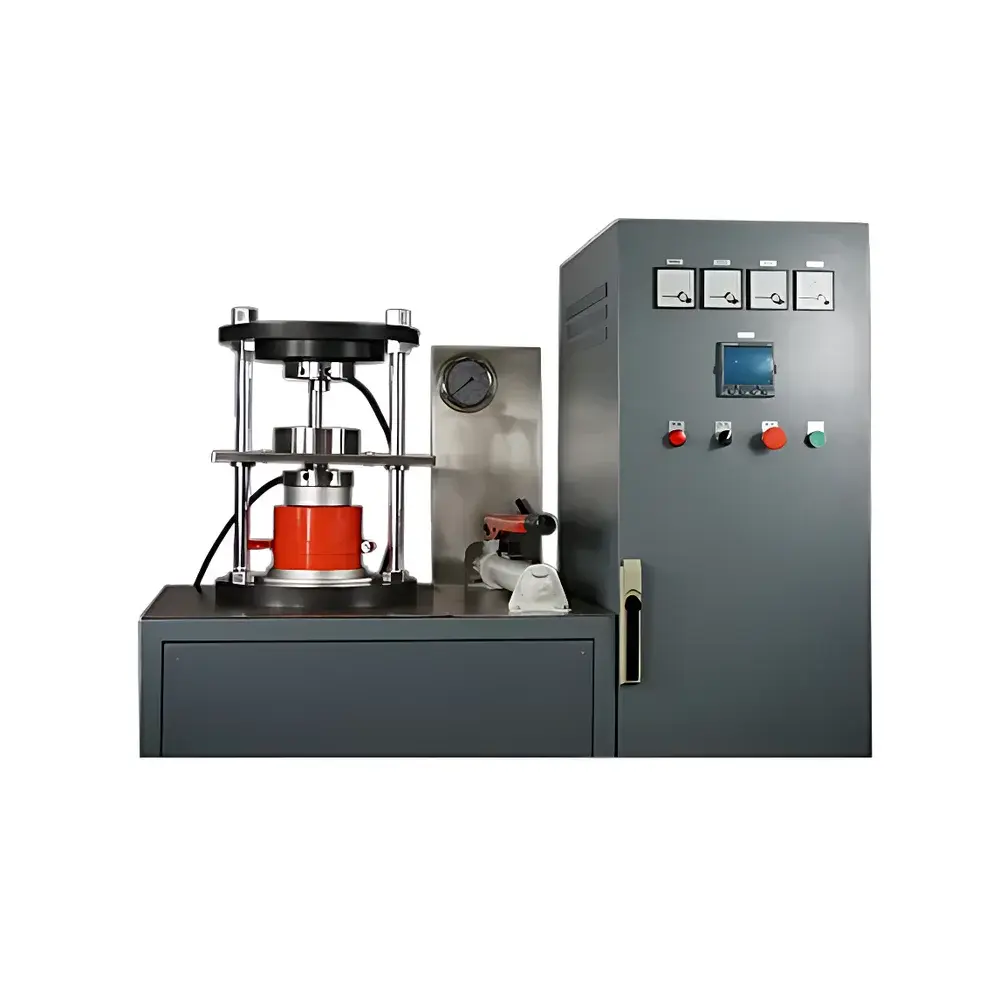
Rocktek RTK Series Piston-Cylinder High-Pressure Apparatus with Automated Pressure Control
| Brand | Rocktek |
|---|---|
| Origin | Hubei, China |
| Model | RTK Piston-Cylinder High-Pressure Apparatus (Automated) |
| Pressure Range | 0–4 GPa |
| Temperature Range | 25–1800 °C |
| Sample Chamber Diameter Options | 10 / 13 / 19 mm |
| Automation | Fully automated pressure ramping and isobaric hold |
| Thermal Ramp & Cool-down Rate | Programmable |
| Continuous Operation Duration | Hours to multi-day stable runs |
| Compliance | Designed for GLP-aligned research environments |
Overview
The Rocktek RTK Series Piston-Cylinder High-Pressure Apparatus is a statically loaded, resistively heated high-pressure experimental platform engineered for reproducible generation of controlled thermobaric conditions in geosciences, condensed matter physics, and advanced materials synthesis. Based on the classical piston-cylinder geometry—where axial force is transmitted through hardened steel or tungsten carbide pistons into a cylindrical pressure medium (e.g., NaCl, MgO, or borosilicate glass)—this apparatus achieves hydrostatic or quasi-hydrostatic pressure states via solid-medium confinement. When coupled with high-purity graphite or MoSi₂ heaters and calibrated thermocouples (Type C or S), it delivers precise, spatially uniform temperatures up to 1800 °C under pressures reaching 4 GPa. Unlike gas-membrane or diamond-anvil cell systems, the RTK piston-cylinder design provides significantly larger sample volumes (mm³ scale), enabling bulk property measurements—including in situ X-ray diffraction, electrical transport, magnetic susceptibility, and quench-recovery microstructural analysis.
Key Features
- Automated pressure control system: Integrated servo-hydraulic actuation with closed-loop feedback enables programmable pressure ramping (e.g., 0.1–100 MPa/min), precise isobaric stabilization (< ±5 MPa drift over 72 h), and real-time pressure logging synchronized with thermal profiles.
- Modular chamber architecture: Interchangeable pressure assemblies support three standard inner bore diameters—10 mm, 13 mm, and 19 mm—allowing optimization between pressure ceiling, sample mass, and thermal homogeneity.
- Thermal management precision: Dual-zone heating configuration (top/bottom heater symmetry) combined with active cooling channels ensures axial temperature gradients < ±15 °C across 10 mm sample lengths at 1600 °C.
- Robust mechanical construction: Load frame fabricated from pre-stressed alloy steel; pressure-transmitting components manufactured from WC-Co composites or sintered diamond compacts for long-term dimensional stability under cyclic loading.
- Flexible operational modes: Supports manual, semi-automated (pre-set ramp/hold sequences), and fully automated protocols via Ethernet-connected controller with SCPI-compatible command set.
Sample Compatibility & Compliance
The RTK apparatus accommodates diverse sample geometries—including cylindrical capsules (Pt, Au, Ni, or graphite), layered multianvil inserts, and encapsulated powder or single-crystal specimens—compatible with common pressure media such as NaCl, KCl, MgO, and pyrophyllite. All standard configurations comply with ASTM E220 (thermocouple calibration), ISO 17025 principles for measurement traceability, and mechanical safety guidelines per EN 61000-6-2 (EMC immunity). For regulated research environments—including pharmaceutical polymorph screening or nuclear materials simulation—the system supports optional audit-trail-enabled firmware compliant with FDA 21 CFR Part 11 requirements when integrated with validated LIMS or ELN platforms.
Software & Data Management
Control and monitoring are executed via Rocktek’s proprietary RTK-PCSuite v3.x software, running on Windows OS with native support for IEEE-488, TCP/IP, and Modbus RTU interfaces. The software provides synchronized acquisition of pressure (strain-gauge or piezoresistive transducer), temperature (dual thermocouple inputs with cold-junction compensation), and time-stamped event markers (e.g., furnace power, hydraulic valve state). Raw datasets export to HDF5 or CSV formats; metadata embedding follows ISA-Tab conventions. Optional Python SDK enables integration into automated workflows using Jupyter-based analysis pipelines or custom machine learning models for condition optimization.
Applications
This apparatus serves as a foundational tool in high-pressure experimental laboratories. In Earth and planetary sciences, it replicates mantle-relevant P–T paths for phase equilibria studies of silicates, carbonates, and hydrous minerals. In materials science, it facilitates synthesis of superhard phases (e.g., wurtzite BN, rhenium diboride), high-Tc superconductors (e.g., FeSe-based intercalates), and metastable ferroelectrics. In chemical physics, it enables kinetic studies of solid-state reactions under confinement, while in aerospace R&D, it supports qualification testing of thermal barrier coatings and refractory composites under thermo-mechanical stress. Its scalability—from desktop units (≤150 kg footprint) to full-frame configurations—makes it suitable for both university teaching labs and national facility beamlines.
FAQ
What pressure media are recommended for operation up to 4 GPa?
NaCl and MgO are routinely used below 3 GPa; above this threshold, borosilicate glass or sintered Al2O3 capsules with MgO sleeves provide improved hydrostaticity and reduced shear stress.
Can the system be retrofitted with in situ diagnostics?
Yes—standard flanged ports (CF-40 or KF-50) allow integration of synchrotron XRD, resistivity probes, or fiber-optic pyrometry without structural modification.
Is third-party calibration support available?
Rocktek maintains partnerships with ISO/IEC 17025-accredited metrology institutes for annual pressure transducer recalibration and thermocouple verification services.
What maintenance intervals are advised for hydraulic and heating subsystems?
Hydraulic oil replacement every 12 months or 2000 operating hours; graphite heater inspection after every 50 high-temperature (>1500 °C) cycles; pressure seal replacement following manufacturer-specified torque degradation thresholds.
Does the system meet electromagnetic compatibility standards for use near sensitive instrumentation?
Yes—RTK units undergo conducted/radiated emissions testing per CISPR 11 Group 2 Class A and are supplied with shielded cabling and ferrite suppression as standard.



