
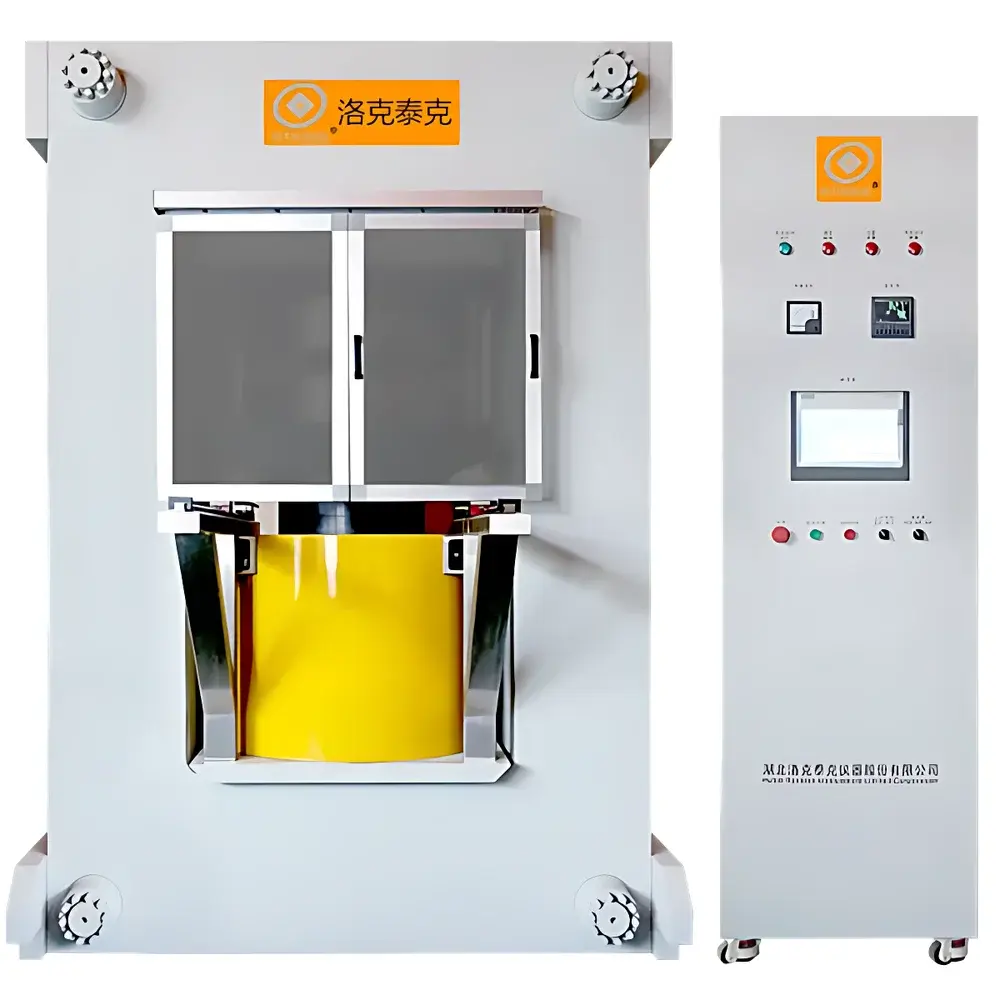
Rocktek DIA-Type and D-DIA-Type Large-Volume Press for High-Pressure High-Temperature Research
| Brand | Rocktek |
|---|---|
| Model | DIA / D-DIA |
| Type | Kawai-Style Multi-Anvil Apparatus |
| Maximum Load Capacity | 1000–2000 metric tons |
| Sample Pressure Range | >20 GPa |
| Sample Temperature Range | >2000 °C |
| Anvil Material | Tungsten Carbide (WC) |
| Stroke | 150 mm |
| Low-Pressure Drive | Hydraulic System |
| High-Pressure Fine Control | Servo-Motor-Driven with PLC Feedback Loop |
| Pressure Control Accuracy | ±0.5 bar |
Overview
The Rocktek DIA-Type and D-DIA-Type large-volume high-pressure high-temperature (HPHT) presses are engineered for geophysical, planetary science, and advanced materials research requiring reproducible static compression beyond 20 GPa and simultaneous heating above 2000 °C. Based on the well-established Kawai-type multi-anvil architecture, these systems employ a six-eight (6–8) anvil configuration with tungsten carbide (WC) anvils to generate quasi-hydrostatic pressure fields within mm-scale sample volumes. Unlike diamond anvil cells (DACs), DIA presses offer significantly larger sample volumes (typically 1–3 mm diameter, ~1 mm height), enabling robust in situ measurements—including electrical resistivity, synchrotron X-ray diffraction, Mössbauer spectroscopy, and optical absorption—via multiple feedthroughs in their open-frame mechanical design. The D-DIA variant incorporates dual opposed anvils with precise alignment mechanisms, enhancing pressure homogeneity and enabling differential stress studies relevant to mantle rheology and deformation physics.
Key Features
- Hybrid actuation system: High-speed hydraulic drive for initial loading in the low-pressure regime (<5 GPa), followed by ultra-precise servo-motor-driven fine pressure control in the high-pressure regime, minimizing thermal drift and mechanical hysteresis.
- Digital closed-loop pressure regulation: Real-time feedback from calibrated digital pressure transducers (0.05% FS accuracy) routed through a programmable logic controller (PLC), ensuring dynamic tracking of user-defined pressure–time profiles with ≤±0.5 bar deviation.
- Segment-based profile programming: Up to 32 independent time–pressure segments per experiment; each segment allows independent ramp rate, hold duration, and target pressure—enabling complex thermobaric histories mimicking geodynamic processes.
- Network-integrated supervisory interface: Ethernet-enabled communication (Modbus TCP/IP) supports remote monitoring, data logging, and integration with laboratory information management systems (LIMS) or custom Python/Matlab acquisition scripts.
- Low-noise operational envelope: Absence of high-flow hydraulic valves during fine control eliminates broadband mechanical noise, critical for vibration-sensitive synchrotron beamline experiments and low-frequency impedance measurements.
- Open mechanical architecture: Modular frame design accommodates customized furnace assemblies (e.g., graphite, LaCrO₃, or MoSi₂ heaters), multi-wire electrical leads, optical viewports, and vacuum/gas-purge manifolds without structural modification.
Sample Compatibility & Compliance
The DIA/D-DIA platform is compatible with standard octahedral pressure media (e.g., NaCl, MgO, boron epoxy) and common heater geometries (tube, toroid, split-tube). It supports both resistive heating (DC/AC) and laser-heated configurations when integrated with external optical paths. All control firmware complies with IEC 61508 SIL2 functional safety requirements for industrial automation. Data acquisition meets ALCOA+ principles for regulated environments: attributable, legible, contemporaneous, original, accurate, complete, consistent, enduring, and available. Audit trails, electronic signatures, and role-based access control are configurable to satisfy FDA 21 CFR Part 11 and EU Annex 11 requirements where applicable.
Software & Data Management
The Rocktek HPHT Control Suite provides a Windows-based GUI with real-time plotting, alarm management, and automated report generation (PDF/CSV). Raw sensor data—including pressure, temperature (via C-type thermocouples or W-Re thermocouples), motor current, and valve status—is timestamped at 10 Hz and stored in HDF5 format for interoperability with scientific Python (NumPy, SciPy, h5py) and MATLAB workflows. Export modules support ASTM E2928-compliant test record templates and ISO/IEC 17025 traceability metadata embedding. Firmware updates are delivered via signed OTA packages with SHA-256 verification.
Applications
- Equation-of-state determination of Earth and planetary mantle minerals (e.g., bridgmanite, ferropericlase, CaSiO₃ perovskite) under deep-mantle conditions.
- In situ phase transition studies using synchrotron XRD, XAS, or Raman spectroscopy across pressure-induced amorphization, spin transitions, and symmetry-breaking events.
- High-pressure synthesis of novel superconductors, ultra-hard ceramics, and metastable polymorphs inaccessible at ambient conditions.
- Rheological characterization of silicate melts and metallic alloys under controlled deviatoric stress (D-DIA mode).
- Calibration of pressure standards (e.g., Pt, Au, MgO, Fe) and development of new pressure scales for multi-anvil devices.
- Thermal conductivity and Seebeck coefficient measurements under simultaneous HPHT via four-probe and lock-in techniques.
FAQ
What distinguishes the DIA from the D-DIA configuration?
The DIA uses a conventional 6–8 anvil geometry with radial symmetry, optimized for hydrostatic compression. The D-DIA replaces two opposing WC anvils with larger, precisely aligned opposed anvils, enabling controlled differential stress application and improved axial strain resolution for deformation experiments.
Can the system be integrated with synchrotron beamlines?
Yes—the open-frame design, standardized flange interfaces (CF-63/CF-100), and low-vibration servo control meet beamline compatibility requirements at APS, ESRF, SPring-8, and PETRA III. Remote operation via EPICS IOC support is available upon request.
Is third-party software integration supported?
Full API documentation (RESTful HTTP endpoints and Modbus register map) is provided for integration with LabVIEW, Python, MATLAB, or custom LIMS platforms. SCADA-level OPC UA gateway licensing is optional.
What maintenance intervals are recommended?
Hydraulic fluid analysis annually; WC anvil inspection after every 50 high-pressure cycles (>15 GPa); servo motor encoder calibration biannually. Mean time between failures (MTBF) exceeds 12,000 operating hours under standard lab use.
Does the system comply with GLP/GMP documentation standards?
Yes—when configured with optional 21 CFR Part 11 add-on module, it provides electronic signature enforcement, change control logs, and raw data archiving compliant with ISO/IEC 17025 and OECD GLP principles.





