
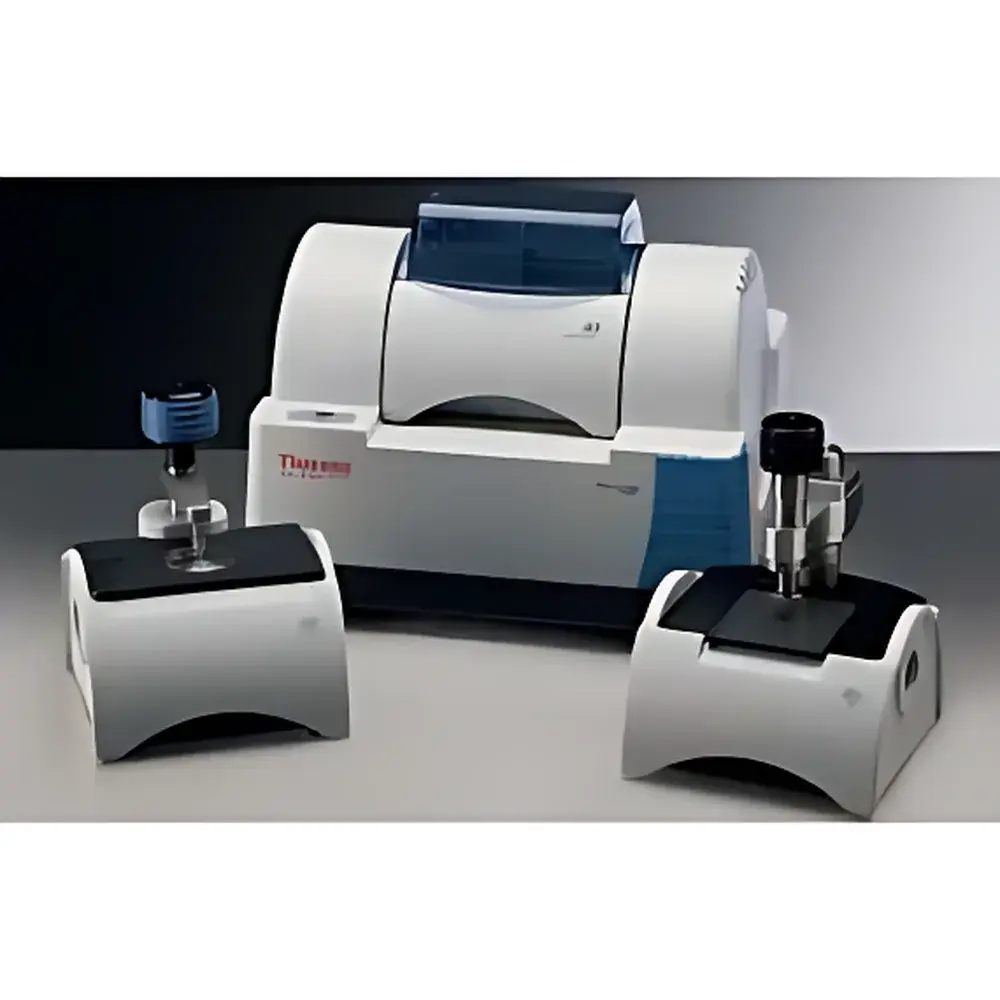
Thermo Scientific Nicolet iS5 Fourier Transform Infrared (FT-IR) Spectrometer
| Brand | Thermo Scientific |
|---|---|
| Origin | USA |
| Model | Nicolet iS5 |
| Instrument Type | Laboratory FT-IR Spectrometer |
| Wavenumber Range | 7800–350 cm⁻¹ |
| Spectral Resolution | Better than 0.8 cm⁻¹ |
| Signal-to-Noise Ratio (S/N) | >1×10⁵ (peak-to-peak, 1 min scan, 4 cm⁻¹ resolution) |
| Scan Speed | Up to 10 scans per second |
| Optical Design | Sealed, desiccated interferometer with dynamic alignment compensation |
| Detector | DTGS (deuterated triglycine sulfate) with optional MCT upgrade |
| Compliance | ASTM E1421, ISO 18389, USP <1119>, FDA 21 CFR Part 11–ready configuration |
Overview
The Thermo Scientific Nicolet iS5 Fourier Transform Infrared (FT-IR) Spectrometer is a compact, robust benchtop instrument engineered for routine and research-grade molecular identification and quantitative analysis in regulated and non-regulated laboratory environments. Based on Michelson interferometry, the system acquires full-spectrum interferograms at high optical throughput and converts them into absorbance/transmittance spectra via fast Fourier transformation. Its sealed, desiccated optical bench eliminates moisture-induced spectral artifacts and solvent vapor degradation—critical for long-term stability in QC labs handling volatile organic compounds or hygroscopic samples. The self-compensating dynamic alignment interferometer maintains optical path integrity without manual recalibration, ensuring consistent photometric accuracy across daily operation and multi-year service life. Designed for reliability under variable environmental conditions, the iS5 delivers reproducible results whether deployed in ISO-certified quality control laboratories, academic teaching facilities, or production-line support stations.
Key Features
- Sealed, dry optics architecture with integrated desiccant cartridge—prevents condensation and chemical corrosion of beam splitter and mirrors
- Self-aligning, dynamically compensated interferometer—eliminates sensitivity to vibration, thermal drift, or mechanical shock
- Precision diamond-turned, kinematically mounted optical components—guarantees long-term wavelength fidelity and minimal maintenance intervals
- Integrated smart accessory recognition—automatically detects ATR, transmission, or reflectance modules and applies optimized acquisition parameters
- DTGS detector standard; optional liquid-nitrogen-cooled MCT detector available for enhanced sensitivity in trace analysis
- Compact footprint (28 × 35 × 20 cm) and low power consumption—enables deployment in space-constrained or mobile analytical workspaces
Sample Compatibility & Compliance
The Nicolet iS5 supports universal sampling modalities including attenuated total reflectance (ATR), transmission (KBr pellet, film, solution cell), diffuse reflectance (DRIFTS), and specular reflectance. Its modular design accommodates standardized accessories compliant with ASTM E1252 (ATR), ASTM E168 (general IR practices), and ISO 18389 (performance verification of FT-IR instruments). When configured with user authentication, audit trail logging, electronic signatures, and data integrity controls, the system meets baseline requirements for GLP, GMP, and FDA 21 CFR Part 11 compliance. Routine performance qualification (PQ) can be executed using NIST-traceable polystyrene film standards per USP guidelines.
Software & Data Management
Controlled by Thermo Scientific OMNIC™ software (v12.x or later), the iS5 provides a validated, configurable platform for method development, spectral acquisition, processing, and reporting. OMNIC includes real-time interferogram monitoring, live spectral preview, customizable toolbars, and role-based access control with password-protected user accounts. Analytical tools encompass peak integration (area/height), baseline correction, atmospheric compensation (H₂O/CO₂ subtraction), spectral subtraction, derivative spectroscopy, and multivariate analysis (PCA, PLS). The integrated spectral library manager supports commercial (Sadtler, Aldrich) and custom databases; automated library search uses correlation coefficient and hit-quality index scoring. All raw interferograms and processed spectra are stored in vendor-neutral .spa format, supporting third-party chemometric platforms and LIMS integration via OPC UA or ASCII export.
Applications
The Nicolet iS5 serves as a primary analytical tool across pharmaceutical, polymer, chemical, food, and forensic disciplines. Typical use cases include raw material identity verification (USP/EP monographs), polymer additive quantification (e.g., plasticizers, stabilizers), counterfeit drug screening, coating thickness estimation via interference fringe analysis, residual solvent detection in APIs, and surface contamination characterization on metallic substrates. Its rapid scan capability and high S/N ratio enable time-resolved studies such as curing kinetics of epoxy resins or hydration dynamics in hydrogels. In teaching laboratories, the intuitive interface and hardware abstraction simplify pedagogical demonstrations of functional group identification and vibrational mode assignment.
FAQ
What is the minimum recommended resolution setting for routine polymer identification?
For most polymer fingerprinting applications, 4 cm⁻¹ resolution is sufficient; however, 0.8 cm⁻¹ or better is advised for distinguishing closely spaced bands in aromatic systems or crystallinity analysis.
Can the iS5 be integrated into an automated sample handling workflow?
Yes—via RS-232, USB, or Ethernet interfaces, the instrument supports remote command execution through OMNIC’s COM API or SCPI-compatible scripting for batch analysis and robotic sampler synchronization.
Is the DTGS detector suitable for detecting low-concentration analytes in aqueous solutions?
While adequate for qualitative identification, aqueous-phase trace analysis typically requires the optional MCT detector due to water’s strong IR absorption and associated noise floor limitations.
How frequently must the desiccant cartridge be replaced?
Under normal lab conditions (20–25°C, 40–60% RH), replacement is required every 6–12 months; the OMNIC software displays a desiccant status indicator and logs replacement events in the audit trail.
Does OMNIC software support 21 CFR Part 11 compliance out-of-the-box?
OMNIC Enterprise Edition provides preconfigured electronic signature workflows, audit trail generation, and role-based permissions—but site-specific validation documentation and procedural SOPs remain the responsibility of the end-user laboratory.
Related Products






