
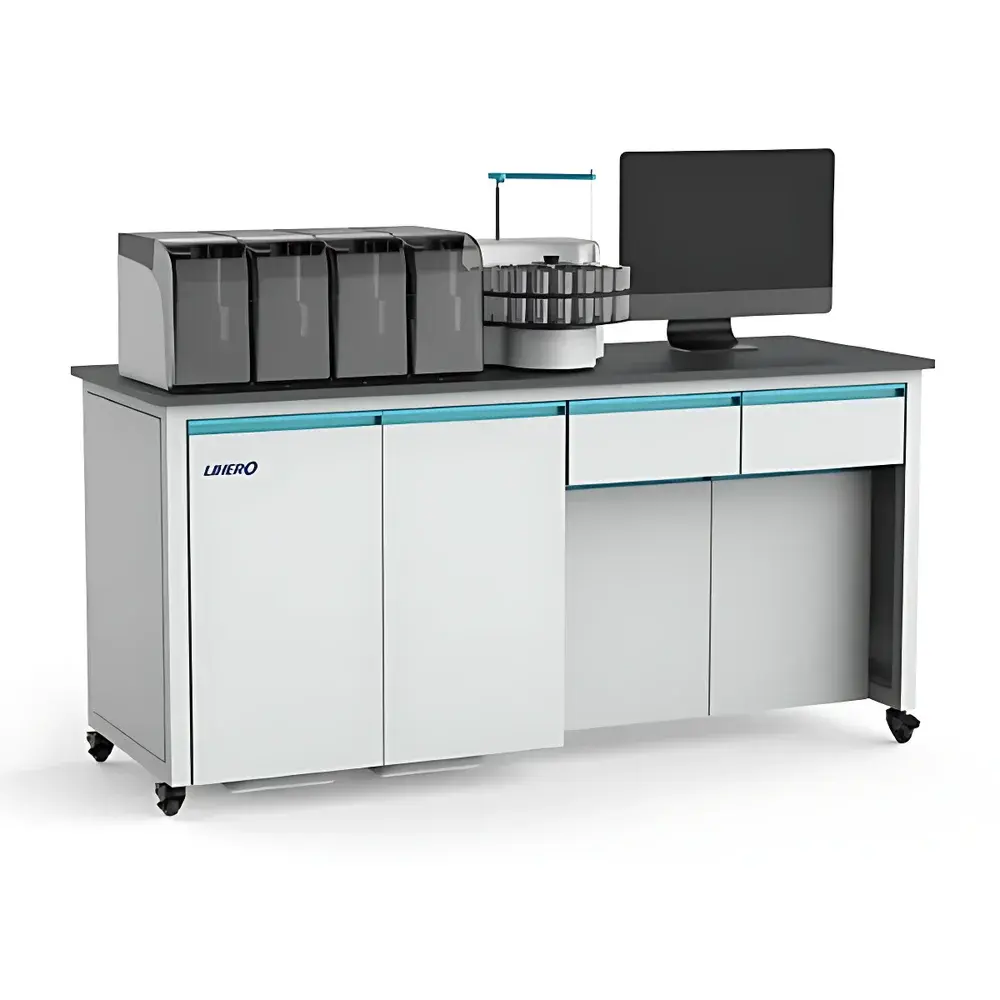
Lihero LFLIM-2015 Fully Automated Multi-Channel Water Quality Analysis System
| Brand | Lihero |
|---|---|
| Origin | Hunan, China |
| Model | LFLIM-2015 |
| Configuration | Modular Multi-Parameter Analyzer with Auto-Sampler |
| Compliance | Designed per Chinese National Standards (e.g., GB/T 5750, HJ Series Methods) |
| Operational Mode | Unattended 24/7 Batch Processing |
| Sample Capacity | 82-position Carousel |
| Detection Modules | COD, Permanganate Index, NH₃-N, Total Phosphorus, Total Nitrogen, Fluoride, Chloride, Anionic Surfactants, Volatile Phenols, Cyanide, Hexavalent Chromium |
| Automation Level | Full Workflow Automation (Sampling → Pre-treatment → Reaction → Detection → Calculation → Reporting) |
| Calibration | Auto-calibration with Manual/Remote Options |
| Maintenance Monitoring | Reagent Consumption Tracking, Component Lifetime Logging |
| Software | Windows-based Control Suite with LIMS Integration Protocol Support |
| Data Integrity | Audit Trail, QC Flagging (Blanks, Standards, Spikes, Duplicates), CFR Part 11–Ready Export Capability |
Overview
The Lihero LFLIM-2015 Fully Automated Multi-Channel Water Quality Analysis System is an integrated laboratory platform engineered for high-throughput, standardized analysis of routine water quality parameters in environmental monitoring labs, municipal water utilities, and industrial effluent testing facilities. Built upon validated wet-chemistry principles aligned with Chinese national standards—including GB/T 5750 (Standard Methods for Examination of Drinking Water), HJ 505 (COD by dichromate method), HJ 535 (ammonia nitrogen by Nessler reagent), and HJ 671 (total phosphorus by molybdenum blue)—the system replaces manual benchtop procedures with a robust, sequence-controlled analytical workflow. Its core architecture combines a precision auto-sampler with independently addressable, chemically isolated detection channels, enabling true parallel processing of up to 11 regulated analytes without cross-contamination. Unlike single-channel analyzers requiring sequential runs, the LFLIM-2015 executes multi-parameter assays on each sample within a single batch cycle—reducing turnaround time, minimizing operator intervention, and ensuring inter-run consistency under GLP-compliant conditions.
Key Features
- Modular Multi-Channel Detection Architecture: Each analytical module operates as an independent reaction-detection unit, utilizing photometric (visible/UV-VIS), colorimetric, or redox-based detection schemes depending on the parameter. Channels are physically segregated and pneumatically isolated to prevent carryover.
- Precision Liquid Handling: Sample and reagent delivery employs dual-mode metering: infrared liquid-level sensing combined with calibrated piston-driven syringe pumps—eliminating tubing-dependent volumetric drift associated with peristaltic systems and ensuring long-term calibration stability (<±0.5% volume accuracy over 3 months).
- Automated System Maintenance: Integrated cleaning routines include high-pressure air purge, acid/base rinse cycles, and heated decontamination protocols for reaction coils and optical flow cells—executed before/after each sample batch and during idle periods.
- Intelligent Calibration & QC Management: Supports scheduled auto-calibration using onboard standard solutions; enables manual calibration verification via external reference standards. Implements four-tier quality control: procedural blanks, certified reference materials (CRMs), spike recovery tests, and duplicate sample analysis—with real-time flagging of out-of-spec results.
- 82-Position Smart Auto-Sampler: Equipped with closed-loop stepper motor control and optical encoder feedback for positional repeatability (<±0.1 mm). Features automatic needle wash stations with dual-solvent capability and minimal dead-volume fluidics to suppress memory effects between high- and low-concentration samples.
- Comprehensive Reagent Lifecycle Monitoring: Software tracks reagent lot numbers, expiration dates, consumption rates, and component wear metrics (e.g., pump actuation count, valve switching cycles), generating predictive maintenance alerts and audit-ready usage logs.
Sample Compatibility & Compliance
The LFLIM-2015 accepts aqueous samples across a broad matrix range—including raw surface water, treated drinking water, wastewater influent/effluent, and industrial process streams—with optional filtration or centrifugation preprocessing handled externally. All detection modules conform to method-specific sensitivity and linearity requirements defined in applicable HJ and GB standards (e.g., NH₃-N detection limit ≤ 0.02 mg/L; COD linear range 10–1000 mg/L). The system supports full traceability per ISO/IEC 17025:2017 requirements, including electronic signatures, user access controls, and immutable audit trails for all analytical events. Data export formats comply with ASTM E1469 (Standard Practice for Laboratory Information Management Systems) and support HL7, ASTM E2500, and custom XML/CSV schemas for integration into enterprise LIMS or regulatory reporting portals.
Software & Data Management
The proprietary Windows-based control software provides centralized orchestration of hardware modules, method sequencing, and data governance. It features dual-install capability for method segregation (e.g., regulatory vs. research workflows), configurable sample priority queues, and batch-wise template import/export for rapid sample metadata entry. All analytical data—including raw absorbance values, kinetic reaction curves, calibration curves, and QC statistics—are stored in a local encrypted SQLite database with daily automated backup. The software enforces ALCOA+ principles: Attributable, Legible, Contemporaneous, Original, Accurate, Complete, Consistent, Enduring, and Available. Optional protocol-based data forwarding enables secure transmission to central LIMS via HTTPS or SFTP, with configurable payload structure and digital signature validation. System diagnostics, error logs, and instrument status history are retained for ≥18 months and exportable for FDA 21 CFR Part 11 compliance audits.
Applications
- Regulatory compliance monitoring for municipal water supply agencies (daily testing of NH₃-N, Cl⁻, F⁻, and residual oxidants)
- Wastewater treatment plant performance evaluation (COD, TN, TP, and volatile phenols across influent, activated sludge, and effluent streams)
- Industrial pretreatment verification (e.g., electroplating discharge screening for Cr⁶⁺ and CN⁻)
- Environmental field lab deployment for river basin surveillance programs
- Contract laboratory high-volume sample throughput (≥200 samples/day per configured channel set)
- Method validation studies supporting ISO 17025 accreditation
FAQ
Does the LFLIM-2015 support remote calibration and diagnostic access?
Yes—via secure RDP or VNC-enabled remote desktop sessions with role-based authentication; firmware updates and calibration parameter adjustments can be performed off-site with full audit trail logging.
Can the system operate without continuous network connectivity?
Yes—the analyzer functions autonomously offline; all methods, calibration data, and sample metadata are stored locally, with synchronized data upload occurring automatically upon network restoration.
Is third-party LIMS integration supported out-of-the-box?
The system includes native drivers for major LIMS platforms (e.g., LabWare, Thermo Fisher SampleManager) and provides documented RESTful API endpoints for custom integrations.
What is the mean time between failures (MTBF) for critical fluidic components?
Based on accelerated life testing, the piston pump assemblies exceed 15,000 operational cycles, and solenoid valves demonstrate >500,000 switching cycles under nominal load conditions.
How does the system handle turbid or particulate-laden samples?
While not a substitute for inline filtration, the system accommodates pre-filtered samples (≤5 µm pore size); optional UV digestion modules for total nitrogen/phosphorus are available as add-on configurations.
Related Products







