
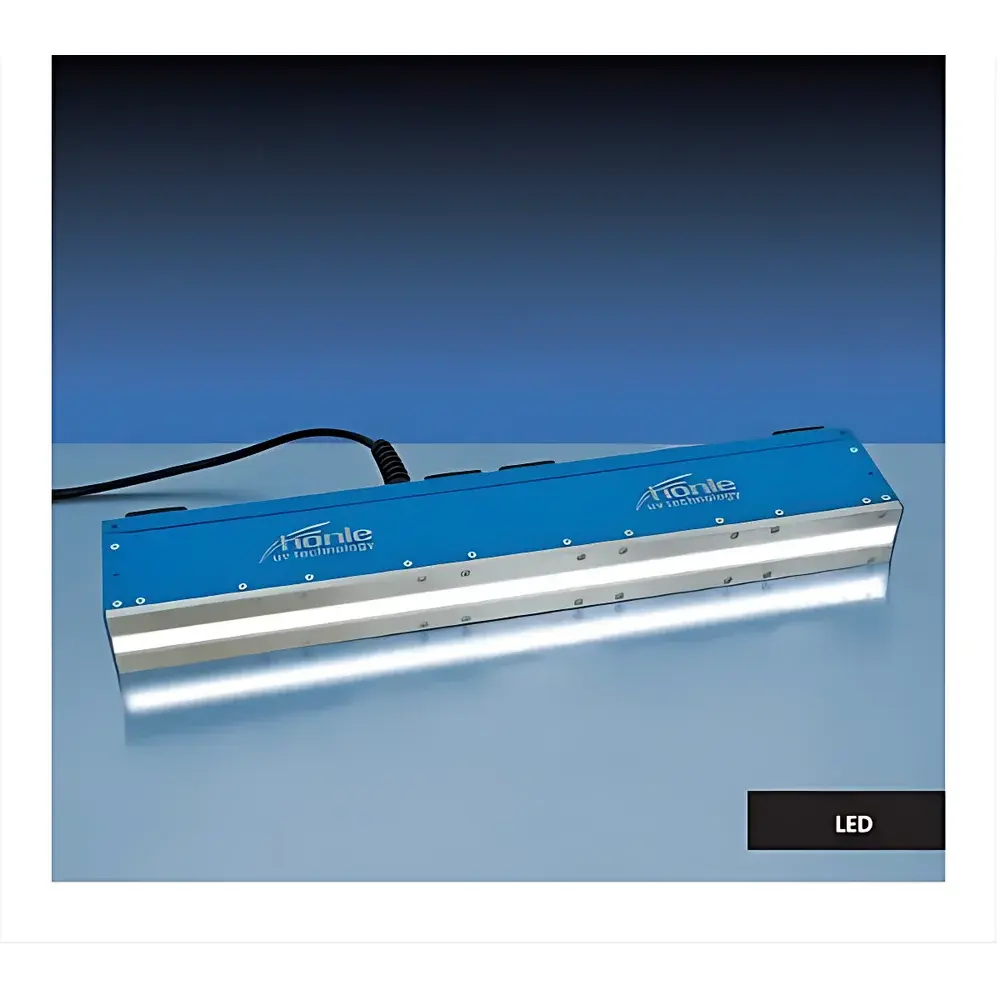
Hoenle LEDLINE 500 UV-LED Curing Line System
| Brand | Hoenle |
|---|---|
| Origin | Germany |
| Model | LEDLINE 500 |
| Wavelength | 365 nm or 405 nm (±10 nm) |
| Lifetime | >20,000 h |
| Irradiation Time Range | 1 s – 19 h (programmable timer) |
| Cooling | Fanless, instant on/off |
| Power Supply | Integrated driver, direct mains connection (no external PSU required) |
| Modular Stackability | Seamless end-to-end alignment for arbitrary length extension |
Overview
The Hoenle LEDLINE 500 is a high-intensity, modular UV-LED linear curing system engineered for precision photopolymerization in industrial and laboratory environments. Unlike broadband mercury-vapor or arc-lamp sources, the LEDLINE 500 employs monochromatic solid-state emitters operating at precisely controlled peak wavelengths—either 365 nm or 405 nm (±10 nm)—to match the absorption maxima of common photoinitiators in acrylate-, epoxy-, and cationic-based formulations. Its design follows the principles of uniform irradiance engineering: densely packed, collimated LED arrays are arranged in a linear configuration to deliver spatially homogeneous radiant exposure across the entire active length. This enables reproducible, depth-controlled curing without thermal overshoot or spectral drift—critical for bonding temperature-sensitive substrates such as optical glass, polycarbonate, and thin-film electronics. The system operates without warm-up or cool-down cycles, supporting rapid start-stop sequencing in automated production lines or manual benchtop workflows.
Key Features
- Monochromatic UV output at 365 nm or 405 nm (±10 nm), optimized for photoinitiator activation in industrial adhesives and coatings
- Integrated digital timer with programmable irradiation duration from 1 second to 19 hours, enabling full process traceability and repeatability
- Fanless thermal management architecture ensures silent, maintenance-free operation and eliminates airflow-induced contamination in cleanroom-adjacent settings
- Self-contained power architecture: built-in constant-current LED driver allows direct connection to standard AC mains (e.g., 100–240 VAC, 50/60 Hz); no external power supply unit required
- Modular mechanical interface enables seamless end-to-end stacking—zero-gap alignment supports continuous irradiation zones of unlimited length (e.g., conveyor integration or large-area composite lamination)
- Robust aluminum housing with IP54-rated ingress protection; designed for Class 10,000 cleanroom compatibility and industrial vibration resistance
- LED lifetime exceeding 20,000 hours at rated drive current, with L70 (70% initial irradiance) performance validated under continuous operation per IEC TR 62717
Sample Compatibility & Compliance
The LEDLINE 500 is compatible with all commercially available UV-curable chemistries exhibiting primary absorption bands near 365 nm (e.g., benzophenone, thioxanthone derivatives) or 405 nm (e.g., iodonium salts, phosphine oxides). It supports ISO 11607-compliant medical device bonding, ASTM D4145 adhesive shear strength validation, and IPC-A-610 Class 3 electronics encapsulation protocols. The system’s fixed-wavelength emission profile facilitates compliance with FDA 21 CFR Part 11 when paired with validated manufacturing execution systems (MES), as irradiation parameters—including timestamped start/stop events and cumulative dose logging—are fully configurable and audit-trail ready. No ozone generation occurs, eliminating need for exhaust ventilation per OSHA 29 CFR 1910.1200 requirements.
Software & Data Management
While the base LEDLINE 500 operates via front-panel controls, optional RS-485 or Ethernet interfaces enable integration into PLC-controlled assembly lines or LabVIEW-based QA platforms. Firmware supports Modbus RTU protocol for real-time monitoring of LED junction temperature, drive current stability, and elapsed irradiation time. All timer settings and operational logs are retained through power cycling. For regulated environments, optional firmware upgrade provides electronic signature capability and 21 CFR Part 11-compliant audit trail generation—including user ID, parameter change history, and timestamped event logs—with encrypted local storage.
Applications
- Structural bonding of dissimilar substrates: UV-cure adhesive curing for glass-to-metal, plastic-to-aluminum, and ceramic-to-composite joints in automotive lighting and consumer electronics assemblies
- Encapsulation and conformal coating of PCBs, sensors, and MEMS devices where thermal budget constraints prohibit conventional thermal curing
- Repair and fabrication of fiber-reinforced polymer (FRP) components using UV-curable polyester and vinyl ester resins in aerospace MRO facilities
- In-line curing of pressure-sensitive adhesives (PSAs) and release liners during roll-to-roll converting operations
- Microfluidic device fabrication requiring precise, low-heat crosslinking of PDMS or hydrogel precursors
- Calibration and reference irradiance source for radiometric validation of UV sensor arrays and spectroradiometers (NIST-traceable calibration available upon request)
FAQ
What safety certifications does the LEDLINE 500 carry?
It complies with IEC 62471 (Photobiological Safety of Lamps), EN 61000-6-3 (EMC Emission), and EN 61000-6-2 (EMC Immunity). CE marking is affixed per Machinery Directive 2006/42/EC and Low Voltage Directive 2014/35/EU.
Can the LEDLINE 500 be integrated into a robotic cell?
Yes—its compact footprint (W × H × D: 500 × 42 × 40 mm), lightweight construction (<1.2 kg), and digital I/O interface support synchronized triggering with UR, KUKA, or ABB robotic controllers.
Is wavelength selection possible after purchase?
No—the 365 nm and 405 nm variants are hardware-differentiated models; wavelength is fixed at time of manufacture and cannot be field-upgraded.
Does the system require recalibration over time?
Radiometric output stability is maintained within ±3% over 12 months under normal operating conditions; annual verification against a NIST-traceable reference detector is recommended for GMP/QSR environments.
How is uniformity quantified across the irradiation line?
Irradiance homogeneity is specified as ≥90% across the central 80% of the active length (per ISO/IEC 17025-accredited measurement at 10 mm working distance), verified using a calibrated UV radiometer with 1 mm spatial resolution.




