
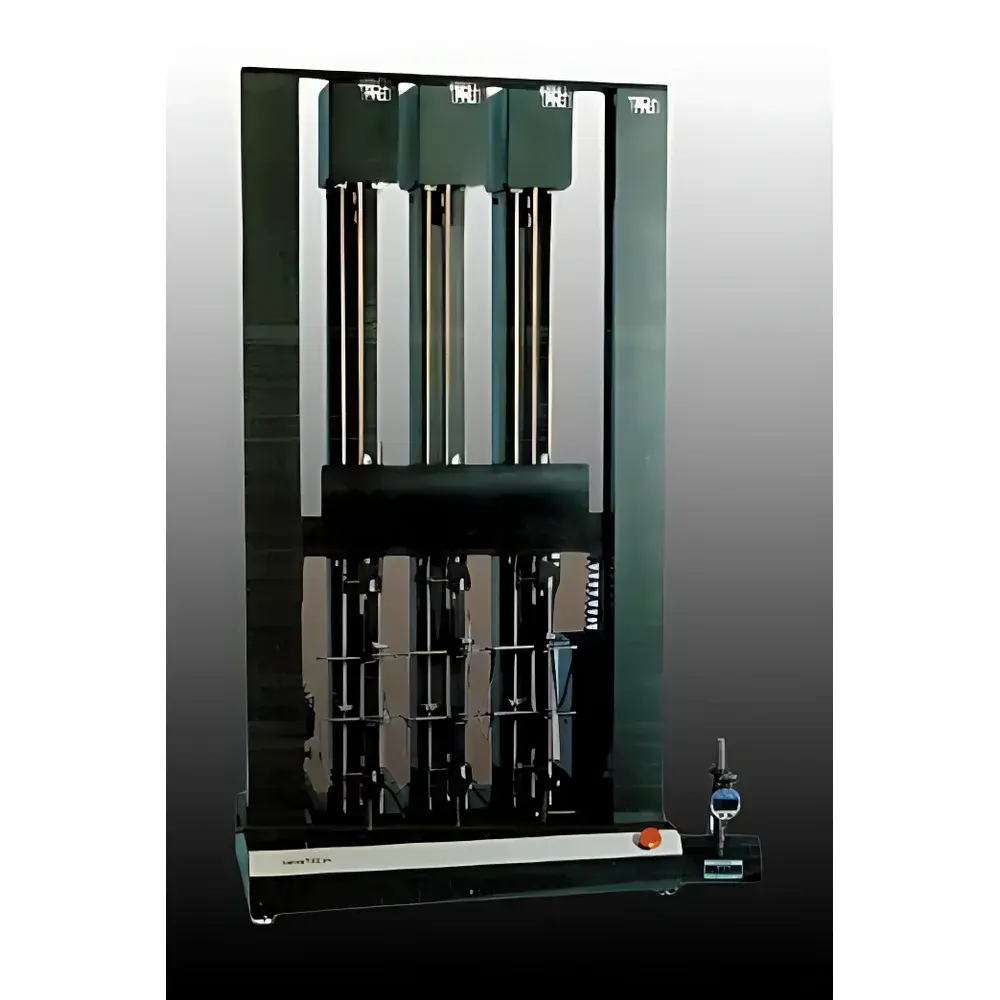
ALPHA tensiTech III Universal Testing Machine for Rubber & Plastics
| Brand | ALPHA |
|---|---|
| Origin | USA |
| Model | tensiTech III |
| Compliance | ASTM D412, ASTM D575, ASTM D624 |
| Software | tensiDATA (data acquisition, control, analysis) |
| Actuation | Pneumatic grips |
| Extensometer | High-elongation digital extensometer |
| Programmability | Fully user-defined crosshead motion profiles and test sequences |
| Sample capacity | Up to 5 specimens per test run |
| Output units | Time, force, stress, strain (configurable) |
| Grip options | O-ring, wire wedge, curved jaw |
| Accessories | Digital thickness gauge, compression platens |
| Enclosure | Service-optimized chassis design |
| Application scope | Tensile, compression, tear, modulus measurement on elastomers and textiles |
| Target materials | Natural rubber, synthetic rubber, silicone rubber, thermoplastic elastomers (TPEs) |
Overview
The ALPHA tensiTech III Universal Testing Machine is an ASTM-compliant electromechanical testing system engineered specifically for the rubber, plastics, and technical textile industries. Designed and manufactured in the United States, it implements a closed-loop servo-controlled drive architecture to deliver precise, repeatable force and displacement measurements under tension, compression, and controlled strain-rate conditions. Its core measurement principle relies on high-fidelity load cell transduction (typically ±0.5% full-scale accuracy, consistent with ISO 7500-1 Class 1 requirements) coupled with optical or clip-on digital extensometry for strain quantification—enabling rigorous determination of tensile modulus, elongation at break, yield point, and compression set behavior. The system is purpose-built for routine quality control laboratories and R&D environments where regulatory traceability, method reproducibility, and multi-standard compliance are mandatory.
Key Features
- Fully programmable test sequencing via tensiDATA software: users define custom crosshead speed ramps, dwell periods, load limits, and stop conditions without scripting.
- Pneumatically actuated, interchangeable grip systems—including O-ring clamps, wire-wedge grips, and contoured curved jaws—designed to minimize slippage and specimen necking during high-elongation testing of elastomeric compounds.
- Integrated high-elongation digital extensometer with sub-micron resolution, calibrated for ASTM D412 Type C dumbbell specimens and compatible with ISO 37 geometries.
- Modular chassis architecture optimized for service accessibility: all major subsystems—including load frame electronics, pneumatic manifold, and sensor interfaces—are front-accessible with standardized fasteners.
- Dual-mode operation: supports both force-controlled and displacement-controlled test modes, with real-time switching capability during active tests.
- Onboard digital thickness gauge interface for automatic specimen thickness compensation prior to stress calculation—critical for accurate MPa-based modulus reporting per ASTM D412 Section 7.3.
Sample Compatibility & Compliance
The tensiTech III accommodates standard and non-standard specimen geometries used across elastomer characterization, including ASTM D412 Type A, B, and C dumbbells; ASTM D575 cylindrical compression samples; and ASTM D624 crescent tear specimens. It supports testing of vulcanized natural rubber, SBR, EPDM, nitrile, silicone, fluorosilicone, TPEs, and woven/nonwoven textile substrates. All hardware and firmware configurations adhere to the mechanical and procedural requirements of ASTM D412 (tension), ASTM D575 (compression), and ASTM D624 (tear). System validation documentation—including as-delivered calibration certificates traceable to NIST standards—is provided with each unit. The platform is routinely deployed in GLP-compliant QC labs and supports audit-ready electronic records when paired with tensiDATA’s optional 21 CFR Part 11 compliance module.
Software & Data Management
tensiDATA is a Windows-based application developed exclusively for the tensiTech platform, offering integrated instrument control, real-time data visualization, and post-test analysis. It enables automated pass/fail evaluation against user-defined upper/lower specification limits for parameters such as tensile strength, elongation, and modulus at 100%, 200%, and 300% strain. Raw data is stored in vendor-neutral CSV and XML formats; stress-strain curves are exportable as SVG or PDF with embedded metadata (operator ID, timestamp, environmental conditions, calibration status). Audit trails log all method modifications, test executions, and result exports—supporting ISO/IEC 17025 and FDA-regulated environments. Optional network licensing allows centralized license management across lab-wide deployments.
Applications
- Quality assurance of incoming raw elastomer batches against supplier specifications.
- Rubber compound development: evaluating cure state effects on modulus progression and hysteresis behavior.
- Compression set analysis per ASTM D395 for sealing and gasket materials.
- Tear resistance profiling of conveyor belting, automotive hoses, and medical tubing.
- Modulus mapping across temperature gradients using optional environmental chamber integration.
- Comparative testing of recycled vs. virgin TPE formulations for sustainability validation programs.
FAQ
Does the tensiTech III support ASTM D412 Type C specimens for thin elastomer films?
Yes—its high-resolution extensometer and low-force load cell configuration (optional 5 N or 50 N ranges) enable compliant testing of specimens as thin as 0.5 mm.
Can tensiDATA generate reports compliant with ISO 17025 documentation requirements?
Yes—when configured with the GLP/GMP add-on module, tensiDATA enforces electronic signatures, version-controlled method templates, and immutable audit logs.
Is pneumatic grip pressure adjustable during a test?
No—grip pressure is set pre-test and held constant; however, tensiDATA allows dynamic crosshead speed adjustment mid-test to simulate complex loading profiles.
What maintenance intervals are recommended for the pneumatic system?
Compressed air filtration and lubrication service every 6 months; annual verification of grip cylinder seal integrity and pressure regulator calibration.
Are third-party extensometers supported?
Only ALPHA-certified digital extensometers are fully integrated; analog LVDT inputs are available but require manual scaling and lack automatic specimen geometry recognition.






