
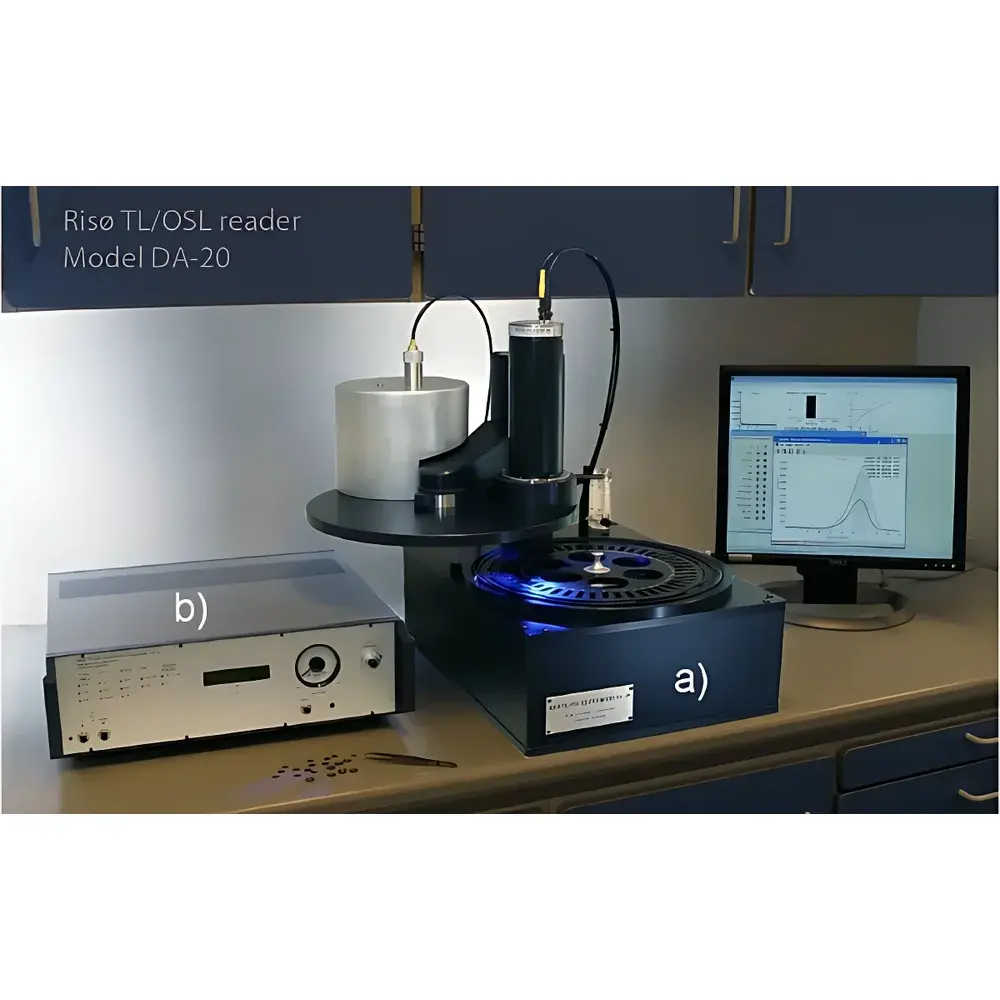
Risø TL/OSL-DA-20 Thermoluminescence and Optically Stimulated Luminescence Dating System
| Origin | Denmark |
|---|---|
| Manufacturer Type | Authorized Distributor |
| Origin Category | Imported |
| Model | TL/OSL-DA-20 |
| Heating Range | RT–700 °C (programmable ramp rate: 0.1–10 K/s) |
| TL Detection | PMT with U-340/BG39/7-59 filter set |
| OSL Excitation Sources | 470 nm blue LED (≥50 mW/cm²), 870 nm IR LED (≥140 mW/cm²), optional 532 nm green laser (50 W/cm²) or 830 nm IR laser (~500 W/cm²) |
| Irradiation Options | β (⁹⁰Sr/⁹⁰Y, 1.48 GBq, ~0.1 Gy/s on quartz), α (²⁴¹Am, 10.7 MBq, ~45 mGy/s on quartz), X-ray (Varian VF-50J, 50 kV/1 mA, 10 mGy/s–2 Gy/s with 50 mm Al filtration) |
| Sample Capacity | 48-position programmable carousel |
| Vacuum & N₂ cooling | Integrated sample chamber with controlled purge and rapid post-heating quenching |
| Compliance | Designed for ISO/IEC 17025-compliant laboratories |
Overview
The Risø TL/OSL-DA-20 is a fully automated, research-grade thermoluminescence (TL) and optically stimulated luminescence (OSL) dating system engineered for high-precision geochronological and archaeological applications. It operates on the fundamental principle that natural minerals—such as quartz and feldspar—accumulate trapped charge carriers in crystal lattice defects when exposed to ionizing radiation over geological time. Upon thermal (TL) or optical (OSL) stimulation, these trapped charges recombine and emit photons proportional to the integrated radiation dose. The DA-20 precisely quantifies this luminescence signal to determine the time elapsed since the last zeroing event (e.g., sediment exposure to sunlight or pottery firing). As a second-generation readout platform developed at the Technical University of Denmark (DTU) Risø Campus, the system integrates modular subsystems—including light detection, programmable heating, multi-wavelength optical stimulation, and calibrated irradiation—within a single, vacuum-compatible measurement chamber. Its architecture enables reproducible, traceable measurements compliant with international standards for luminescence dating, including ISO 14887 (luminescence dating—general principles) and ASTM D7261 (standard test method for determination of equivalent dose using OSL).
Key Features
- Fully computer-controlled operation with intuitive software interface supporting method scripting, real-time parameter monitoring, and hardware synchronization.
- 48-sample carousel with automated positioning, enabling unattended batch processing and statistical replication across multiple aliquots or single grains.
- Programmable heating system capable of linear ramps from ambient temperature to 700 °C at rates adjustable between 0.1 and 10 K/s; includes active nitrogen gas cooling for rapid post-TL quenching and thermal management of the heater filament.
- Dual-mode OSL excitation: continuous-wave (CW) and linearly modulated (LM-OSL) protocols supported via feedback-stabilized LED arrays (470 nm blue, 870 nm infrared); optional laser modules (532 nm green or 830 nm IR) available for single-grain analysis.
- Multi-source irradiation capability: selectable β (⁹⁰Sr/⁹⁰Y), α (²⁴¹Am), and X-ray (50 kV Varian VF-50J) sources, each independently controlled via software with dose-rate calibration traceable to national metrology institutes.
- Vacuum-compatible sample chamber with programmable gas purging, enabling inert-atmosphere TL measurements and suppression of thermal noise during low-signal detection.
Sample Compatibility & Compliance
The TL/OSL-DA-20 accommodates standard 9.7 mm diameter planchets, custom-mounted single grains, and powdered mineral separates. Its optical path incorporates interchangeable interference filters (Hoya U-340, Schott BG39, Corning 7-59) optimized for UV–blue emission spectra typical of quartz and feldspar. All irradiation components meet IEC 61000-4 electromagnetic compatibility standards and are housed behind interlocked shielding compliant with IAEA SSG-28 safety guidelines for sealed radioactive sources. Data acquisition adheres to ALARA principles and supports full audit trails required under ISO/IEC 17025 accreditation. Instrument firmware and software logs all user actions, parameter changes, and calibration events with timestamped, non-erasable records—meeting documentation requirements for GLP environments and FDA 21 CFR Part 11 electronic record integrity.
Software & Data Management
The proprietary Analyst Suite v4.x provides end-to-end workflow control—from irradiation protocol definition and stimulation sequence programming to raw photon count integration and dose-response curve fitting (e.g., SAR, MAAD, or regenerative-dose models). Raw data are stored in vendor-neutral HDF5 format with embedded metadata (sample ID, stimulation parameters, environmental conditions, detector gain settings). Export modules support direct import into R-based luminescence analysis packages (e.g., ‘Luminescence’ CRAN package) and MATLAB-based custom modeling frameworks. Automated quality checks flag outliers based on plateau consistency, recycling ratio deviation, and recuperation thresholds. Calibration certificates for PMT gain, LED power output, and dose-rate linearity are digitally embedded and version-controlled within the software database.
Applications
- Archaeological chronology: dating of ceramics, burnt flint, and fired clay sediments via TL; burial timing of sediments using quartz/feldspar OSL in stratigraphic contexts.
- Quaternary geochronology: establishing sediment accumulation rates, glacial retreat sequences, and paleoseismic event horizons in fluvial, aeolian, and lacustrine deposits.
- Radiation accident dosimetry: retrospective dose reconstruction using dental enamel, brick, or tile samples collected from affected zones.
- Food irradiation verification: detection of gamma- or electron-beam-treated spices and herbs via residual TL signal in silicate contaminants.
- Fundamental luminescence physics: kinetic parameter estimation (trap depth, frequency factor), thermal quenching studies, and defect characterization in insulating crystals.
FAQ
What is the difference between TL and OSL measurement modes on the DA-20?
TL involves heating a sample to release trapped charge carriers, producing a glow curve whose integral correlates with accumulated dose. OSL uses specific wavelengths of light (e.g., 470 nm or 870 nm) to optically empty traps without thermal perturbation—enabling repeated measurements on the same aliquot.
Can the system perform single-grain OSL analysis?
Yes—when equipped with the optional 532 nm green laser module and motorized XYZ stage, the DA-20 supports spatially resolved stimulation of individual quartz grains mounted on aluminum discs.
Is source calibration traceable to national standards?
All radioactive sources (⁹⁰Sr/⁹⁰Y, ²⁴¹Am) are supplied with NIST-traceable activity certificates. X-ray output is calibrated using a PTB-certified ionization chamber and referenced to air kerma standards.
How does the system ensure signal stability during long-duration measurements?
The photomultiplier tube operates under constant high-voltage regulation with temperature-compensated gain control. LED excitation intensity is actively monitored via integrated photodiodes and adjusted in real time to maintain ±1% power stability over 24-hour runs.
What maintenance is required for routine operation?
Annual PMT quantum efficiency verification, biannual recalibration of heating ramp accuracy and LED irradiance, and quarterly cleaning of optical windows and sample chamber interior using spectroscopic-grade solvents. No consumables are required beyond standard nitrogen supply and disposable planchets.




