
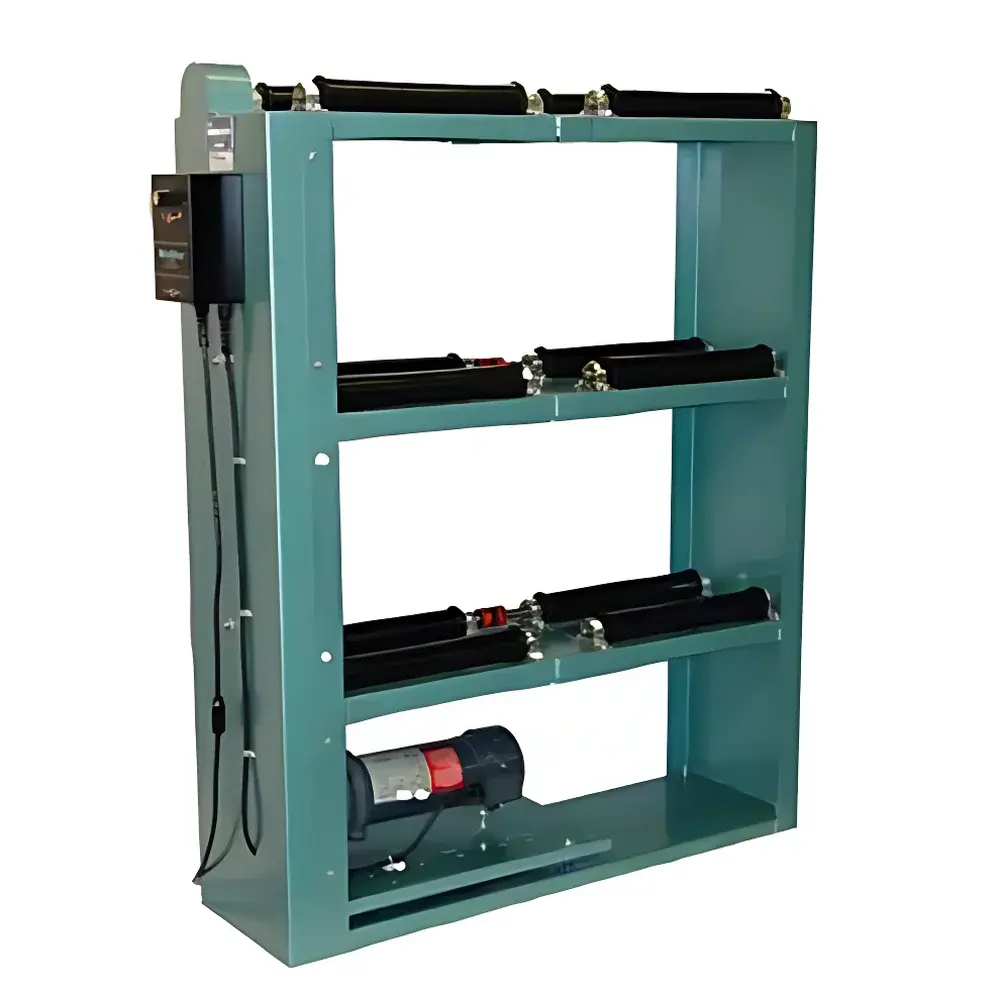
LabTech LC-95 & LC-95F Three-Tier Jar Mill
| Origin | USA |
|---|---|
| Supplier Type | Authorized Distributor |
| Origin Category | Imported |
| Model | LC-95 (115 V, 50–60 Hz), LC-95F (230 V, 50 Hz) |
| Drive Motor | Fully Enclosed DC Motor |
| Speed Range | 20–300 rpm |
| Roller Diameter | 2 in (50.8 mm) |
| Roller Material | Neoprene-Coated Steel |
| Maximum Feed Capacity | 84 L |
| Final Particle Size Range | 1–50 µm |
| Top Particle Size Input | ≤ 1 mm |
| Bearing Type | Sealed Ball Bearings |
| Drive System | Roller Chain Transmission |
| Frame Construction | Welded Structural Steel |
| Compatibility | Standard Borosilicate Glass, Alumina, or Porcelain Jars (sold separately) |
| Grinding Media | Ceramic, Stainless Steel, or Zirconia Beads (sold separately) |
Overview
The LabTech LC-95 and LC-95F Three-Tier Jar Mills are industrial-grade, benchtop-scale batch grinding systems engineered for reproducible, scalable comminution of dry or slurry-based materials. Based on the principle of tumbling attrition—where rotational energy is transferred via frictional contact between rotating neoprene-coated rollers and cylindrical grinding jars—the system achieves controlled particle size reduction through sustained mechanical impact and shear. Unlike planetary or vibratory mills, jar mills operate at lower rotational speeds but deliver superior thermal stability and mechanical consistency across extended duty cycles. Designed for laboratories requiring repeatable scale-up data from R&D to pilot production, these units support method transfer to larger production mills by maintaining identical jar geometry, media-to-sample ratio, and energy input profiles. The welded steel frame, sealed ball bearings, and roller chain drive architecture ensure long-term dimensional stability and minimal maintenance under continuous operation.
Key Features
- Fully enclosed DC motor with analog speed control (20–300 rpm), enabling precise tuning of kinetic energy input without voltage fluctuation sensitivity
- Three-tier vertical configuration accommodates up to six standard grinding jars simultaneously—optimizing throughput while minimizing floor space requirements
- Neoprene-coated steel rollers (50.8 mm diameter) provide uniform torque transmission and consistent jar centering, reducing eccentric wear and vibration-induced sample segregation
- Robust structural steel frame with reinforced cross-bracing resists torsional deflection during high-load operation, preserving alignment integrity over thousands of operational hours
- Dual-voltage compatibility: LC-95 (115 V, 50–60 Hz) for North American and Japanese lab infrastructure; LC-95F (230 V, 50 Hz) for EU, UK, and APAC markets—both conform to IEC 61000-6-3 EMC standards
- Roller chain drive system eliminates belt slippage, ensuring constant speed ratio and eliminating periodic recalibration of rotational frequency
Sample Compatibility & Compliance
The LC-95 series accepts industry-standard cylindrical grinding jars ranging from 250 mL to 20 L capacity—including borosilicate glass, 99.5% alumina, and porcelain vessels—each secured via adjustable clamping brackets. Compatible grinding media include spherical zirconia (0.3–3 mm), stainless steel (1–6 mm), and ceramic beads, selected based on Mohs hardness differential and chemical inertness requirements. The system supports both dry grinding and wet slurry processing with viscosity limits up to 5,000 cP. All mechanical components comply with ISO 12100:2012 (safety of machinery) and meet UL 61010-1 and CE marking requirements for laboratory equipment. For regulated environments, the mill’s mechanical design permits full traceability of operating parameters when integrated with external logging devices—supporting GLP audit readiness and FDA 21 CFR Part 11–compliant workflows when paired with validated data acquisition software.
Software & Data Management
While the LC-95 and LC-95F operate as standalone electromechanical instruments without embedded firmware, their analog speed controller features a calibrated 0–10 V output signal that interfaces directly with third-party programmable logic controllers (PLCs) or data acquisition systems (e.g., National Instruments DAQmx, LabVIEW). This allows time-stamped recording of rotational speed, runtime, and power draw—enabling correlation of milling parameters with downstream particle size distribution (PSD) analysis from laser diffraction (ISO 13320) or sieve analysis (ASTM E11). Optional external timers with relay outputs support unattended multi-stage protocols (e.g., intermittent milling cycles with cooling intervals), critical for heat-sensitive pharmaceutical actives or nanomaterial synthesis.
Applications
These jar mills serve diverse sectors where controlled, low-heat mechanical activation is essential: mineralogical sample preparation for XRF and ICP-MS analysis; homogenization of battery cathode precursors (e.g., NMC, LFP); dispersion of pigment concentrates in coatings R&D; size reduction of ceramic green bodies prior to sintering; and pre-milling of API-excipient blends in early-phase solid dosage development. Their ability to process abrasive, corrosive, or hygroscopic feedstocks—without internal electronics or lubrication points exposed to the process zone—makes them suitable for GMP-aligned cleanroom-adjacent labs handling Class 3–5 hazardous materials per NFPA 70E.
FAQ
Are grinding jars and media included with the LC-95 purchase?
No. Jars and grinding media are sold separately to allow users to select optimal material compatibility, volume, and abrasion resistance for specific applications.
What is the maximum recommended continuous run time per cycle?
For thermal management and bearing longevity, LabTech recommends maximum 8-hour continuous operation per cycle, followed by a minimum 30-minute cooldown period.
Can the LC-95 be used for cryogenic milling?
Not natively. The unit lacks integrated cooling ports or dewar integration; however, externally jacketed jars with circulating coolant may be mounted with custom bracketing—subject to mechanical validation.
Does the mill support ASTM E11 or ISO 3310-1 sieve calibration protocols?
Yes—its consistent rotational profile and jar geometry enable direct correlation to sieve-based particle size reporting when used with certified reference standards and validated analytical sieves.
Is technical documentation available in English for regulatory submissions?
Yes. Full OEM manuals—including mechanical drawings, torque specifications, electrical schematics, and compliance certificates—are provided in English upon order confirmation and support 21 CFR Part 11 audit trails when used with compliant external logging hardware.






