
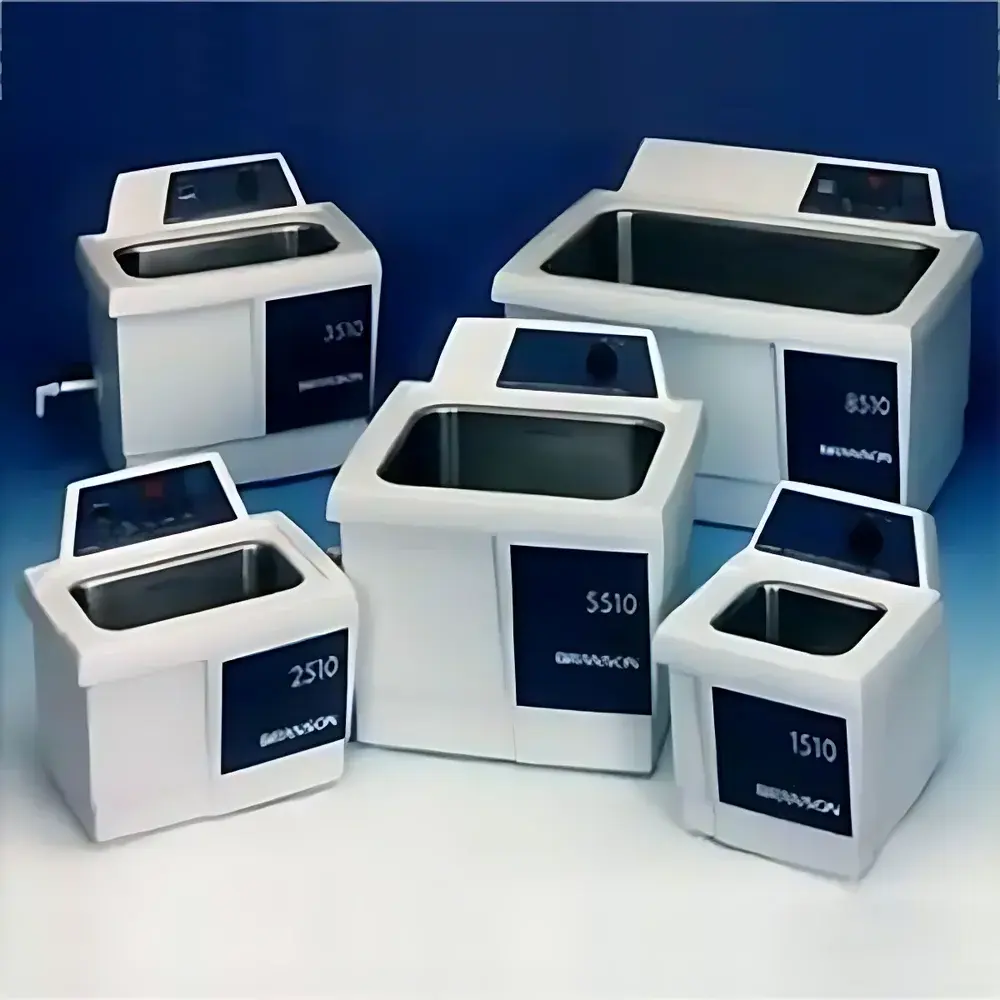
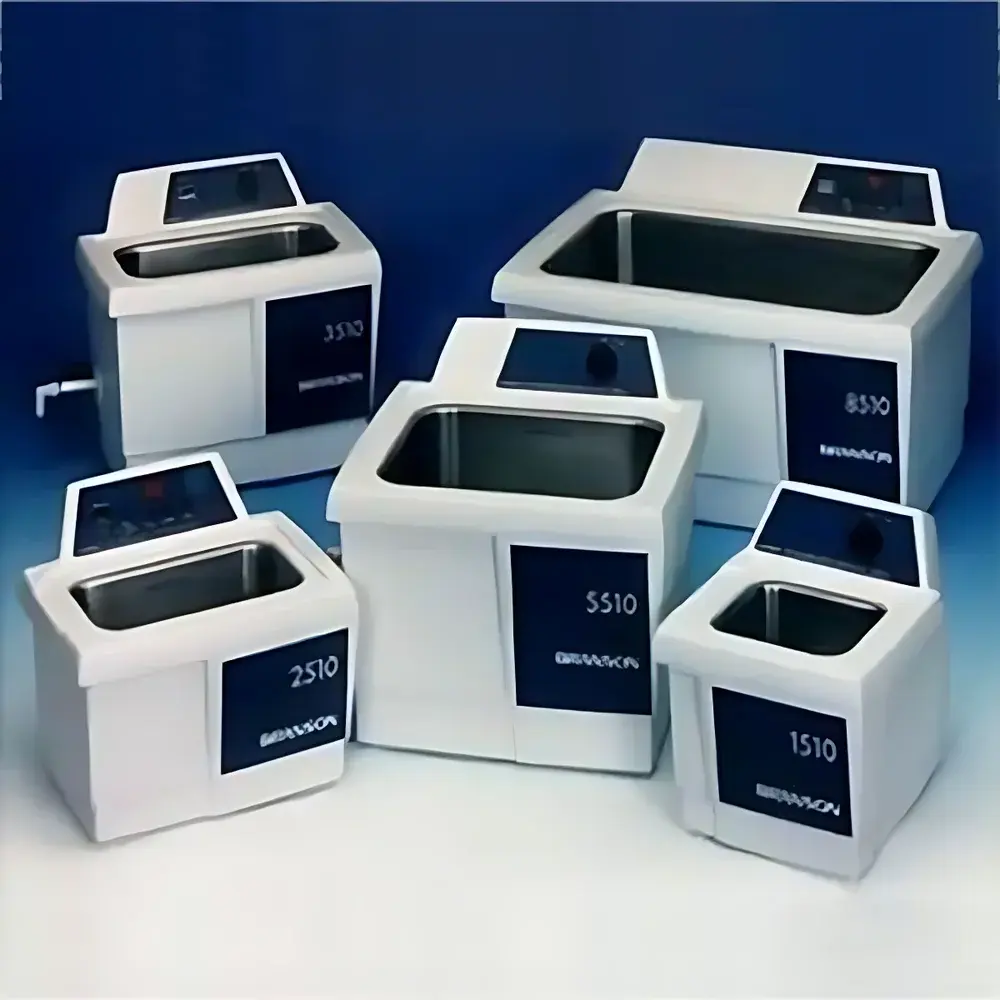
Branson M8800/M5800/M3800/M2800/M1800 Series Ultrasonic Cleaner
| Brand | Branson |
|---|---|
| Origin | USA |
| Model | M8800 / M5800 / M3800 / M2800 / M1800 |
| Tank Capacity | 1.9 L |
| Ultrasonic Frequency | 40 kHz |
| Ultrasonic Power Output | 63 W |
| Adjustable Power | Yes |
| Adjustable Temperature | Yes |
| Adjustable Timer | Yes |
| Sound-Dampening Lid | Included |
| Drain/Inlet | Manual Control |
| Construction | 304L Stainless Steel Tank, Polypropylene (PP) Housing, Langevin-Type Ceramic-Metal Transducer |
| Transducer Material | Engineered Ceramic |
| Heating Element | Bonded Foil Heater |
| Control Board Placement | Elevated Above Tank |
| Compliance | Designed for GLP/GMP-aligned lab environments |
Overview
The Branson M8800/M5800/M3800/M2800/M1800 Series Ultrasonic Cleaners are precision-engineered benchtop systems designed for consistent, repeatable cleaning of delicate and complex components in regulated laboratory and industrial settings. These units operate on the principle of ultrasonic cavitation—where high-frequency mechanical energy (40 kHz) is transmitted through a liquid medium to generate microscopic vacuum bubbles that collapse with localized energy release, effectively dislodging particulate contaminants, oils, flux residues, and biofilms from surfaces without mechanical abrasion. The series employs a Langevin-type transducer architecture, integrating engineered ceramic elements bonded to aluminum alloy mass blocks to ensure thermal stability, long-term resonance fidelity, and minimal frequency drift over extended duty cycles. This design directly supports applications requiring compliance with ASTM D2603 (Standard Test Method for Sonic Shear Stability of Lubricants), ISO 13852 (Safety of Machinery – Acoustic Emission Measurement), and USP particulate matter testing preparation protocols.
Key Features
- Spherical wave propagation technology ensures uniform energy distribution across the entire tank volume—critical for reproducible cleaning of multi-geometry parts such as microfluidic chips, optical lenses, and surgical instruments.
- Langevin transducers constructed with high-purity piezoelectric ceramic discs mounted on precision-machined aluminum horns deliver stable 40 kHz output with ≤±0.5% frequency deviation under load, minimizing standing wave formation and hot-spot erosion.
- Electronics architecture isolates the printed circuit board above the tank level, preventing condensation ingress and electrolytic corrosion—enhancing mean time between failures (MTBF) in high-humidity environments.
- Tank fabricated from cold-rolled 304L stainless steel (ASTM A240) with seamless draw-formed geometry eliminates weld seams where residue accumulation could occur; surface finish Ra ≤ 0.8 µm per ISO 13485 requirements for medical device cleaning validation.
- Enclosure molded from chemical-resistant polypropylene (PP) provides structural rigidity while attenuating airborne noise to ≤55 dB(A) at 1 m distance—meeting OSHA 29 CFR 1910.95 workplace exposure limits.
- Bonded foil heating system enables precise temperature control from ambient to 80°C ±1°C, supporting aqueous alkaline, enzymatic, and low-surface-tension solvent-based cleaning chemistries.
Sample Compatibility & Compliance
These cleaners accommodate a broad range of sample types—including glassware (vials, cuvettes, pipette tips), metal components (stainless steel, titanium, aluminum alloys), polymer substrates (PC, PMMA, PTFE), and ceramic-based sensors—without inducing surface pitting or dimensional change. The 1.9 L tank volume accommodates standard ANSI/NSF-certified labware up to 150 mm in height. Units are compatible with validated cleaning agents meeting ASTM F3127 (Standard Guide for Cleaning Validation of Medical Devices) and support IQ/OQ/PQ documentation packages. All models include a manually operated drain valve and fill port compliant with ISO 15197:2013 fluid handling interface standards. The sound-dampening lid meets UL 61010-1 safety certification for electrical equipment used in laboratory environments.
Software & Data Management
While the M-series operates via intuitive analog/digital hybrid controls (rotary encoder + LED display), optional RS-232 or USB-to-serial interfaces enable integration into centralized lab information management systems (LIMS). Time, temperature, and power settings can be logged externally with timestamping for audit trails required under FDA 21 CFR Part 11 and EU Annex 11. Firmware supports user-defined cleaning profiles (up to 12 memory slots), each with independent ramp-up/down logic for temperature and ultrasonic activation—facilitating method transfer between shifts or facilities. Data export formats include CSV and XML for traceability in GLP-compliant analytical laboratories.
Applications
- Pre-analytical sample preparation for ICP-MS, HPLC, and SEM—removing adsorbed metal ions and organic carryover from quartz and fused silica components.
- Cleaning of calibration standards (e.g., NIST-traceable reference materials) prior to gravimetric or volumetric analysis.
- Removal of solder paste and rosin flux from PCB assemblies in electronics QA/QC labs.
- Decontamination of reusable surgical instruments and endoscope channels in hospital central sterile supply departments (CSSD).
- Surface preparation of catalyst substrates and MEMS devices prior to thin-film deposition or bonding processes.
- Validation of cleaning efficacy per ISO 15883-1 for reprocessed medical devices in ISO 13485-certified manufacturing sites.
FAQ
What is the recommended cleaning solution chemistry for general laboratory use?
Aqueous alkaline solutions (pH 9–11) containing nonionic surfactants and chelating agents (e.g., sodium citrate) are optimal for removing organic soils and metal oxides without corroding 304L stainless steel tanks or PP housings.
Can these units be used with flammable solvents?
No—these models are not explosion-proof and must only be operated with water-based or non-flammable, low-volatility cleaning media per NFPA 30 and OSHA 1910.106 guidelines.
Is validation support documentation available?
Yes—Branson provides IQ/OQ templates, transducer performance verification reports, and tank uniformity mapping data upon request for GxP-regulated installations.
How often should the transducer be recalibrated?
Transducer resonance frequency and impedance are factory-verified and do not require periodic recalibration; however, annual acoustic power measurement using a calibrated calorimetric probe (per ASTM E1499) is recommended for audit readiness.
What maintenance is required for long-term reliability?
Routine tasks include weekly tank descaling with 5% citric acid solution, monthly inspection of the drain valve seal integrity, and biannual visual verification of transducer bond-line adhesion per manufacturer’s service bulletin SB-ULTRA-2023.



