
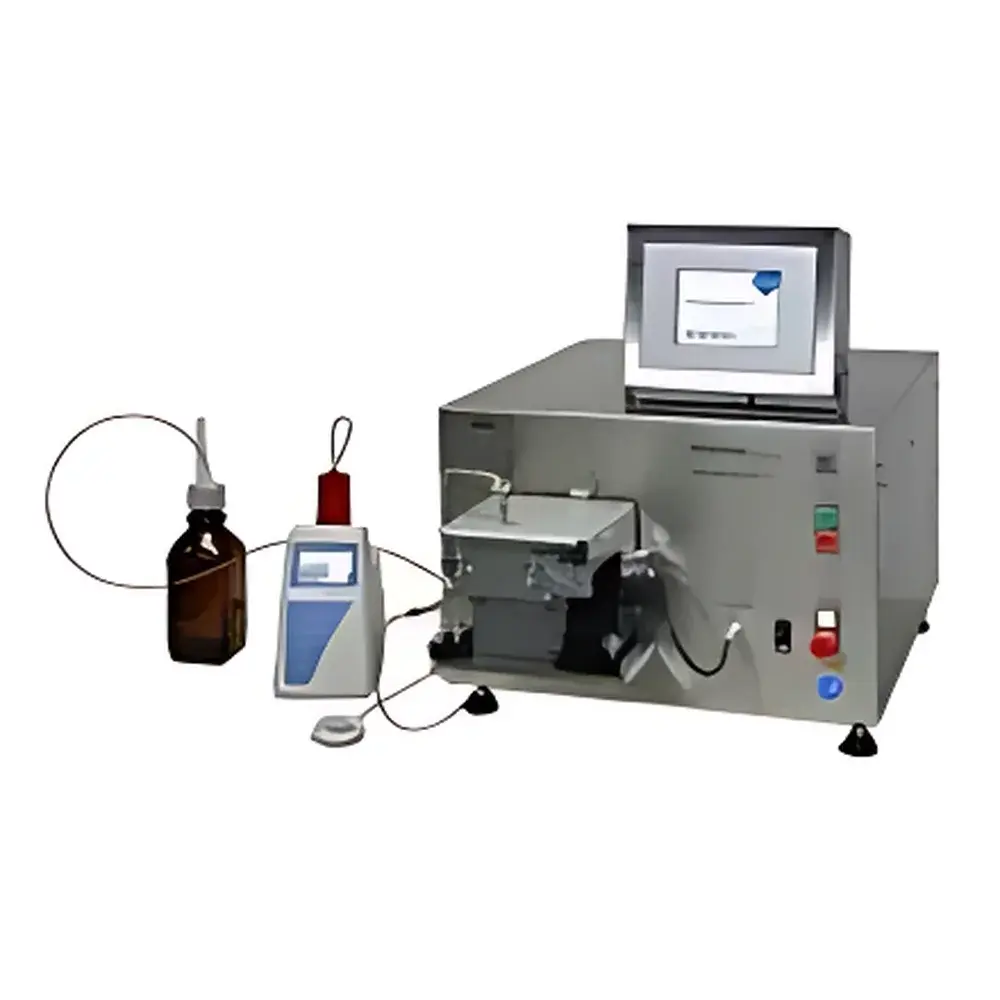
Brabender Absorptometer C-Type Carbon Black Oil Absorption Tester
| Brand | Brabender |
|---|---|
| Origin | Germany |
| Model | C-Type |
| Compliance | ASTM D2414, ASTM D3493 (Methods A, B, C) |
| Drive | AC frequency-controlled motor (0.75 kW) |
| Speed Range | 5–150 rpm (default 125 rpm per ASTM) |
| Speed Stability | Quartz-based digital feedback control |
| Torque Measurement | Electronic, 0–10 N·m full scale |
| Dropping Rate | Programmable (default 4 mL/min per ASTM |
| Mixing Chamber Volume | 100 mL |
| Dropper Accuracy | ±0.05 mL |
| Power Supply | 230 V AC, 50/60 Hz, 4 A |
| Dimensions (W×D×H) | 530 × 560 × 700 mm (excl. burette) |
| Weight | ~75 kg |
| Software Platform | 32-bit Windows-compatible (Win98/ME/XP/2000), PC-controlled titration & torque acquisition, ASTM-compliant curve analysis (e.g., 70% max torque point for Method C), polynomial fitting of torque inflection points, auto-data logging, multi-mixer support |
Overview
The Brabender Absorptometer C-Type is a precision-engineered instrument dedicated to the quantitative determination of oil absorption number (OAN) in carbon black—defined as the volume of dibutyl phthalate (DBP) or paraffin oil absorbed per 100 g of dry carbon black under standardized shear conditions. Operating on the principle of controlled-shear mixing and real-time torque monitoring, the C-Type employs Couette-type rheological dynamics within a calibrated mixing chamber. As oil is incrementally dosed into the carbon black sample under regulated rotational speed, the system captures the complete torque-versus-time profile. This profile exhibits three distinct physical transitions: the initial free-flowing phase (low resistance), the agglomeration or “wetting” phase (rising torque), and the final fluidization or “collapse” phase (torque peak followed by decline). The OAN is determined at the inflection corresponding to 70% of maximum torque (ASTM D3493 Method C) or at the torque plateau (Method A/B), directly correlating with carbon black structure, aggregate morphology, and surface porosity. Unlike empirical or gravimetric alternatives, the C-Type delivers traceable, operator-independent results rooted in fundamental rheomechanical response.
Key Features
- Direct OAN measurement without pre-calibration against reference standards—software performs automatic zeroing and baseline correction using real-time torque drift compensation.
- High-fidelity torque sensing with ≤0.5% full-scale linearity and <0.1 N·m resolution, enabling precise identification of critical inflection points on the torque curve.
- Programmable variable-speed drive (5–150 rpm) with quartz-stabilized digital feedback ensures compliance with ASTM-specified shear rates across Methods A, B, and C.
- Microprocessor-controlled burette with ±0.05 mL volumetric accuracy and programmable dispensing profiles (linear, stepwise, or adaptive rate) minimizes operator-induced variability.
- Interchangeable mixing bowls (100 mL capacity) with geometrically optimized impeller blades ensure consistent shear field distribution and reproducible particle dispersion.
- Optional thermostatic jacket interface supports temperature-controlled testing (e.g., 23 °C ± 0.5 °C), critical for evaluating temperature-dependent wetting kinetics in high-performance elastomer formulations.
Sample Compatibility & Compliance
The C-Type is validated exclusively for carbon black grades used in rubber compounding, including N110 through N990 series, furnace blacks, and specialty conductive blacks. It accommodates both dry, free-flowing powders and lightly agglomerated batches without pre-sieving. All operational parameters—including default speed (125 rpm), drop rate (4 mL/min), and torque threshold logic—are preconfigured to satisfy ASTM D2414 (Standard Test Method for Oil Absorption of Pigments) and ASTM D3493 (Standard Test Method for Oil Absorption of Carbon Black). The instrument architecture supports GLP-aligned audit trails: software logs user ID, timestamp, method version, raw torque data arrays, curve-fit coefficients, and final OAN with metadata embedding. Full traceability meets FDA 21 CFR Part 11 requirements when deployed with validated electronic signatures and secure user access controls.
Software & Data Management
The 32-bit Windows-native application provides full instrument orchestration: synchronized titration control, torque acquisition at 10 Hz sampling, real-time curve visualization, and ASTM-compliant endpoint calculation. It implements polynomial regression (3rd–5th order) across the torque transition region to suppress noise and enhance repeatability—critical for distinguishing subtle structural differences between high-structure and low-structure blacks. Data files are stored in ASCII-delimited format (.txt) with embedded headers for LIMS integration. Batch reporting includes statistical summaries (n ≥ 3), %RSD, confidence intervals, and deviation flags against historical control limits. The software permits method cloning and parameter override for R&D applications beyond ASTM scope—e.g., alternative oils (e.g., TOTM), non-standard speeds, or custom torque thresholds—while maintaining full revision history and change logs.
Applications
This instrument serves as the reference method for carbon black quality assurance in tire manufacturing, where OAN directly predicts compound viscosity, filler dispersion efficiency, and vulcanizate tensile modulus. It is routinely deployed in supplier qualification protocols, incoming raw material inspection, and formulation optimization for silica–carbon black hybrids. In R&D settings, the C-Type supports structure–property modeling: correlations between OAN and Payne effect magnitude, bound rubber content, or dynamic hysteresis are quantitatively established. Its robustness extends to regulatory submissions—data generated on the C-Type are accepted by ISO/IEC 17025-accredited labs and cited in technical dossiers for REACH and TSCA compliance. For academic polymer physics studies, the torque curve itself serves as a proxy for interfacial energy and network formation kinetics during filler–polymer interaction.
FAQ
What distinguishes the C-Type from older Brabender models (e.g., A- or B-Type)?
The C-Type introduces digital torque transduction, PC-based closed-loop titration control, and ASTM D3493 Method C compliance—specifically the 70% maximum torque endpoint algorithm—which earlier analog units cannot resolve with equivalent precision.
Can the instrument be used for non-carbon-black fillers like silica or calcium carbonate?
While technically operable, ASTM validation and torque curve interpretation protocols are specific to carbon black’s unique aggregate geometry and surface chemistry; use for other fillers requires full method revalidation per ISO 17025 guidelines.
Is routine calibration required, and what standards are traceable?
Torque sensor calibration is traceable to national metrology institutes (e.g., PTB Germany) via annual third-party certification; volumetric calibration uses certified Class A glassware and NIST-traceable oil density references.
How does the optional thermostatic jacket improve measurement reliability?
It mitigates ambient thermal drift during extended test sequences, ensuring DBP viscosity remains within ASTM-specified range (23 °C ± 0.5 °C), thereby stabilizing capillary penetration kinetics and reducing inter-laboratory variance.
Does the software support automated report generation for ISO/IEC 17025 audits?
Yes—reports include instrument ID, calibration status, analyst signature, raw data export, uncertainty budget (based on torque and volume error propagation), and electronic audit trail compliant with ILAC-P14 requirements.






