
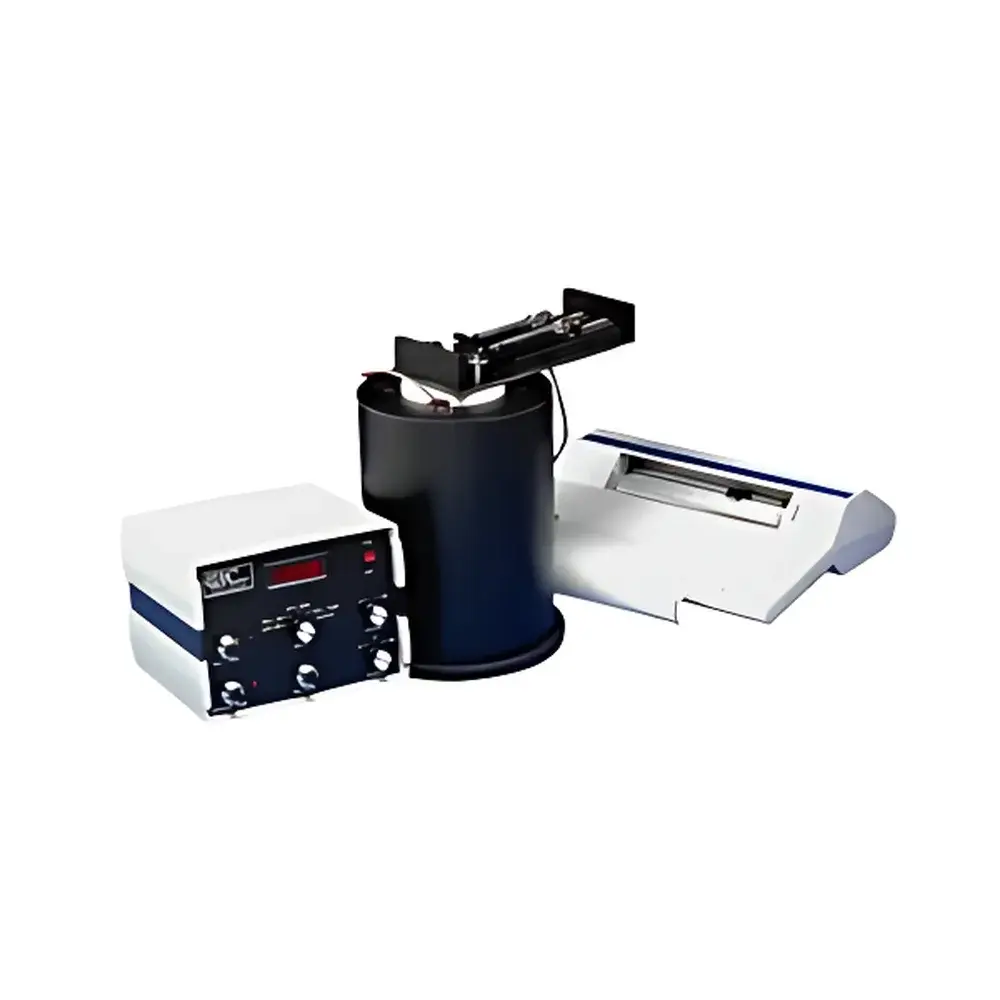
UIC 833 Vapor Pressure Osmometry (VPO) Molecular Weight Analyzer
| Brand | UIC |
|---|---|
| Model | 833 |
| Origin | USA |
| Type | Vapor Pressure Osmometer |
| Molecular Weight Range | 100–25,000 Da (in toluene) |
| Minimum Detectable Concentration | 5 × 10⁻⁵ mol/L (toluene) |
| Temperature Control Range | Ambient to 130 °C (with optional chiller for sub-ambient operation) |
| Response Time | 2–5 min per sample |
| Sample Volume | 0.25 mL |
| Sensor Current Settings | 5, 20, 100 µA |
| Output Signal | 0–200 mV analog |
| Solvent Compatibility | Toluene, benzene, chloroform, 1,2-dichloroethane, methylene chloride, acetone, dimethylformamide (DMF), pyridine, water |
| Power Requirement | 220 V, 50 Hz, 1 A |
| Construction | All-steel sealed chamber with dual precision mechanical syringes and bowl-shaped thermistor housing |
| Dimensions (Controller) | 22 × 24 × 17 cm (L×W×H) |
| (Sample Cell) | 23 × 23 × 27 cm (L×W×H) |
Overview
The UIC 833 Vapor Pressure Osmometry (VPO) Molecular Weight Analyzer is a precision benchtop instrument engineered for the determination of number-average molecular weight (Mn) of non-volatile solutes in solution. It operates on the fundamental thermodynamic principle of vapor pressure depression: when a non-volatile solute dissolves in a volatile solvent, the equilibrium vapor pressure above the solution decreases proportionally to the solute’s mole fraction. The 833 quantifies this depression by measuring the differential thermal response between two matched thermistors—one exposed to pure solvent vapor, the other to solution vapor—within a temperature-controlled, hermetically sealed chamber. This differential manifests as a resistance change across a sensitive Wheatstone bridge circuit, converted into a calibrated voltage output (0–200 mV) proportional to solute concentration. Designed for robustness and inter-laboratory reproducibility, the 833 delivers reliable Mn data for polymers, dendrimers, peptides, and synthetic macromolecules without requiring calibration standards for each run—provided the instrument is properly conditioned and the solvent system is well-characterized.
Key Features
- All-steel, fully sealed reaction chamber ensures long-term stability and eliminates vapor leakage, critical for low-concentration measurements and extended baseline drift control.
- Dual mechanically actuated micro-syringes enable precise, operator-independent sample and solvent delivery—eliminating manual injection variability and minimizing disturbance to thermal equilibrium.
- Bowl-shaped thermistor housing accommodates variable sample volumes and high-viscosity solutions without compromising measurement repeatability or accuracy.
- Three selectable bridge current settings (5, 20, 100 µA) allow optimization of sensitivity and signal-to-noise ratio across diverse molecular weight ranges and solvent systems.
- Integrated temperature control (ambient to 130 °C) with optional external chiller support enables method development across broad thermal windows—including sub-ambient operation for volatile solvents such as chloroform or acetone.
- Compact footprint (controller: 22 × 24 × 17 cm; cell: 23 × 23 × 27 cm) and minimal external interface (only two Luer-lock ports for sample/solvent introduction) simplify integration into regulated QC environments.
- Analog 0–200 mV output supports direct connection to chart recorders, data acquisition systems, or modern DAQ hardware compliant with IEEE 1451.2 or USB-DAQ standards.
Sample Compatibility & Compliance
The UIC 833 supports a wide range of organic and aqueous solvent systems—including toluene, benzene, chloroform, 1,2-dichloroethane, methylene chloride, acetone, DMF, pyridine, and water—enabling characterization of both hydrophobic and hydrophilic macromolecules. Its validated molecular weight range spans 100–25,000 Da in toluene and 100–5,000 Da in water, making it suitable for oligomers, linear polymers, and moderately sized biopolymers. The instrument meets foundational requirements for GLP-compliant laboratories: its analog output architecture supports audit-trail-capable data logging when paired with 21 CFR Part 11–compliant acquisition software; temperature stability (±0.01 °C) and thermistor matching (±0.001 Ω) are documented in factory calibration reports traceable to NIST standards. While not an automated GMP system, the 833’s mechanical design, absence of software-dependent workflows, and deterministic thermal response facilitate straightforward IQ/OQ/PQ validation protocols aligned with ISO/IEC 17025 and ASTM D5225 guidelines for osmometric analysis.
Software & Data Management
The UIC 833 operates as a standalone analog instrument, requiring no proprietary software for basic operation. Voltage output is directly interpretable as ΔR/R₀, which correlates linearly with molality via pre-established calibration curves (supplied with instrument documentation). For digital integration, users may employ third-party DAQ platforms (e.g., National Instruments LabVIEW, Keysight PathWave, or Python-based PyDAQmx) to acquire, timestamp, and store raw signals. Calibration curve generation follows standard practice: serial dilutions of a reference polymer (e.g., polystyrene in toluene) yield a plot of mV vs. log(Mn), enabling interpolation for unknowns. All calibration and sample data files can be exported in CSV or ASCII format, supporting traceability, peer review, and regulatory submission packages under FDA or EMA expectations.
Applications
- Quality control of synthetic polymers (e.g., polyacrylates, polyesters, polyethers) during R&D and manufacturing release testing.
- Verification of step-growth polymerization completion and branching density in dendritic architectures.
- Stability assessment of protein conjugates and PEGylated therapeutics in formulation development.
- Batch-to-batch consistency evaluation of natural gums, cellulose derivatives, and polysaccharides in food/pharma excipient qualification.
- Supporting ISO 13885-1 (plastics — determination of number-average molecular mass by vapor pressure osmometry) and ASTM D5225 (standard test method for number-average molecular weight of polymers by vapor pressure osmometry).
FAQ
What molecular weight range is reliably measurable with the UIC 833?
The instrument provides accurate Mn values from 100 to 25,000 Da in low-polarity solvents such as toluene, and 100 to 5,000 Da in higher-polarity media including water—subject to solvent volatility and thermistor thermal response limits.
Can the 833 be used for aqueous biological samples?
Yes, provided the solute is non-volatile and thermally stable below 130 °C; however, water’s high heat of vaporization necessitates careful equilibration and may reduce sensitivity compared to organic solvents.
Is the system compliant with 21 CFR Part 11?
The base instrument is analog-only and does not include electronic signature or audit trail functionality; full Part 11 compliance requires integration with validated third-party data acquisition and electronic lab notebook (ELN) systems.
How is calibration performed?
Calibration uses certified narrow-distribution polymer standards (e.g., polystyrene, PMMA) dissolved in the target solvent at known concentrations; a minimum of three points generates a robust linear or semi-log calibration curve.
What maintenance is required?
Routine maintenance includes periodic cleaning of syringe barrels and thermistor wells with appropriate solvents, verification of seal integrity, and annual thermistor resistance matching checks using a precision multimeter.



