
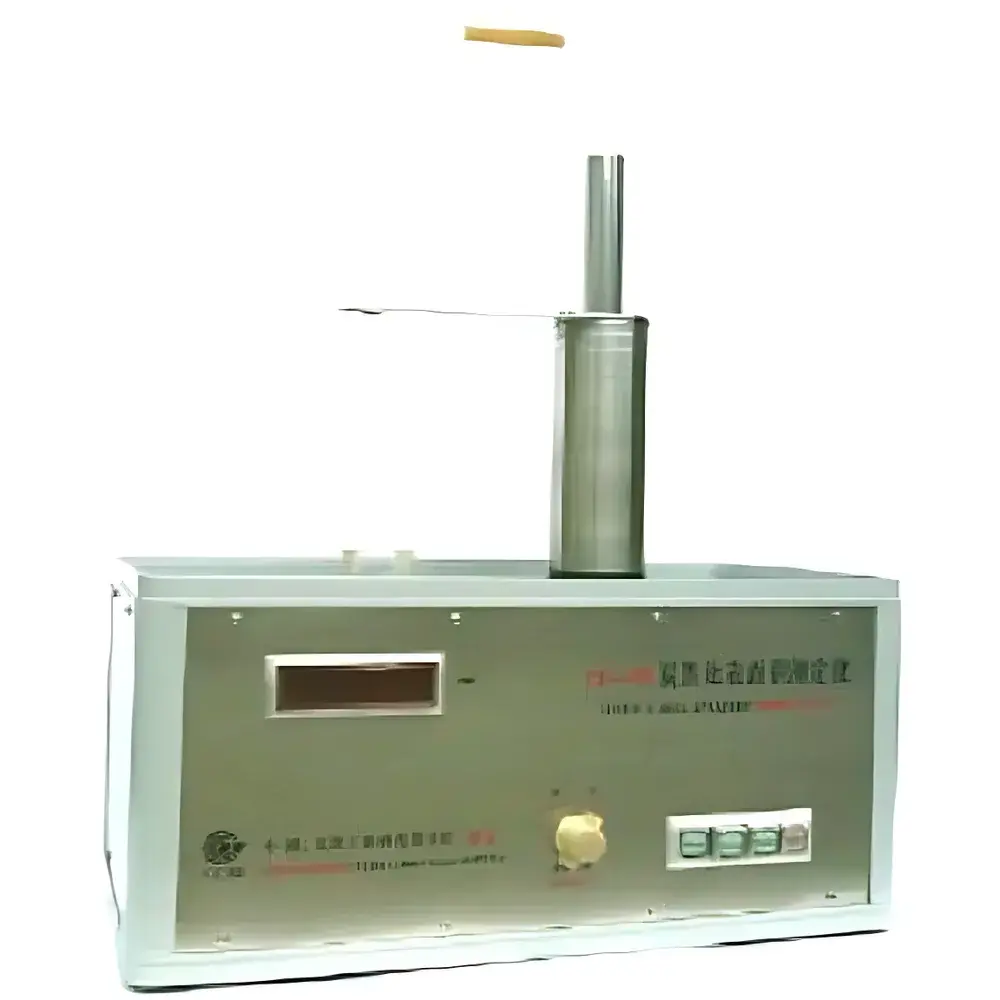
GY-TBY-10 CTAB Surface Area Analyzer
| Origin | Imported |
|---|---|
| Manufacturer Type | Authorized Distributor |
| Model | GY-TBY-10 |
| Pricing | Available Upon Request |
Overview
The GY-TBY-10 CTAB Surface Area Analyzer is a dedicated, standards-compliant instrument engineered for the precise determination of specific surface area (SSA) of carbon black and precipitated silica (silica gel, commonly known as “white carbon black”) via the Cetyltrimethylammonium Bromide (CTAB) adsorption method. It operates on the fundamental principle of selective ionic surfactant adsorption at the solid–liquid interface, where CTAB molecules form a monolayer on the surface of carbon black or silica particles in aqueous suspension. The endpoint of adsorption is detected optically through turbidity change during titration—specifically, the onset of colloidal coagulation (flocculation) induced by excess CTAB, captured in real time using high-sensitivity photodetection. Designed in strict alignment with GB/T 3780.5—China’s national standard equivalent to ISO 6810:1985(E)—the analyzer supports half-sample analysis (50% sample mass vs. full-standard protocol), delivering full compliance without compromising measurement integrity. Its architecture integrates digital precision dosing, optical endpoint recognition, and robust thermal/environmental tolerance (0–40 °C ambient), making it suitable for routine QC laboratories in carbon black manufacturing, rubber compounding, and silica production facilities.
Key Features
- Digital micro-dosing pump with high-resolution volumetric control (±0.02 mL per step), enabling reproducible CTAB titrant delivery under programmable flow profiles.
- Optoelectronic endpoint detection system utilizing collimated LED light source and silicon photodiode receiver, optimized for rapid (<2 s response) and unambiguous flocculation threshold identification.
- Half-sample analysis mode compliant with ISO 6810:1985(E), reducing reagent consumption by ~50% and shortening total assay time by 30–40% versus conventional full-mass protocols.
- Calibration traceability supported through certified reference materials (CRM) for carbon black (e.g., NIST SRM 1860a analogs) and internal procedural validation per GB/T 3780.5 Annex B.
- Stable operational performance across ambient temperatures from 0 °C to 40 °C; power input: 220 V AC ±10%, 50 Hz; no external cooling or gas supply required.
- Modular design facilitating maintenance of optical path, titration line, and sample cell—no specialized tools required for routine cleaning or replacement.
Sample Compatibility & Compliance
The GY-TBY-10 is validated for use with ASTM D3265 (for precipitated silica), GB/T 3780.5 (carbon black), and ISO 6810:1985(E) (general CTAB method). It accommodates standard carbon black grades across the N100–N900 series (e.g., N110, N220, N330, N550, N660, N774, N990) and precipitated hydrated silica (CAS 10279-57-9) with BET surface areas ranging from 20 m²/g to 350 m²/g. Sample preparation follows mandatory isothermal adsorption (25 ±1 °C, 60 min equilibration) and vacuum filtration per GB/T 3780.5 Section 6. Instrument uncertainty (UI) is quantified at ±1.5% (k = 2) under verified operating conditions and standardized pretreatment, meeting GLP documentation requirements for industrial QA/QC reporting. While not FDA 21 CFR Part 11–certified out-of-box, audit trails and raw data export (CSV/TXT) support retrospective validation for GMP-aligned environments.
Software & Data Management
The analyzer operates via embedded firmware with local LCD interface and physical keypad navigation—no PC dependency for basic operation. All measurement parameters (titrant volume, endpoint signal intensity, slope threshold, sample ID, date/time stamp) are stored internally (≥1,000 records) and exportable via USB 2.0 to standard spreadsheet formats. Raw photometric time-series data (10 Hz sampling) is retained for endpoint verification and method troubleshooting. Optional Windows-based companion software (v3.2+) provides graphical overlay of turbidity curves, statistical summary (mean, SD, RSD%), batch reporting templates aligned with ISO/IEC 17025 clause 7.8, and electronic signature fields compatible with internal QA approval workflows.
Applications
- Routine quality control of carbon black surface area in rubber compound formulation—correlating CTAB SSA with dispersion efficiency, reinforcement index, and vulcanizate tensile strength.
- Batch release testing of precipitated silica used in tire treads, toothpaste abrasives, and silicone rubber fillers.
- Method development and cross-validation studies between CTAB, nitrogen BET, and iodine number techniques.
- Automated turbidimetric titrations in general analytical chemistry labs—including sulfate, chloride, or phosphate determination where coagulation endpoints apply.
- Teaching laboratories demonstrating colloidal stability, surfactant adsorption isotherms, and interfacial characterization principles.
FAQ
What standards does the GY-TBY-10 comply with?
It is fully aligned with GB/T 3780.5, ISO 6810:1985(E), and supports ASTM D3265 for silica.
Can it measure nitrogen BET surface area?
No—it is exclusively configured for CTAB-based liquid-phase adsorption; BET requires gas sorption instrumentation (e.g., static volumetric or dynamic flow analyzers).
Is calibration required before each analysis?
Daily verification using a control sample is recommended; full calibration (titrant concentration, optical baseline) is performed per GB/T 3780.5 Section 7.2 every 72 hours or after reagent change.
Does the instrument require degassed samples?
No—samples are processed as aqueous slurries following standardized wetting and dispersion per GB/T 3780.5; vacuum degassing is not part of the CTAB method.
What maintenance intervals are recommended?
Optical window cleaning weekly; titration tubing replacement every 6 months; photodiode sensitivity check annually using factory-provided reference filter set.





