
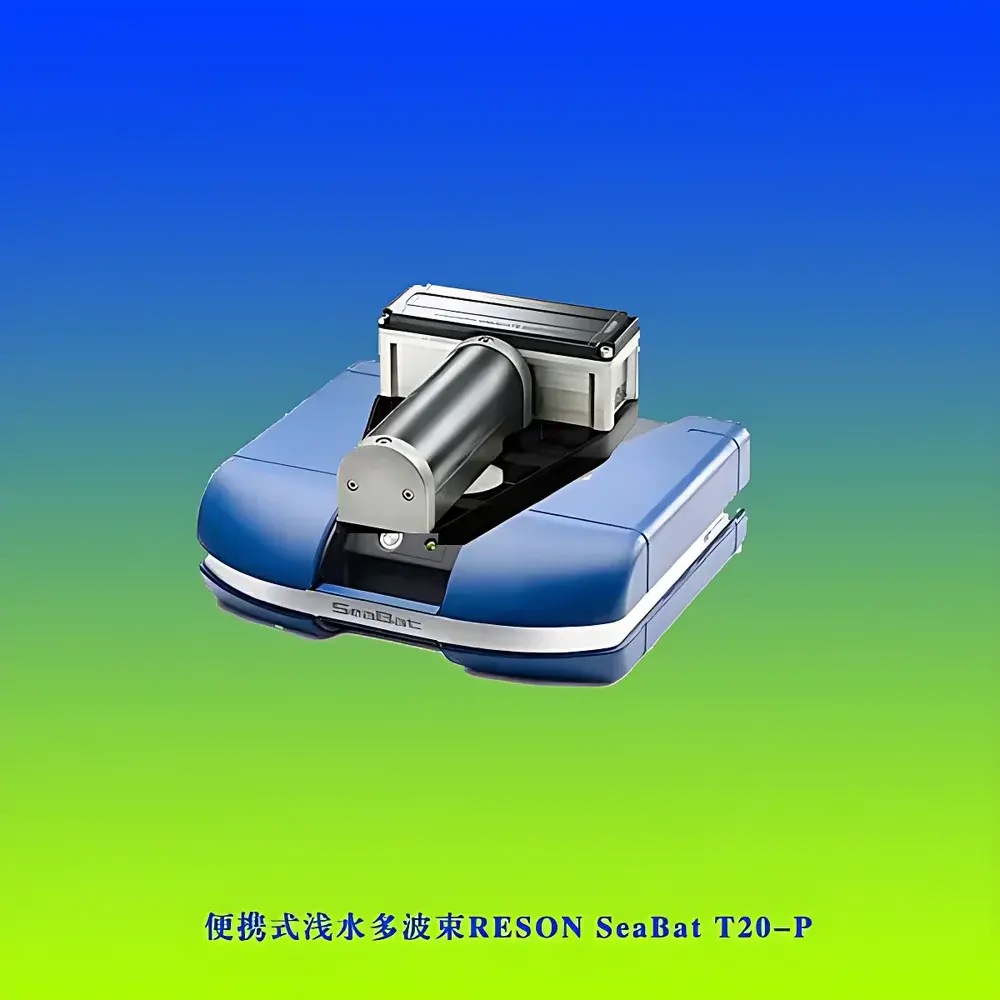
Reson SeaBat T20-P Portable Shallow-Water Multibeam Echosounder
| Origin | Denmark |
|---|---|
| Manufacturer Type | Authorized Distributor |
| Origin Category | Imported |
| Model | SeaBat T20-P |
| Price | USD 100,000 (FOB Copenhagen) |
| Operating Frequency | 200–400 kHz |
| Beam Count | 512 |
| Max Swath Width | 140° (up to 165° in FlexMode) |
| Depth Range | 0.5–400 m (at 200 kHz) |
| Ping Rate | Up to 50 Hz |
| Vertical Beamwidth | 1.1° @ 400 kHz / 2.2° @ 200 kHz |
| Horizontal Beamwidth | 1.1° @ 400 kHz / 2.2° @ 200 kHz |
| Depth Resolution | 6 mm |
| Transducer Housing Material | Titanium Alloy |
| Submerged Weight | <8 kg (combined Tx/Rx) |
| Processor IP Rating | IP54 |
| Power Input | 24 VDC or 100–230 VAC, 50/60 Hz |
| Max Power Consumption | 300 W (peak) |
| Operating Temperature (Processor) | –2°C to +40°C |
| Operating Temperature (Transducer) | –2°C to +30°C |
| Cable Length (standard) | 10 m (25 m / 50 m optional) |
| Pressure Rating (Transducer) | 50 m |
Overview
The Reson SeaBat T20-P is a compact, high-performance portable shallow-water multibeam echosounder engineered for rapid deployment on small survey platforms—including unmanned surface vessels (USVs), kayaks, rigid-hulled inflatable boats (RHIBs), and autonomous underwater vehicles (AUVs). Built upon Reson’s proven SeaBat architecture and leveraging advanced broadband chirp signal processing, the T20-P operates across a dual-frequency range (200 kHz and 400 kHz) to deliver high-resolution bathymetric data, full water column imagery, and co-registered sidescan sonar in a single ping. Its core measurement principle relies on coherent beamforming and real-time phase-difference processing to resolve seabed topography with sub-centimeter vertical precision and angular resolution down to 1.1°. Designed for compliance with IHO S-44 Special Order and CAT1 standards for hydrographic surveying, the system supports rigorous QA/QC workflows required by national mapping agencies, environmental consultancies, and coastal engineering firms.
Key Features
- Lightweight titanium transducer assembly (<8 kg submerged) with integrated Tx/Rx modules and pressure-rated housing (50 m depth rating)
- Modular portable sonar processor (14 kg) featuring fanless thermal management, IP54 ingress protection, and dual power input (24 VDC or 100–230 VAC)
- Real-time beamforming engine supporting up to 512 beams per ping and dynamic swath optimization (140° nominal, extendable to 165° via FlexMode)
- Simultaneous acquisition of bathymetry, backscatter intensity, water column data, and sidescan imagery—no post-processing stitching required
- Embedded auto-calibration routines for pitch, roll, heading, and time synchronization using integrated sensor fusion (GNSS, IMU, motion sensor inputs)
- Low-power architecture optimized for battery-operated platforms: typical operational draw is 200 W (peak 300 W)
Sample Compatibility & Compliance
The SeaBat T20-P is certified for operation in Class I, Division 2 hazardous locations (per UL 1604) and conforms to electromagnetic compatibility (EMC) requirements under EN 61326-1:2013. It meets the mechanical and environmental testing criteria outlined in MIL-STD-810G for shock, vibration, and thermal cycling. All firmware and data logging modules are compliant with ISO 19901-7:2021 (offshore survey instrumentation) and support audit-ready metadata tagging per IHO S-100 framework. Data outputs adhere to standard formats including XTF, PD0, and S7K, enabling direct ingestion into CARIS HIPS & SIPS, QPS Qimera, and ERDAS IMAGINE for georeferenced analysis. The system supports traceable calibration via NIST-traceable reference targets and integrates seamlessly with GNSS receivers meeting RTK or PPK positioning accuracy (≤2 cm horizontal, ≤3 cm vertical).
Software & Data Management
SeaBat T20-P operates exclusively through the SeaBat User Interface (SUI), a Windows-based application deployable on user-supplied laptops or ruggedized field workstations. SUI provides full remote control, real-time quality monitoring (including SNR, beam coherence, and ping validity flags), and automated QC dashboards aligned with IHO S-44 performance thresholds. All raw and processed datasets include embedded timestamps synchronized to GPS PPS signals, ensuring temporal integrity for multi-sensor fusion. The software supports FDA 21 CFR Part 11-compliant electronic signatures, role-based access control, and immutable audit trails for GLP/GMP-aligned marine survey operations. Export options include GeoTIFF, LAS, and CSV with customizable metadata headers for GIS interoperability and regulatory reporting.
Applications
- High-resolution nearshore bathymetric mapping for dredging planning and sediment volume estimation
- Infrastructure inspection of pipelines, cables, and offshore wind foundations in water depths <400 m
- Environmental habitat classification using calibrated backscatter and water column anomaly detection
- Rapid-response surveys following storm events or underwater landslides
- Integration with USV fleets for persistent maritime domain awareness (MDA) and change detection
- Academic research in estuarine morphodynamics, coral reef resilience monitoring, and submerged archaeological site documentation
FAQ
What is the minimum detectable depth and vertical resolution?
The system achieves a minimum operational depth of 0.5 m with a theoretical depth resolution of 6 mm at optimal signal-to-noise ratio conditions.
Can the T20-P operate from moving platforms without external motion sensors?
No—accurate motion compensation requires external pitch/roll/heading input via RS422 or NMEA 0183; integrated inertial navigation is not included but supported via third-party IMUs.
Is raw beam data accessible for custom processing?
Yes—full complex beamformed data (I/Q samples) and raw echo envelopes are streamed via Ethernet in real time and logged to disk in open binary formats.
Does the system support multistatic configurations or synthetic aperture processing?
Not natively—the T20-P is a monostatic system; SAR-like enhancement is available only through post-processed mosaic algorithms in licensed CARIS or QPS software.
What certifications apply to the transducer’s titanium housing?
The housing complies with ASTM B348 Grade 5 (Ti-6Al-4V) material specifications and undergoes hydrostatic pressure testing to 1.5× rated depth (75 m) prior to shipment.






