
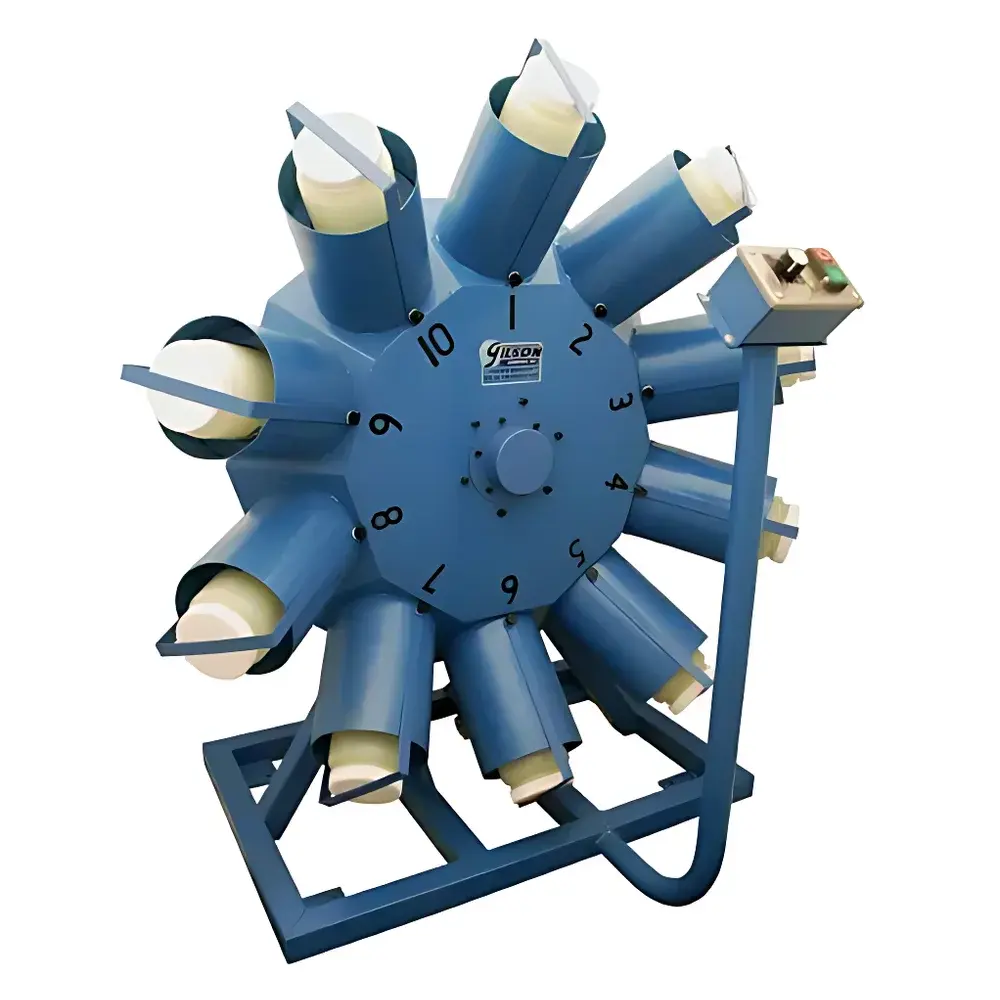
Gilson SP-48R / SP-48RF Mixing Wheel
| Origin | USA |
|---|---|
| Manufacturer Type | Authorized Distributor |
| Origin Category | Imported |
| Model | SP-48R (115 V / 60 Hz), SP-48RF (230 V / 50 Hz) |
| Pricing | Upon Request |
| Sample Capacity | 0.5 gal (2 L) per station |
| Number of Stations | 10 |
| Station Angle | 45° |
| Speed Range | 0–25 rpm |
| Construction | Heavy-duty powder-coated steel floor stand |
| Clamping Mechanism | Spring-loaded, numbered sample station fixtures |
| Compatible Vessel | SC-108 wide-mouth polyethylene sample jars (sold separately) |
| Optional Accessory | SPA64 jack rocks for enhanced mixing efficiency |
Overview
The Gilson SP-48R and SP-48RF Mixing Wheels are precision-engineered laboratory devices designed to homogenize dry, granular, or powdered materials through controlled rotational motion. Based on the principle of tumbling agitation—where sample containers are rotated along a fixed axis at a defined inclination—the system ensures reproducible blending without mechanical shear or particle attrition. This method is particularly suited for preparing representative subsamples from heterogeneous bulk materials prior to analytical testing, compliance verification, or quality control assessment. The device operates in accordance with ASTM D2013 (“Standard Practice for Preparing Coal Samples for Analysis”), which specifies tumbling as an accepted technique for achieving compositional uniformity in coarse particulate solids. Both models feature identical mechanical architecture but differ only in electrical configuration: the SP-48R supports 115 V / 60 Hz input (North America, Japan), while the SP-48RF accommodates 230 V / 50 Hz (Europe, Asia-Pacific, and other IEC-compliant regions). Neither unit includes internal electronics beyond motor control; speed regulation is achieved via analog potentiometer, enabling stable operation across the full 0–25 rpm range.
Key Features
- Ten precisely indexed sample stations mounted at a fixed 45° angle to optimize gravitational cascading action during rotation.
- Spring-loaded, numbered clamping fixtures ensure secure retention of 0.5-gallon (2 L) sample containers—minimizing risk of displacement or spillage during extended mixing cycles.
- Robust floor-standing frame fabricated from heavy-gauge steel with industrial-grade powder coating for corrosion resistance and long-term structural integrity.
- Variable-speed DC motor drive with analog speed control allows fine-tuned adjustment between 0 and 25 rpm, supporting method-specific protocols requiring low-energy tumbling or accelerated homogenization.
- Designed for compatibility with Gilson SC-108 wide-mouth polyethylene sample jars (sold separately), which provide chemical resistance, static-dissipative properties, and leak-proof sealing via threaded caps.
- Optional SPA64 jack rocks—dense ceramic or stainless-steel media—can be introduced into sample vessels to enhance mixing kinetics for cohesive or high-density materials.
Sample Compatibility & Compliance
The SP-48 series accepts standard 0.5-gallon (2 L) containers with diameters up to 115 mm and heights not exceeding 220 mm. It is validated for use with dry, free-flowing, non-adhesive materials including coal, aggregate, soil, cement, limestone, and mineral ores. The 45° station orientation conforms explicitly to ASTM D2013 Section 7.2, ensuring regulatory acceptability in laboratories subject to ASTM-, ISO-, or EPA-mandated sampling procedures. While not intrinsically rated for hazardous environments, the device complies with UL 61010-1 (Safety Requirements for Electrical Equipment for Measurement, Control, and Laboratory Use) and meets CE marking requirements under the Low Voltage Directive (2014/35/EU) and EMC Directive (2014/30/EU). No explosion-proof certification is provided; operation in classified areas requires third-party hazard evaluation.
Software & Data Management
The SP-48R and SP-48RF are standalone electromechanical instruments with no embedded firmware, digital interface, or data logging capability. All operational parameters—including speed setting, run duration, and station assignment—are manually configured and recorded externally by the user. For laboratories operating under GLP or GMP frameworks, documentation of mixing parameters must be maintained in hardcopy or LIMS-integrated electronic records. Though the device itself does not support 21 CFR Part 11 compliance features (e.g., electronic signatures, audit trails), its mechanical simplicity and deterministic behavior facilitate straightforward validation—particularly when paired with time-stamped video monitoring or calibrated stopwatch protocols.
Applications
- Preparation of representative sub-samples from bulk shipments of coal, coke, or biomass feedstocks prior to proximate or ultimate analysis.
- Homogenization of construction aggregates (e.g., sand, gravel, crushed stone) before sieve analysis or specific gravity determination per ASTM C136 and ASTM C127.
- Blending of heterogeneous environmental soil cores for metals extraction or organic contaminant screening (EPA Method 5035A).
- Conditioning of catalyst powders or pharmaceutical excipients where mechanical shear could compromise particle morphology or crystallinity.
- Quality assurance workflows in mining, cement production, and waste-to-energy facilities requiring ISO/IEC 17025-aligned sampling preparation.
FAQ
What voltage options are available for the Gilson Mixing Wheel?
The SP-48R operates on 115 V / 60 Hz; the SP-48RF is configured for 230 V / 50 Hz. These variants are not interchangeable without external voltage conversion.
Are sample jars included with the unit?
No. SC-108 wide-mouth polyethylene sample jars (0.5 gal, with screw caps) must be ordered separately. A 12-pack is commonly referenced as part number SC-108-12.
Can the Mixing Wheel accommodate containers larger than 0.5 gallons?
No. The station geometry and clamping mechanism are engineered exclusively for 0.5-gallon (2 L) vessels meeting Gilson’s dimensional specifications.
Is speed calibration traceable to NIST standards?
While the motor controller does not include factory-certified calibration, users may verify rotational speed using a handheld tachometer traceable to NIST or equivalent national metrology institute.
Does the device require routine maintenance?
Yes. Annual inspection of motor brushes (if applicable), lubrication of bearing assemblies, and verification of clamp spring tension are recommended per Gilson’s Maintenance Guide MG-SP48.





