
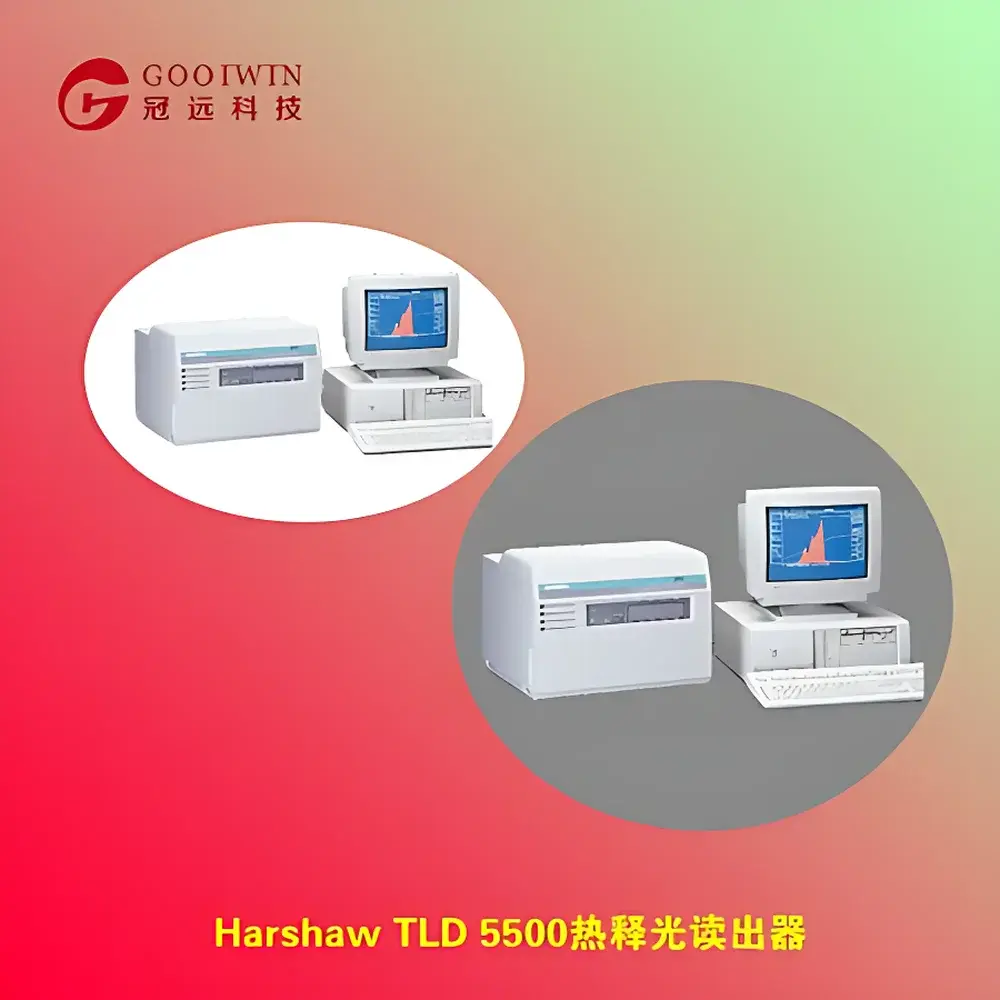
UNION TLD 5500 Thermoluminescence Dosimeter Reader
| Brand | UNION |
|---|---|
| Origin | Germany |
| Model | TLD 5500 |
| Type | Single-channel automated thermoluminescence reader for routine low-to-medium throughput dosimetry |
| Dose Range | Configurable segmented calibration (e.g., 10 µGy – 10 Gy, application-dependent) |
| Heating Profile | Programmable linear/ramp heating up to 300 °C |
| Readout Sensitivity | < 1 µGy (typical for LiF:Mg,Ti chips) |
| Automation | Motorized planchet loader/unloader, integrated glow curve acquisition and analysis |
| Compliance | Designed to support ISO/IEC 17025-compliant dosimetry workflows, compatible with GLP/GMP documentation requirements |
Overview
The UNION TLD 5500 Thermoluminescence Dosimeter Reader is an engineered solution for precise, reproducible measurement of ionizing radiation dose using thermoluminescent dosimetry (TLD) principles. It operates on the fundamental physical phenomenon wherein crystalline phosphors—such as LiF:Mg,Ti, CaSO4:Dy, or Al2O3:C—store energy from incident radiation in metastable electron traps; upon controlled thermal stimulation, this stored energy is released as visible photons proportional to the absorbed dose. The TLD 5500 implements a calibrated, programmable heating cycle (up to 300 °C) coupled with a low-noise photomultiplier tube (PMT) detection system to acquire high-fidelity glow curves. Unlike manual or dual-channel systems, the TLD 5500 is optimized for laboratories requiring consistent, traceable, and auditable dose assessment at moderate sample volumes—particularly where regulatory alignment with food irradiation validation, occupational health monitoring, environmental surveillance, and research-grade dosimetry is essential.
Key Features
- Single-channel high-stability readout architecture with temperature-controlled planchet chamber and real-time thermal profiling
- Programmable heating rates (0.1–20 °C/s) and endpoint temperatures, enabling optimization for diverse TLD materials and dose ranges
- Automated sample handling: motor-driven planchet loader/unloader supports batch processing of up to 20 standard 3.2 mm or 4.5 mm TLD chips per run
- Glow curve deconvolution software module for peak separation, kinetic parameter extraction (E, s), and trap population analysis
- Segmented dose-response calibration capability: users may define multiple linear or polynomial regression intervals across extended dose ranges (e.g., 10 µGy–1 mGy; 1 mGy–1 Gy; 1–10 Gy), improving accuracy over full-range single-curve fitting
- Integrated background subtraction, noise filtering, and baseline correction algorithms compliant with IEC 62387-1:2012 recommendations for TL signal processing
Sample Compatibility & Compliance
The TLD 5500 accommodates standard commercial TLD elements—including LiF:Mg,Ti (TLD-100), LiF:Mg,Cu,P (TLD-100H), CaF2:Dy, and Al2O3:C—mounted on stainless-steel or ceramic planchets. Its mechanical and thermal design ensures uniform heating and minimal cross-talk between successive reads. The instrument supports calibration traceability to national metrology institutes (e.g., PTB, NPL) and facilitates compliance with international standards including ISO/IEC 17025:2017 (for testing laboratories), ISO/ASTM 51275:2021 (practice for dosimetry in food irradiation), and IAEA Technical Reports Series No. 469. Data integrity features align with FDA 21 CFR Part 11 requirements when used with validated software configurations, including electronic signatures, audit trails, and user-access controls.
Software & Data Management
The included TLD Analysis Suite v3.x provides a Windows-based interface for instrument control, real-time glow curve visualization, and post-acquisition quantification. All raw data (time–temperature–intensity arrays), processed curves, calibration metadata, and operator logs are stored in encrypted SQLite databases with immutable timestamps. Export options include CSV, XML (for LIMS integration), and PDF reports containing full traceability: chip ID, annealing history, readout parameters, uncertainty budgets (Type A/B), and compliance flags. The software supports multi-user role management and integrates with enterprise authentication systems (LDAP/Active Directory). Audit trail records capture every parameter change, data export, and report generation event—enabling full reconstruction of analytical workflows during internal or external audits.
Applications
- Food irradiation validation: Routine verification of delivered dose in facilities applying gamma, X-ray, or electron beam treatment per Codex Alimentarius standards
- Environmental radiation monitoring: Field-deployable TLD badge analysis for terrestrial gamma dose rate mapping and radon progeny exposure assessment
- Research dosimetry: Characterization of novel phosphor materials, kinetic modeling of trap distributions, and intercomparison studies under EURADOS protocols
- Medical physics support: Secondary standard calibration of radiotherapy QA phantoms and brachytherapy source verification
- Occupational safety programs: Personnel dosimeter processing in nuclear medicine, radiopharmacy, and industrial radiography settings
FAQ
What TLD materials are validated for use with the TLD 5500?
LiF:Mg,Ti (TLD-100), LiF:Mg,Cu,P (TLD-100H), CaSO4:Dy, and Al2O3:C are fully supported; custom calibrations can be established for other phosphors upon request.
Does the system support dose reconstruction for mixed-field exposures?
Yes—when paired with multi-element filters or composite planchets, the TLD 5500’s glow curve analysis enables semi-quantitative neutron/gamma discrimination via peak ratio methods.
Is firmware update capability available remotely?
Firmware updates are distributed via secure USB key or authenticated HTTPS download; remote live updates are disabled by default to maintain regulatory compliance.
Can the TLD 5500 be integrated into an existing LIMS environment?
Yes—through standardized HL7 or ASTM E1384-compliant interfaces, with optional middleware for seamless bidirectional data exchange.
What maintenance intervals are recommended?
Annual PM (preventive maintenance) is advised, including PMT gain verification, heater calibration check, and optical path inspection; full certification reports are issued per ISO/IEC 17025 clause 6.4.10.
Related Products





