
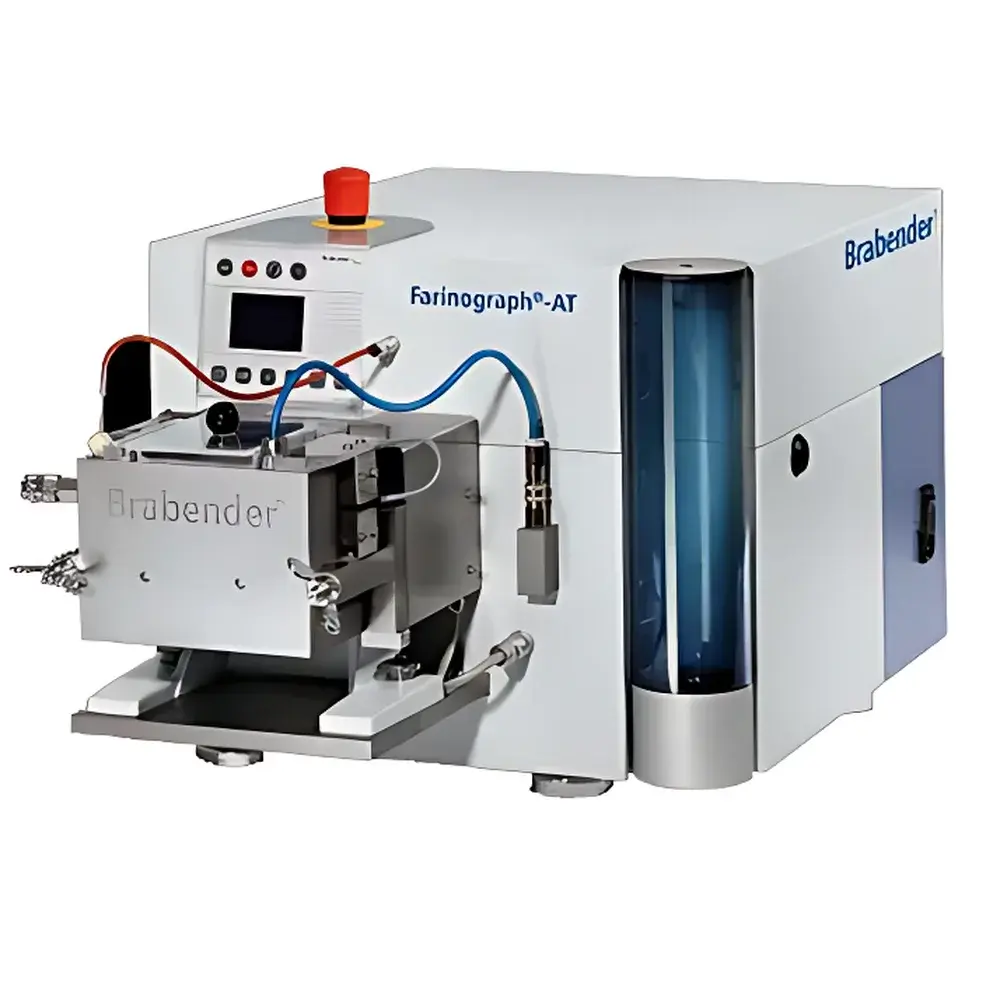
Brabender Farinograph-AT Automatic Farinograph
| Brand | Brabender |
|---|---|
| Origin | Germany |
| Model | Farinograph-AT |
| Torque Range | Up to 20 N·m |
| Speed Control | 0–200 rpm |
| Temperature Monitoring | Dough & Water Temperature Simultaneously |
| Data Output | Real-time Color Torque-Time Curve (Farinogram) |
| Compliance | ASTM D4748, ISO 5530-1, AACC Method 54-21A |
| Software | Brabender LabStation with GLP/GMP Audit Trail Support |
| Water Reservoir Capacity | 2 L, Thermostatically Controlled |
Overview
The Brabender Farinograph-AT is an automated farinograph designed for precise, reproducible assessment of wheat flour and other cereal-based dough systems under controlled rheological conditions. It operates on the principle of controlled mechanical shear applied to a hydrated dough sample within a thermostatically regulated mixing bowl. As the rotating kneading arm—driven by a high-torque (20 N·m), low-inertia motor—exerts defined shear stress on the dough, the resulting resistance torque is measured via angular deflection of the motor housing mounted on precision bearings. This torque signal, continuously digitized and time-stamped, forms the basis of the farinogram: a standardized torque-versus-time curve that quantifies key functional parameters including water absorption, dough development time, stability, weakening (departure time), and mixing tolerance index. The instrument conforms to internationally recognized test standards including ISO 5530-1, ASTM D4748, and AACC Method 54-21A, ensuring data comparability across global R&D, quality control, and regulatory laboratories.
Key Features
- Automated water titration system with 2 L thermostatically controlled reservoir—enabling precise, operator-independent hydration control and repeatable absorption endpoint detection
- Variable-speed drive (0–200 rpm) with programmable speed profiles, supporting both standard farinographic protocols and non-standard shear history simulations
- Simultaneous real-time monitoring and recording of dough temperature and added water temperature—critical for evaluating thermal sensitivity in heat-labile formulations
- Integrated torque measurement with high-resolution analog-to-digital conversion, delivering consistent farinogram morphology across batch-to-batch testing
- Full-color graphical display showing torque, temperature, and time axes on a single synchronized plot—facilitating immediate visual interpretation of dough behavior
- Automatic calculation of energy input (kWh/kg) based on torque, speed, and duration—providing objective metrics for process scalability and equipment selection
- Patented mechanical coupling design minimizing bearing hysteresis and thermal drift—ensuring long-term calibration stability without routine recalibration
Sample Compatibility & Compliance
The Farinograph-AT accommodates a broad range of particulate and semi-viscous materials beyond wheat flour, including rye, oat, rice, and gluten-free blends; hydrocolloid-enriched batters; egg white foams; starch pastes; and even non-food systems such as cheese curd, fish surimi, and processed meat emulsions. Its robust bowl geometry and torque-sensing architecture enable reliable characterization of low-hydration doughs (e.g., cookie or cracker formulations) and highly extensible systems (e.g., noodle or pasta doughs). All hardware and firmware comply with CE marking requirements and support 21 CFR Part 11-compliant electronic records when configured with Brabender LabStation software—including user access controls, audit trails, electronic signatures, and immutable data archiving. Validation documentation (IQ/OQ/PQ templates) and traceable calibration certificates are available upon request.
Software & Data Management
Brabender LabStation software provides full instrument control, real-time visualization, and post-acquisition analysis. It supports customizable test protocols, user-defined pass/fail criteria, overlay comparison against reference farinograms (stored in secure database), and export to CSV, PDF, or XML formats compatible with LIMS integration. Advanced modules include video synchronization (time-stamped camera feed aligned with torque/temperature traces), parametric trend analysis across multiple batches, and statistical process control (SPC) chart generation for QA/QC dashboards. Data integrity safeguards include automatic timestamping, checksum validation, and write-once-read-many (WORM) storage options compliant with GLP and GMP environments.
Applications
- Determination of optimal water absorption for flour blending and mill process optimization
- Quantification of dough development time and stability—key indicators for fermentation tolerance and oven spring performance
- Evaluation of enzymatic activity (e.g., α-amylase impact on breakdown) through controlled temperature ramping and extended testing
- Characterization of alternative protein matrices (e.g., pea, fava, or insect flour) in hybrid baking systems
- Formulation screening for extruded snacks, pet food, and plant-based meat analogues requiring defined viscoelastic thresholds
- Process validation of continuous mixing lines by correlating lab-scale farinogram parameters with industrial mixer energy input profiles
FAQ
What standards does the Farinograph-AT comply with?
ISO 5530-1, ASTM D4748, AACC Method 54-21A, and EN 15050.
Can the instrument measure temperature-sensitive doughs?
Yes—the system independently monitors and logs both dough and water temperatures throughout the test cycle, enabling thermal profiling and correction algorithms.
Is raw data export supported for third-party statistical analysis?
Yes—CSV, XML, and PDF exports include all sampled torque, temperature, time, and metadata fields, preserving full traceability.
How is calibration verified during routine operation?
Built-in diagnostic routines perform zero-torque verification and reference-load checks; optional NIST-traceable torque calibration kits are available for periodic verification.
Does the software support multi-user environments with role-based permissions?
Yes—LabStation implements configurable user roles (Operator, Supervisor, Administrator) with granular access control over method editing, data deletion, and report signing.




