
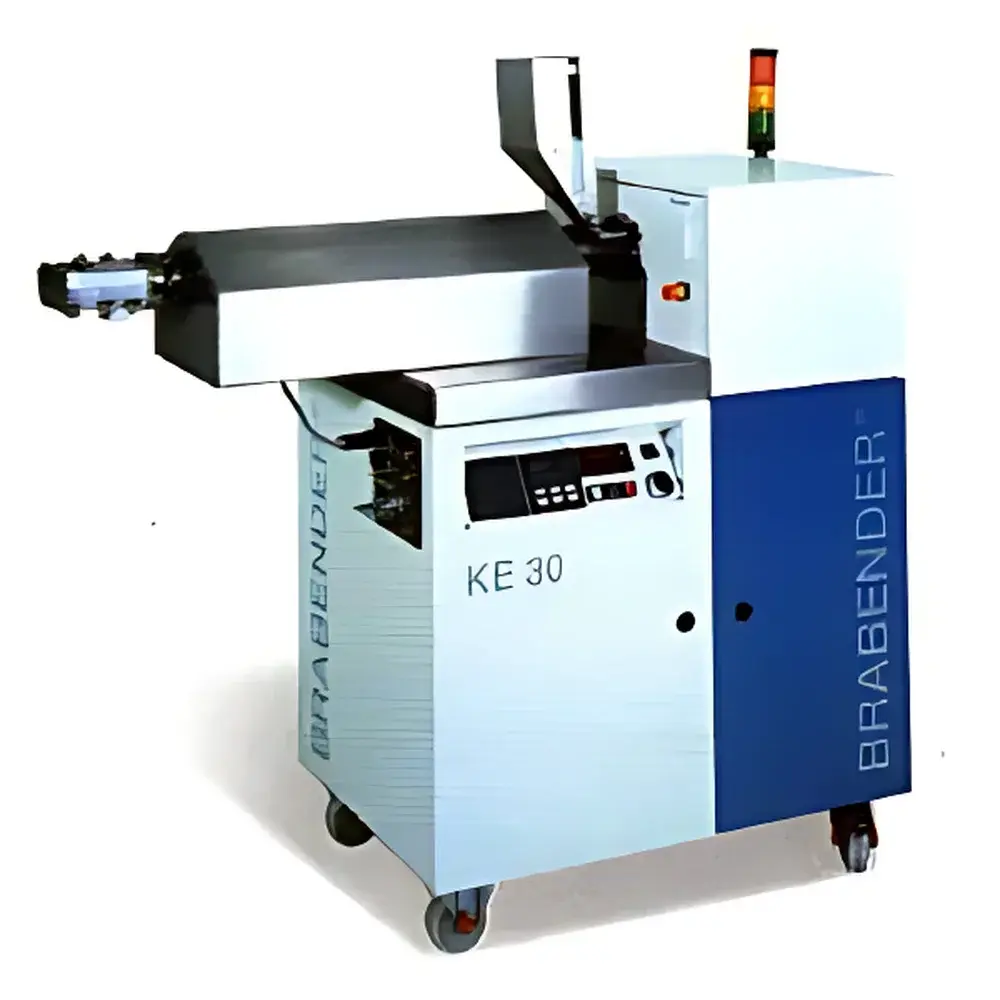
Brabender KE 19/KE 30 Standalone Extruder
| Origin | Germany |
|---|---|
| Manufacturer Type | Authorized Distributor |
| Origin Category | Imported |
| Model | KE 19 / KE 30 |
| Pricing | Upon Request |
Overview
The Brabender KE 19/KE 30 Standalone Extruder is a precision-engineered, benchtop-scale single-screw extrusion system designed for laboratory-based process development, formulation screening, and small-batch production in the rubber and plastics industries. Operating on classical screw extrusion principles—comprising feed zone, compression (melting) zone, and metering (pumping) zone—the system enables controlled thermal-mechanical processing of thermoplastics, elastomers, thermoplastic elastomers (TPEs), compounded masterbatches, and filled polymer systems. Its modular architecture supports variable screw configurations (e.g., conveying, mixing, barrier, reverse-thread elements), allowing users to replicate industrial screw geometries at reduced scale while maintaining rheologically relevant shear history and residence time distribution. The KE series is engineered for high reproducibility across trials, with temperature-controlled barrel zones (typically 5–7 individually regulated heating/cooling segments), precise torque and rotational speed monitoring, and real-time pressure measurement at die entry—critical parameters for correlating lab-scale data to full-scale production.
Key Features
- Modular twin-barrel design: KE 19 (19 mm screw diameter) and KE 30 (30 mm screw diameter) models offer scalable throughput from 0.1–5 kg/h (KE 19) to 1–25 kg/h (KE 30), supporting both exploratory formulation work and pilot-scale validation.
- High-precision drive system: Servo-motor-driven with closed-loop speed control (0.1–120 rpm range), delivering stable torque output up to 150 Nm (KE 30) and enabling accurate shear rate profiling per ISO 11443 and ASTM D3835.
- Thermally isolated, segmented barrel: Each zone features independent PID-controlled heating and forced-air or water cooling, ensuring axial temperature uniformity within ±1.0 °C and enabling precise simulation of thermal profiles encountered in industrial extrusion lines.
- Closed-feed hopper with volumetric or gravimetric feeding options: Minimizes material degradation and ensures consistent solids conveyance, particularly critical for hygroscopic or low-bulk-density compounds.
- Interchangeable die modules: Supports flat-film, annular (tube), profile, and strand dies; optional melt pressure transducers and inline rheometers (e.g., capillary rheometer integration) enable real-time viscoelastic characterization during extrusion.
- Rugged cast-iron frame with vibration-damped mounting: Ensures mechanical stability during extended operation and facilitates seamless integration with downstream units (e.g., haul-off, pelletizer, laser micrometer, or online FTIR).
Sample Compatibility & Compliance
The KE 19/KE 30 accommodates a broad spectrum of polymeric materials—including polyolefins (PP, PE), engineering resins (PA6, PC, PBT), thermoplastic vulcanizates (TPVs), silicone compounds, and PVC formulations—with or without fillers (CaCO₃, talc, glass fiber), plasticizers, flame retardants, or pigments. All wetted components comply with FDA 21 CFR §177.1520 for food-contact polymer processing. System design adheres to CE Machinery Directive 2006/42/EC and conforms to IEC 61000-6-2/6-4 electromagnetic compatibility standards. Data acquisition meets GLP and GMP documentation requirements when paired with Brabender’s WinCC-based software, supporting 21 CFR Part 11-compliant electronic signatures and audit trails.
Software & Data Management
Control and data acquisition are managed via Brabender’s proprietary Plasti-Corder® Lab-Station software (Windows-based). The platform provides synchronized logging of >30 real-time parameters—including screw speed, torque, barrel zone temperatures, melt pressure, motor power, and feed rate—at user-defined sampling intervals (down to 100 ms). Raw data exports to CSV or ASCII formats; integrated analysis tools support viscosity curve generation (shear stress vs. shear rate), power-law fitting, and time-series trend evaluation. Customizable report templates facilitate compliance-ready documentation for internal QA/QC, supplier qualification, or regulatory submissions (e.g., ISO 9001, IATF 16949).
Applications
- R&D of new polymer blends and composites, including dispersion quality assessment of nanofillers and conductive additives.
- Process window mapping: Determination of optimal temperature profiles, screw speed, and feed rate combinations to minimize degradation while maximizing output consistency.
- Raw material qualification: Comparative evaluation of resin lots, regrind content impact, or moisture sensitivity under controlled extrusion conditions.
- Quality assurance of finished products: Inline dimensional verification of extruded profiles or film thickness uniformity using integrated optical sensors.
- Training and education: Hands-on instruction in extrusion physics, melt rheology, and troubleshooting common defects (e.g., melt fracture, surging, die lip buildup).
FAQ
What is the typical residence time distribution (RTD) profile for the KE 30 under standard operating conditions?
Residence time varies with screw configuration, feed rate, and melt viscosity—but typically ranges from 60–180 seconds for homopolymers at 30% torque loading. RTD can be quantified experimentally using tracer methods (e.g., colorant pulse injection) supported by optional flow visualization ports.
Can the KE series be used for reactive extrusion (e.g., grafting or polymerization)?
Yes—when equipped with vented barrels, liquid injection nozzles, and inert gas purging, the system supports controlled reactive extrusion processes. Reaction kinetics must be validated case-by-case due to scale-dependent heat/mass transfer limitations.
Is third-party calibration certification available for torque and temperature sensors?
Brabender provides factory calibration certificates traceable to PTB (Physikalisch-Technische Bundesanstalt); on-site recalibration services and ISO/IEC 17025-accredited external certification are available upon request.
How does the KE 19 compare to micro-extruders with <10 mm screw diameters?
Unlike sub-10 mm systems, the KE 19 maintains industrially representative shear rates and melt fracture thresholds, offering superior scalability for thermally sensitive materials where residence time and shear history fidelity are critical.





