
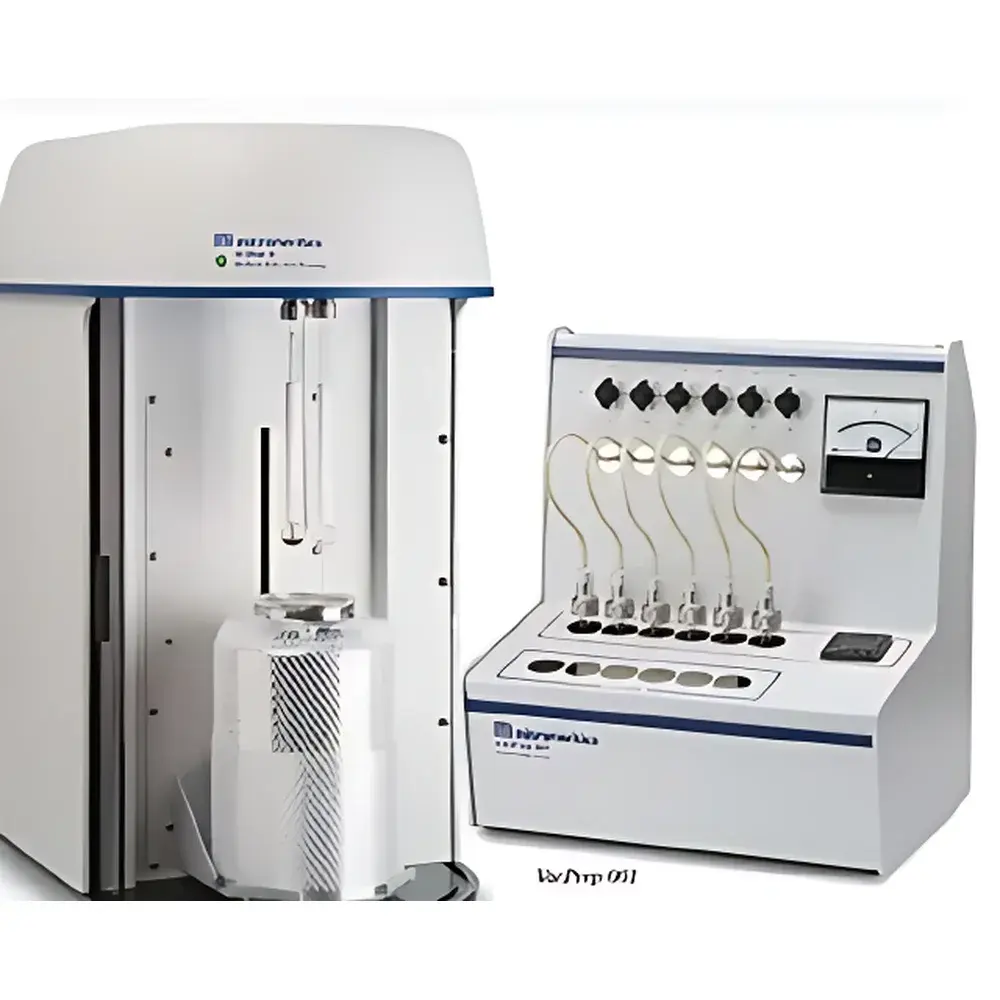
Micromeritics TriStar II 3020 Surface Area and Porosimetry Analyzer
| Brand | Micromeritics |
|---|---|
| Origin | USA |
| Model | TriStar II 3020 |
| Configuration | Fully Automated, Triple-Station Gas Adsorption Analyzer |
| Vacuum System | Standard High-Vacuum (Upgradable to Ultra-High Vacuum) |
| Temperature Control | Liquid Nitrogen Isothermal Jacket with Auto-Level Maintenance |
| Analysis Gases | N₂, Ar, Kr, CO₂ (He-free dead volume calibration supported) |
| Software Compliance | Optional 21 CFR Part 11–Compliant Confirm™ Software with IQ/OQ Documentation |
| Data Processing Methods | BET (single/multi-point), Langmuir, BJH, DH, t-plot, αs-plot, MP, DFT (NLDFT), DR, DA, HK, TC, Freundlich, Temkin |
| Continuous Operation | ≥60 hours unattended |
| Sample Throughput | Three independent analyses simultaneously (BET surface area <20 min per sample) |
| Free Space Determination | Automatic, manual, or calculated |
| Cryogen Capacity | Large-volume Dewar flask (standard) |
| Regulatory Support | GLP/GMP-ready architecture |
Overview
The Micromeritics TriStar II 3020 Surface Area and Porosimetry Analyzer is a high-precision, fully automated gas adsorption instrument engineered for quantitative characterization of specific surface area, pore size distribution (micropores, mesopores, and macropores), total pore volume, and adsorption isotherm analysis. It operates on the fundamental principles of physical gas adsorption—primarily nitrogen at 77 K—combined with rigorous thermodynamic modeling and statistical mechanical theory. The system employs volumetric (manometric) measurement methodology, where pressure changes in a calibrated manifold are correlated with adsorbed gas quantity using real-gas equations of state. Its triple-station architecture enables true parallel analysis—each station features an independent transducer, temperature-stabilized dosing line, and dedicated pressure sensor—eliminating sequential “queue-based” operation and ensuring inter-sample measurement independence critical for statistical validity in QC and R&D environments.
Key Features
- Triple-station design with simultaneous, autonomous analysis—no cross-talk or shared vacuum resources between stations
- Liquid nitrogen isothermal jacket with auto-leveling mechanism maintains thermal stability (< ±0.1 K) throughout extended runs (≥60 h continuous operation)
- Integrated high-vacuum system (base pressure <1 × 10⁻⁷ torr) standard; optional ultra-high vacuum upgrade for low-surface-area materials (<0.1 m²/g) and micropore characterization
- Flexible gas compatibility: supports N₂, Ar (87 K), Kr (77 K), CO₂ (273 K), and other adsorbates without helium dependency for free-space determination
- Modular Dewar configuration: accepts multiple standardized cryogen vessels (including large-capacity options) and sample tube geometries (e.g., borosilicate, quartz, U-shaped)
- Full method configurability: automatic or user-defined degassing protocols (temperature ramping, hold steps, vacuum/purge control) with real-time mass loss monitoring capability (when paired with optional microbalance)
Sample Compatibility & Compliance
The TriStar II 3020 accommodates powders, granules, monoliths, fibers, and thin-film coatings across diverse industrial and academic domains—including pharmaceutical excipients, catalyst supports, battery electrode materials, MOFs/COFs, aerogels, ceramic precursors, and biomedical scaffolds. All hardware and firmware comply with ISO 9001 design controls and meet mechanical safety requirements per IEC 61010-1. When equipped with Confirm™ software, the system satisfies FDA 21 CFR Part 11 requirements for electronic records and signatures—including role-based access control, immutable audit trails, electronic signature workflows, and full data integrity validation. Installation Qualification (IQ) and Operational Qualification (OQ) documentation packages are available to support GLP, GMP, and ISO/IEC 17025 laboratory accreditation processes.
Software & Data Management
The TriStar II 3020 runs on Micromeritics’ proprietary ASiQ software platform, which embeds over 25 internationally recognized data reduction models—including IUPAC-recommended BET linearization protocols, IUPAC-compliant BJH desorption branch analysis, and advanced density functional theory (DFT) kernels (NLDFT, QSDFT). Raw isotherm data are stored in vendor-neutral ASCII format with full metadata tagging (instrument ID, operator, date/time stamp, calibration history, gas purity, degas parameters). Batch processing, template-driven report generation (PDF/Excel), and customizable export filters ensure traceability and interoperability with LIMS and ELN systems. Confirm™ software adds electronic signature capture, change control logs, and automated compliance reporting aligned with ALCOA+ principles (Attributable, Legible, Contemporaneous, Original, Accurate, Complete, Consistent, Enduring, Available).
Applications
This analyzer delivers quantitative structural insights essential for material development and quality assurance. In catalysis, it quantifies active site dispersion via BET surface area and distinguishes microporous diffusion limitations using t-plot and αs-plot analysis. For battery cathode materials (e.g., NMC, LFP), it correlates specific surface area with slurry rheology and electrochemical impedance. In pharmaceuticals, it validates consistency of silica-based excipients and detects batch-to-batch variations in porous structure affecting dissolution kinetics. In carbon capture research, it characterizes amine-functionalized sorbents using CO₂ isotherms at subambient temperatures. Additional use cases include pore network modeling for geologic formations (shale, clays), thermal insulation performance prediction (aerogel porosity vs. Knudsen conductivity), and QC release testing of activated carbons per ASTM D3663 and ISO 9277.
FAQ
Can the TriStar II 3020 analyze samples requiring non-nitrogen adsorbates?
Yes. The system supports argon (87 K), krypton (77 K), carbon dioxide (273 K), and other gases with appropriate temperature control and calibration protocols.
Is helium required for free space determination?
No. The instrument supports He-free dead volume calibration using the adsorbate gas itself—eliminating helium dependency and reducing operational cost and supply chain risk.
How does the triple-station architecture improve data reliability?
Each station operates with independent pressure transducers, temperature-regulated dosing lines, and isolated vacuum manifolds—ensuring no inter-channel interference and enabling statistically robust replicate measurements within a single run.
What validation documentation is provided for regulated environments?
Micromeritics offers factory-certified IQ/OQ protocols, including as-installed verification, vacuum integrity tests, temperature uniformity mapping, pressure transducer linearity checks, and software functionality verification—all traceable to NIST standards.
Can DFT models be applied to non-carbonaceous materials?
Yes. The NLDFT library includes kernel sets validated for silica, alumina, titania, zeolites, and metal–organic frameworks—each selected based on pore geometry, surface chemistry, and adsorbate–surface interaction potential.






