
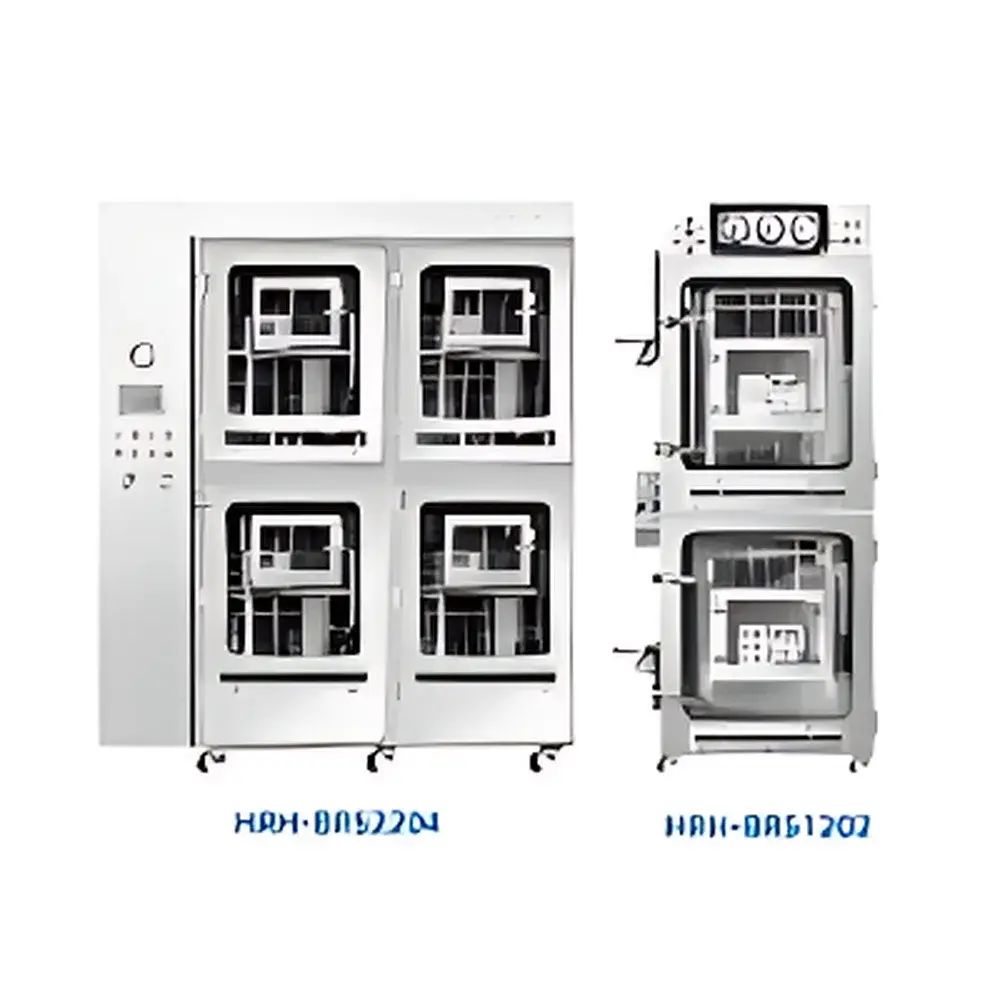
HRH-BRS1202 & HRH-BRS2204 Primate Negative-Pressure Isolation Cages
| Brand | Huironghe |
|---|---|
| Origin | Beijing, China |
| Model | HRH-BRS1202 (2-primate capacity), HRH-BRS2204 (4-primate capacity) |
| Construction | Welded SUS304 stainless steel |
| Air changes | ≥15 h⁻¹ |
| Chamber pressure range | −20 to −100 Pa (adjustable) |
| HEPA filtration | H14 grade (≥99.995% @ 0.3 µm), in-situ leak testing & decontamination capability |
| Ammonia monitoring | ≤14 mg/m³ |
| Lighting | ≥150 lx for operator, 100–200 lx for primates |
| Disinfection interface | Hydrogen peroxide (H₂O₂) vapor inlet |
| Fan | Imported EBM low-noise centrifugal blower |
| Cage foldability | Volume reduction to 20% of unfolded size |
| Waste tray | Anodized aluminum, quick-release |
| Compliance | Meets RB199-2015 (non-hermetic animal isolation equipment), GB14925-2023 (primate housing standards) |
| Communication | Ethernet + dry-contact I/O |
| Power | AC 220 V / 50 Hz, <1 kW |
Overview
The HRH-BRS1202 and HRH-BRS2204 Primate Negative-Pressure Isolation Cages are engineered for high-containment inhalation exposure studies involving non-human primates (NHPs) in ABSL-3 and ABSL-4 laboratories. These systems operate on the principle of sustained negative-pressure containment—maintaining a controlled pressure gradient between the internal chamber and ambient laboratory space—to prevent unidirectional leakage of aerosolized pathogens during inhalation challenge, immunization, or inhaled therapeutic formulation evaluation. Each unit functions as a self-contained, ventilated isolator with fully integrated environmental monitoring, redundant HEPA filtration, and validated decontamination pathways. Designed specifically for NHPs weighing up to 4 kg, the cages comply with national biosafety infrastructure standards (RB199-2015) and primate housing specifications (GB14925-2023), and have been deployed operationally at the Chinese Center for Disease Control and Prevention.
Key Features
- Modular dual-configurations: HRH-BRS1202 accommodates two primates in independent compartments; HRH-BRS2204 supports four, with physical separation minimizing cross-contamination risk.
- SUS304 stainless steel monocoque construction ensures structural integrity, corrosion resistance, and compatibility with repeated sterilization cycles—including autoclaving after folding (volume reduced to 20% of operational footprint).
- H14-grade HEPA filters on both supply and exhaust streams provide ≥99.995% particle removal efficiency at 0.3 µm; all filters support in-situ integrity testing (DOP/PAO scanning) and vapor-phase hydrogen peroxide (VHP) decontamination without disassembly.
- Real-time multi-parameter monitoring: Differential pressure (cage interior vs. lab, filter delta-P), temperature, relative humidity, and ammonia concentration (electrochemical sensor, range 0–50 mg/m³, accuracy ±1.5 mg/m³) feed into an embedded control system with configurable alarm thresholds and event logging.
- Ergonomic access design: Front polycarbonate observation window; lateral transparent panels enable visual contact between adjacent animals to mitigate stress-induced behavioral anomalies; wide (480 × 800 mm) primate access door with adjustable mechanical restraint mechanism (≤10 mm linear compression, position-locking).
- Low-noise ventilation: German-engineered EBM centrifugal blowers deliver stable airflow (60 m³/h for BRS1202; 120 m³/h for BRS2204) at <55 dB(A) at 1 m distance, supporting ≥15 air changes per hour while maintaining Class 7 cleanroom-equivalent particulate control (ISO 14644-1).
Sample Compatibility & Compliance
These cages are validated for use with cynomolgus macaques, rhesus macaques, and other small NHP species ≤4 kg. All materials contacting animals or airflow paths meet USP Class VI biocompatibility requirements. The system satisfies RB199-2015’s performance criteria for non-hermetic animal isolation devices—including minimum static pressure differential (≥10 Pa), leakage rate limits, and structural safety margins. Integration-ready for GLP-compliant study execution: audit-trail-enabled data logging (timestamped sensor outputs, mode transitions, alarm events), electronic signature support via optional software module, and alignment with ISO/IEC 17025 documentation frameworks for method validation. Not intended for long-term husbandry beyond acute exposure protocols (≤14 days).
Software & Data Management
The embedded controller features a web-accessible interface (Ethernet TCP/IP) supporting remote configuration, real-time dashboard visualization, and CSV export of time-stamped environmental logs. Dry-contact I/O ports allow integration with central building management systems (BMS) or third-party data acquisition platforms (e.g., LabVIEW, SCADA). Alarm conditions trigger email/SMS notifications (via optional gateway) and automatic entry into a tamper-evident audit log compliant with FDA 21 CFR Part 11 requirements when paired with validated identity authentication and electronic signature modules. Firmware updates are performed via secure HTTPS with SHA-256 signature verification.
Applications
- Inhalation toxicology and efficacy assessment of novel biologics, mRNA vaccines, or nanoparticle-based therapeutics under BSL-3/ABSL-4 containment.
- Pathogen aerosol challenge models (e.g., SARS-CoV-2, M. tuberculosis, Ebola virus surrogate) requiring strict source containment and operator protection.
- Pharmacokinetic/pharmacodynamic (PK/PD) correlation studies where precise dosing via nebulized or dry-powder inhalation is required across defined exposure durations.
- Environmental stressor evaluation—including lighting regimens (programmable 10/14 or 12/12 photoperiods), air quality modulation (NH₃ scrubbing response), and acclimatization protocols prior to terminal procedures.
- Method development and validation for OECD TG 412 (subacute inhalation toxicity) and ISO 10993-12 (biological evaluation of medical devices—sample preparation and reference materials).
FAQ
What biosafety levels are these cages certified for?
They are designed and validated for continuous operation in ABSL-3 and ABSL-4 laboratories per RB199-2015 and institutional biosafety committee (IBC) requirements.
Can the cages be autoclaved?
Yes—folded configuration reduces external dimensions by 80%, enabling simultaneous sterilization of multiple units in standard horizontal autoclaves (121 °C, 20 min, saturated steam). All gaskets and sensors are autoclave-rated.
Is remote monitoring supported?
Yes—via built-in Ethernet port supporting HTTP/HTTPS, Modbus TCP, and SNMPv3 for integration into enterprise laboratory networks.
How is filter integrity verified without opening the cabinet?
Each HEPA filter bank includes dedicated upstream/downstream aerosol sampling ports compatible with standard DOP/PAO leak test kits; no disassembly or chamber breach is required.
What lighting spectrum is used for animal illumination?
Full-spectrum white LEDs (CCT 5000 K, CRI >85) calibrated to deliver 100–200 lx at cage floor level, compliant with FELASA and AAALAC International recommendations for diurnal rhythm maintenance.
Related Products



