
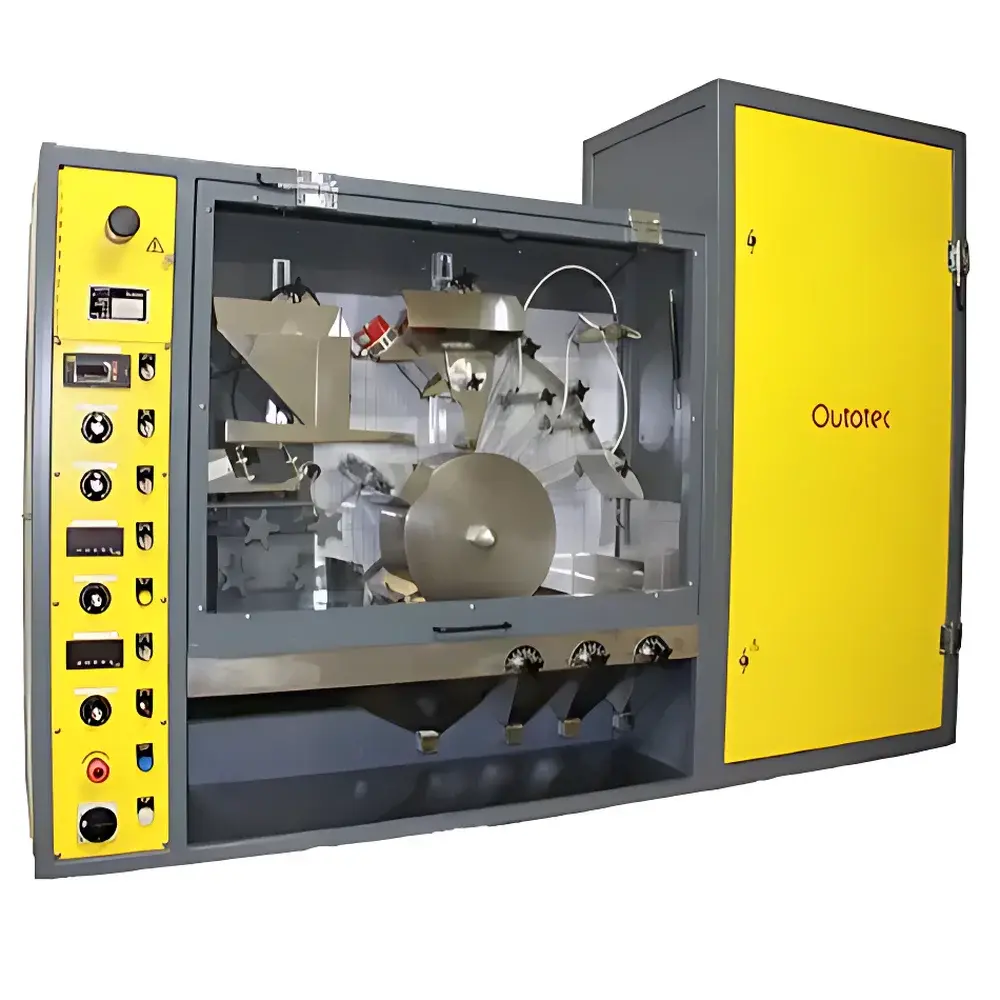
Sepor EHTP (25) 111-15 Laboratory Electrostatic Separator
| Origin | USA |
|---|---|
| Manufacturer Type | Authorized Distributor |
| Origin Category | Imported |
| Model | Sepor EHTP (25) 111-15 |
| Feed Size Range | 0.074 mm – 10 mm |
| Max Throughput | 150 kg/h |
| Roll Diameters | 10 in & 14 in (152 mm & 356 mm), Width: 6 in (152 mm) |
| DC Electrode Voltage | ±40 kV |
| AC Discharge Electrode Voltage | 18 kV |
| Adjustable AC Transformer Output | 0–12 kV AC |
| Drive | Beltless, Direct-Drive ½ hp Motor |
| Roll Heating | Infrared Radiant Heater (Optional) |
| Grounding Brush | Tensioned Conductive Roller Brush |
| Feed Control | Variable-Speed Vibratory Hopper & Linear Feeder for Coarse/Fine Fractions |
| Product Collection | Three-Stream Adjustable Splitter (Non-Conductors, Semiconductors, Conductors) |
Overview
The Sepor EHTP (25) 111-15 is a bench-scale electrostatic separator engineered for precise dry mineral and material separation based on differences in surface conductivity, work function, and dielectric properties. Operating on the principle of triboelectric and induction charging followed by Coulombic force deflection in a high-voltage electrostatic field, this instrument enables reproducible, non-contact separation of particulate mixtures without solvents or water—making it ideal for pre-concentration studies, process development, and material characterization in metallurgical research, recycling R&D, and advanced materials laboratories. Its modular architecture supports systematic parameter optimization—including particle charge history, roll surface potential, electrode geometry, and residence time—critical for scaling to pilot or industrial electrostatic separation systems.
Key Features
- Two interchangeable stainless-steel separation rolls (10″ and 14″ diameter × 6″ width) with infrared radiant heating capability for controlled surface temperature adjustment—enhancing charge retention and selectivity for low-conductivity minerals such as quartz, feldspar, and plastics.
- Dual high-voltage electrode system: a fixed DC electrode (±40 kV) for primary particle charging and deflection, and an AC discharge electrode (18 kV, 50/60 Hz) for controlled neutralization of residual charge prior to collection—minimizing cross-contamination between product streams.
- Variable-speed vibratory hopper and linear feed chute, independently adjustable for coarse (>0.5 mm) and fine (<0.5 mm) fractions, ensuring uniform monolayer feed presentation critical for consistent charge distribution and trajectory separation.
- Beltless, direct-drive ½ hp motor delivers stable, low-maintenance rotational control across the full operational speed range—eliminating belt slippage and enabling precise correlation between roll velocity and particle trajectory.
- Three-stream product splitter with individually adjustable gates allows real-time partitioning into non-conductive, semi-conductive, and conductive fractions—each channel equipped with grounded collection trays compatible with downstream gravimetric or chemical assay.
- Tensioned grounding brush assembly mounted adjacent to the discharge zone removes adhering particles from the roll surface, maintaining consistent surface resistivity and preventing buildup-induced arcing or performance drift during extended operation.
Sample Compatibility & Compliance
The EHTP (25) 111-15 accommodates dry, free-flowing granular samples ranging from 74 µm (200 mesh) to 10 mm—covering typical feed sizes for industrial mineral sands, electronic waste (e-waste) shredder fractions, plastic flake streams, and crushed battery black mass. Feed moisture must remain below 0.5 wt% to prevent charge leakage and agglomeration. All high-voltage components comply with UL 508A and IEC 61000-4-2 standards for electrical safety and electromagnetic compatibility. The unit’s grounding architecture meets IEEE Std 100-2000 requirements for electrostatic discharge (ESD) protection in laboratory environments. While not certified for GMP manufacturing, its design supports GLP-compliant documentation workflows—including manual log entries for voltage settings, feed rate, roll speed, and ambient RH/T—facilitating audit-ready experimental records.
Software & Data Management
This is a manually operated, analog-controlled electrostatic separator with no embedded microprocessor or digital interface. All operational parameters—including DC bias voltage, AC transformer output (0–12 kV AC), roll speed (RPM), and vibratory feed amplitude—are adjusted via calibrated front-panel potentiometers and mechanical dials. Operators record settings and fraction yields using standardized lab notebooks or LIMS-integrated spreadsheets. Optional third-party data acquisition modules (e.g., USB-based HV probes and tachometers) may be integrated for time-synchronized logging—enabling correlation of electrostatic response with feed composition per ASTM D257 (Standard Test Methods for DC Resistance or Conductance of Insulating Materials) and ISO 18093 (Electrostatic Separation of Granular Solids).
Applications
- Mineral processing R&D: Separation of ilmenite/rutile/zircon from heavy mineral sands; liberation analysis of lithium-bearing spodumene from gangue silicates.
- Circular economy & e-waste valorization: Recovery of copper, aluminum, and precious metals from shredded printed circuit boards (PCBs); sorting of ABS/PS/PC polymer fractions from mixed plastic streams.
- Recycling process optimization: Pre-concentration of graphite/anode scrap from spent Li-ion batteries; removal of conductive contaminants from recycled glass cullet.
- Materials science: Surface modification evaluation (e.g., plasma treatment, silanization) via comparative charge decay kinetics; screening of antistatic additives in polymer composites.
- Educational use: Demonstration of contact electrification, image charge effects, and dielectrophoretic motion in undergraduate and graduate-level physical chemistry and mineral engineering curricula.
FAQ
What is the maximum recommended feed moisture content for reliable separation?
Feed must be dried to ≤0.5 wt% moisture prior to processing; higher moisture levels cause charge dissipation and reduce trajectory resolution.
Can the unit operate continuously for extended periods?
Yes—designed for up to 8-hour continuous operation under nominal load; periodic inspection of the grounding brush and electrode alignment is recommended every 4 hours.
Is the infrared roll heater standard or optional?
Infrared radiant heating is an optional factory-installed feature; base configuration operates at ambient roll temperature.
Does the system include safety interlocks or emergency shutdown?
Yes—a main power disconnect switch, HV interlock on the access panel, and grounded metal enclosure meet Class I, Division 2 hazardous location requirements per NEC Article 500.
Are calibration certificates provided for the high-voltage meters?
Factory-calibrated analog meters are supplied; NIST-traceable recalibration services are available through authorized Sepor service partners upon request.






